. 2016:2016:4829716.
doi: 10.1155/2016/4829716. Epub 2016 Dec 12.

Effect of Trehalose and Trehalose Transport on the Tolerance of Clostridium perfringens to Environmental Stress in a Wild Type Strain and Its Fluoroquinolone-Resistant Mutant

Affiliations

Effect of Trehalose and Trehalose Transport on the Tolerance of Clostridium perfringens to Environmental Stress in a Wild Type Strain and Its Fluoroquinolone-Resistant Mutant

Miseon Park et al. Int J Microbiol. 2016.

Abstract

Trehalose has been shown to protect bacterial cells from environmental stress. Its uptake and osmoprotective effect in Clostridium perfringens were investigated by comparing wild type C. perfringens ATCC 13124 with a fluoroquinolone- (gatifloxacin-) resistant mutant. In a chemically defined medium, trehalose and sucrose supported the growth of the wild type but not that of the mutant. Microarray data and qRT-PCR showed that putative genes for the phosphorylation and transport of sucrose and trehalose (via phosphoenolpyruvate-dependent phosphotransferase systems, PTS) and some regulatory genes were downregulated in the mutant. The wild type had greater tolerance than the mutant to salts and low pH; trehalose and sucrose further enhanced the osmotolerance of the wild type to NaCl. Expression of the trehalose-specific PTS was lower in the fluoroquinolone-resistant mutant. Protection of C. perfringens from environmental stress could therefore be correlated with the ability to take up trehalose.


Conflict of interest statement

The authors declare that they have no competing interests.

Figures
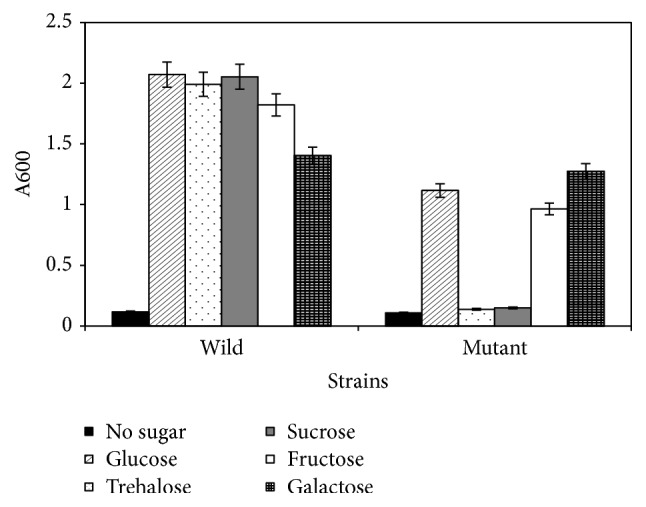
Figure 1
Figure 1
Growth of wild type C. perfringens ATCC 13124 and the mutant 13124GR in minimal medium with different sugars. Error bars = standard deviation.
Figure 2
Figure 2
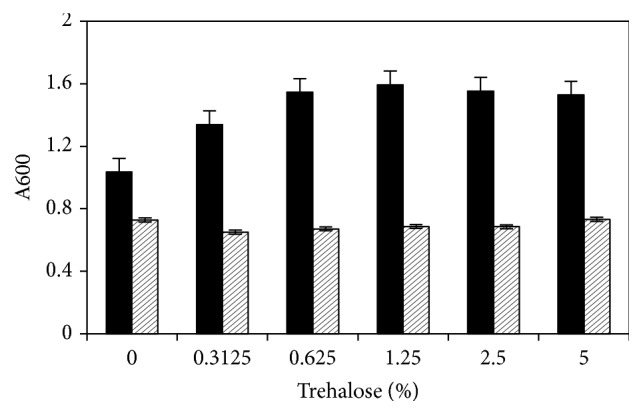
Effect of different concentrations of trehalose on the growth of wild type C. perfringens ATCC 13124 (black bars) and mutant 13124GR (cross-hatched bars) in brain heart infusion (BHI).
Figure 3
Figure 3
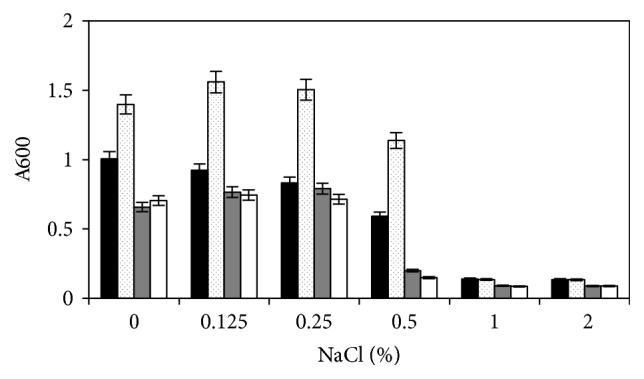
Growth of wild type C. perfringens ATCC 13124 and mutant 13124GR with different concentrations of NaCl in the absence and presence of trehalose. Black bars (wild type without trehalose), gray bars (mutant without trehalose), dotted bars (wild type with trehalose), and white bars (mutant with trehalose). OD was measured after 24 hours' anaerobic incubation at 37°C.
Figure 4
Figure 4
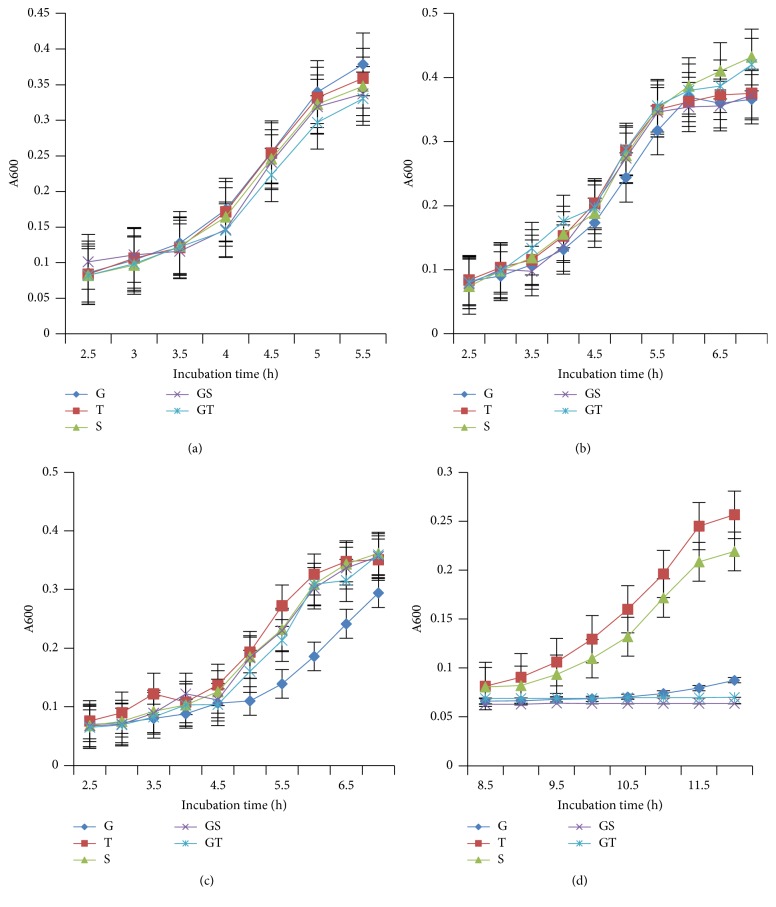
Growth rate of wild type C. perfringens ATCC 13124 with different concentrations of NaCl in the presence and absence of trehalose and sucrose in the minimal medium. Without NaCl (a), 0.5% NaCl (b), 1% NaCl (c), and 2% NaCl (d). G = glucose, T = trehalose, S = sucrose, GS = glucose + sucrose, and GT = glucose + trehalose.
Figure 5
Figure 5
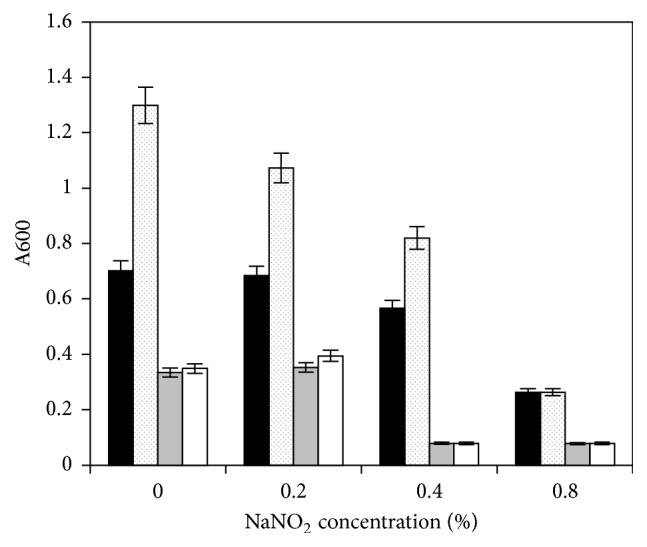
Effect of trehalose on the growth of wild type C. perfringens ATCC 13124 and mutant 13124GR in BHI medium in the presence of different concentrations of sodium nitrite. Black bars, wild type without trehalose; dotted bars, wild type with trehalose; gray bars, mutant without trehalose; white bars, mutant with trehalose.
Figure 6
Figure 6
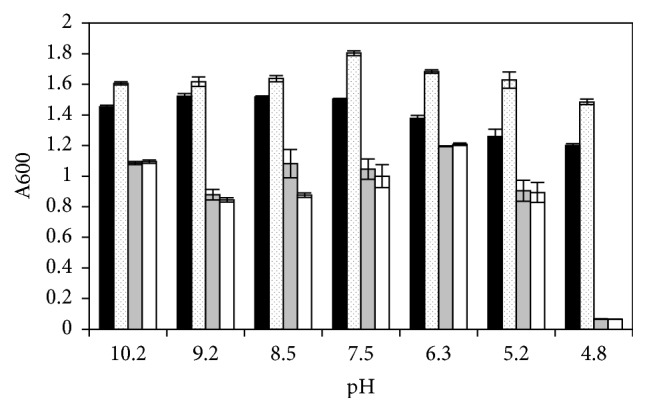
Effect of trehalose on the growth of wild type C. perfringens ATCC 13124 and mutant 13124GR at different pH values. Black bars, wild type without trehalose; dotted bars, wild type with trehalose; gray bars, mutant without trehalose; white bars, mutant with trehalose.

References

    1. Cheung J. K., Wisniewski J. A., Adams V. M., Quinsey N. S., Rood J. I. Analysis of the virulence-associated RevSR two-component signal transduction system of Clostridium perfringens . International Journal of Medical Microbiology. 2016;306(6):429–442. doi: 10.1016/j.ijmm.2016.05.011. - DOI - PubMed
    1. Myers G. S. A., Rasko D. A., Cheung J. K., et al. Skewed genomic variability in strains of the toxigenic bacterial pathogen, Clostridium perfringens . Genome Research. 2006;16(8):1031–1040. doi: 10.1101/gr.5238106. - DOI - PMC - PubMed
    1. Ohtani K., Shimizu T. Regulation of toxin gene expression in Clostridium perfringens . Research in Microbiology. 2015;166(4):280–289. doi: 10.1016/j.resmic.2014.09.010. - DOI - PubMed
    1. Strom A. R., Kaasen I. Trehalose metabolism in Escherichia coli: stress protection and stress regulation of gene expression. Molecular Microbiology. 1993;8(2):205–210. doi: 10.1111/j.1365-2958.1993.tb01564.x. - DOI - PubMed
    1. Leslie S. B., Israeli E., Lighthart B., Crowe J. H., Crowe L. M. Trehalose and sucrose protect both membranes and proteins in intact bacteria during drying. Applied and Environmental Microbiology. 1995;61(10):3592–3597. - PMC - PubMed

LinkOut - more resources