Occurrence of Parasites of the Genus Eustrongylides spp. (Nematoda: Dioctophymatidae) in Fish Caught in Trasimeno Lake, Italy
- PMID: 28058245
- PMCID: PMC5178836
- DOI: 10.4081/ijfs.2016.6130
Occurrence of Parasites of the Genus Eustrongylides spp. (Nematoda: Dioctophymatidae) in Fish Caught in Trasimeno Lake, Italy
Abstract
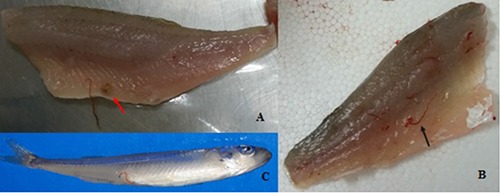
Eustrongylides spp. is considered a freshwater fish zoonotic nematode. In the present study, the prevalence of Eustrongylides spp. in six edible fish (European perch - Perca fluviatilis, goldfish - Carassius auratus, largemouth black bass - Micropterus salmoides, tench- Tinca tinca, carp - Cyprinus carpio and sand smelt - Atherina boyeri) of Trasimeno lake was surveyed. The investigations were conducted from October 2014 to September 2015 and 384 specimens per species for each season were caught in Trasimeno lake and examined for the presence of larvae in the abdominal cavity and muscle. The presence of nematodes in the abdominal cavity and musculature was revealed in three fish species. The prevalence of Eustrongylides spp. infection was 6.84, 1.89 and 0.13% in perch, largemouth black bass and sand smelt, respectively. The number of parasites per fish was only one in largemouth black bass and sand smelt and ranged from one up to three in perch. This study states that the European perch, largemouth black bass and sand smelt of Trasimeno lake are infected with zoonotic parasites; therefore, food business operators have to take appropriate measures to guarantee the health of consumers.
Keywords: Eustrongylides spp; Freshwater fish; Nematode larvae; Parasitic hazards.
Conflict of interest statement
the authors declare no potential conflict of interest.
Figures
References
-
- Anderson RC, 2000. Nematode parasites of vertebrates. Their development and transmission. 2nd ed. CAB International Publishing, Wallingford, UK.
-
- Bjeli - abrilo O, Novakov N, irkovi M, Kosti D, Popovi E, Aleksi N, Luji J, 2013. The first determination of Eustrongylides excisus Jägerskiöld, 1909: larvae (Nematoda: Dioctophymatidae) in the pike-perch Sander lucioperca in Vojvodina (Serbia). Helminthologia 50:291-4.
-
- Broglia A, Kapel C, 2011. Changing dietary habits in a changing world: emerging drivers for the transmission of foodborne parasitic zoonoses. Vet Parasitol 182:2-13. - PubMed
-
- Centers for Disease Control, 1982. Intestinal perforation caused by larval Eustrongylides – Maryland. MMWR Morb Mortal Wkly Rep 31:383-4. - PubMed
-
- Çolak SÖ, 2013. The helminth community of the sand smelt (Atherina boyeri Risso, 1810) from Lake Iznik, Turkey. J Helminthol 87:129-34. - PubMed
LinkOut - more resources
Full Text Sources
Other Literature Sources
Research Materials
Miscellaneous