


Repeatability of ectopic beats from 48-hr ambulatory electrocardiography: The Atherosclerosis Risk in Communities (ARIC) Study
- PMID: 28058808
- PMCID: PMC5500442
- DOI: 10.1111/anec.12426
Repeatability of ectopic beats from 48-hr ambulatory electrocardiography: The Atherosclerosis Risk in Communities (ARIC) Study
Abstract
Background: The purpose of this study was to characterize the repeatability of ectopic beats, defined by premature atrial contractions (PACs) and premature ventricular contractions (PVCs), on ambulatory electrocardiogram (aECG) monitoring and evaluate the effect of length of aECG monitoring on the repeatability estimates.
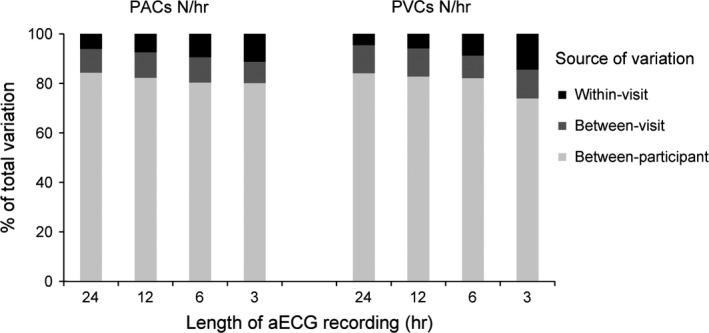
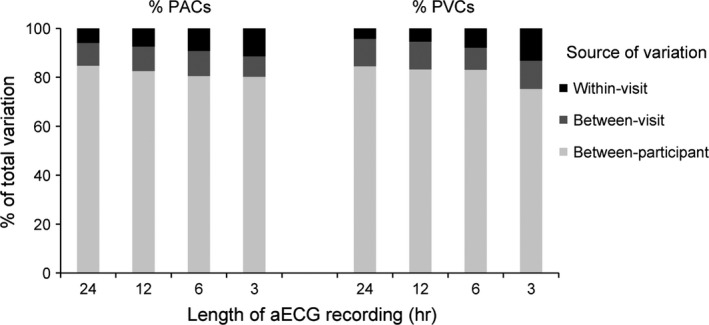
Methods: This analysis includes 95 randomly selected participants from the Atherosclerosis Risk in Communities Study (ARIC; 2011-2013). The participants wore a Holter monitor for two, 48-hr periods separated by a mean of 38 days following an identical, standardized protocol. We divided each 48-hr recording into 3-, 6-, 12-, and 24-hr recording periods and calculated intraclass correlation coefficients (ICCs) for PACs and PVCs and also as a percentage of the corresponding total of recorded beats per hour among these periods.
Results: All participants had ≥1 PAC during the 48-hr recordings, and only two participants had no PVCs. ICCs were >0.83 for all indices and recording lengths ≥12 hrs. ICCs were intermediate for 6-hr recordings (range 0.80-0.83) and lower for 3-hr recordings (range 0.74-0.80). The ratio of the between- to within-participant variation increased with recording length.
Conclusion: Repeatability of PACs and PVCs was excellent for recording lengths of 6-24 hr and fair for 3 hr. Repeatability varies over shorter duration recordings within the 48-hr recording period, and thus the present results have implications for detection algorithms for ectopic beats and can facilitate epidemiologic and clinical applications in which knowledge of measurement variability and misclassification are needed.
Keywords: Holter; premature atrial contractions; premature ventricular contractions; supraventricular ectopic beats; ventricular ectopic beats.
© 2017 Wiley Periodicals, Inc.
Conflict of interest statement
The authors declared no conflict of interest.
Figures
References
-
- Anastasiou‐Nana, M. I. , Menlove, R. L. , Nanas, J. N. , & Barker, A. H. (1988). Changes in spontaneous variability of ventricular ectopic activity as a function of time in patients with chronic arrhythmias. Circulation, 78, 286–295. - PubMed
-
- Anderson, J. L. , Anastasiou‐Nana, M. I. , Menlove, R. L. , Moreno, F. L. , Nanas, J. N. , & Barker, A. H. (1990). Spontaneous variability in ventricular ectopic activity during chronic antiarrhythmic therapy. Circulation, 82, 830–840. - PubMed
-
- Binici, Z. , Intzilakis, T. , Nielsen, O. W. , Kober, L. , & Sajadieh, A. (2010). Excessive supraventricular ectopic activity and increased risk of atrial fibrillation and stroke. Circulation, 121, 1904–1911. - PubMed
-
- Bland, J. M. , & Altman, D. G. (1995). Comparing two methods of clinical measurement: A personal history. International Journal of Epidemiology, 24(Suppl 1), S7–S14. - PubMed
Publication types
MeSH terms
Grants and funding
- HHSN268201100012C/HL/NHLBI NIH HHS/United States
- HHSN268201100009I/HL/NHLBI NIH HHS/United States
- HHSN268201100010C/HL/NHLBI NIH HHS/United States
- HHSN268201100008C/HL/NHLBI NIH HHS/United States
- HHSN268201100005G/HL/NHLBI NIH HHS/United States
- HHSN268201100008I/HL/NHLBI NIH HHS/United States
- HHSN268201100007C/HL/NHLBI NIH HHS/United States
- HHSN268201100011I/HL/NHLBI NIH HHS/United States
- HHSN268201100011C/HL/NHLBI NIH HHS/United States
- R01 HL116900/HL/NHLBI NIH HHS/United States
- HHSN268201100006C/HL/NHLBI NIH HHS/United States
- HHSN268201100005I/HL/NHLBI NIH HHS/United States
- HHSN268201100009C/HL/NHLBI NIH HHS/United States
- HHSN268201100005C/HL/NHLBI NIH HHS/United States
- HHSN268201100007I/HL/NHLBI NIH HHS/United States
- T32 HL007055/HL/NHLBI NIH HHS/United States
LinkOut - more resources
Full Text Sources
Other Literature Sources
Medical
