


Mapping Post-Glacial expansions: The Peopling of Southwest Asia
- PMID: 28059138
- PMCID: PMC5216412
- DOI: 10.1038/srep40338
Mapping Post-Glacial expansions: The Peopling of Southwest Asia
Abstract
Archaeological, palaeontological and geological evidence shows that post-glacial warming released human populations from their various climate-bound refugia. Yet specific connections between these refugia and the timing and routes of post-glacial migrations that ultimately established modern patterns of genetic variation remain elusive. Here, we use Y-chromosome markers combined with autosomal data to reconstruct population expansions from regional refugia in Southwest Asia. Populations from three regions in particular possess distinctive autosomal genetic signatures indicative of likely refugia: one, in the north, centered around the eastern coast of the Black Sea, the second, with a more Levantine focus, and the third in the southern Arabian Peninsula. Modern populations from these three regions carry the widest diversity and may indeed represent the most likely descendants of the populations responsible for the Neolithic cultures of Southwest Asia. We reveal the distinct and datable expansion routes of populations from these three refugia throughout Southwest Asia and into Europe and North Africa and discuss the possible correlations of these migrations to various cultural and climatic events evident in the archaeological record of the past 15,000 years.
Figures
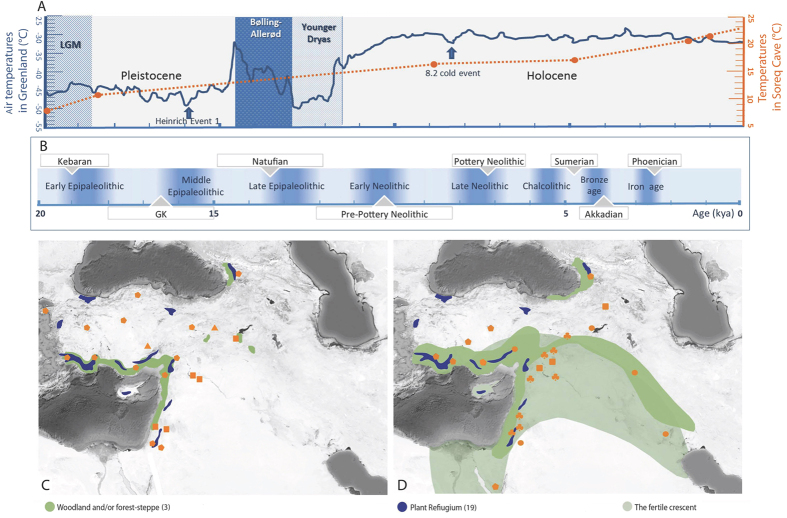
 human occupation signs 29–15.2 ka,
  wood charcoal, nuts 15.9–11.2 ka, ▲centers of obsidian trade 16–14 ka. (D) Evidence of human activities in the Neolithic;
  plant domestication 12.5–9.6 ka,
  human occupation signs 11.9–5 ka,
  animal domestication,
  charred plants, agriculture and charcoal 10.2–7.3 ka. (Base map constructed from Map data: Google, Digital Globe,
 References
-
- Byrd B. F. Reassessing the Emergence of Village Life in the Near East. Journal of Archaeological Research 13, 231–290 (2005).
-
- Connor S. E. & Kvavadza E. V. Modelling late Quaternary changes in plant distribution, vegetation and climate using pollen data from Georgia, Caucasus. Journal of Biogeography 36, 529–545 (2009).
-
- Rose J. I. New Light on Human Prehistory in the Arabo-Persian Gulf Oasis. Current Anthropology 51, 849–883 (2010).
Publication types
Grants and funding
LinkOut - more resources
Full Text Sources
Other Literature Sources
Miscellaneous
