. 2017 Mar 9;60(5):1665-1672.
doi: 10.1021/acs.jmedchem.6b01483. Epub 2017 Jan 25.

Nonclassical Size Dependence of Permeation Defines Bounds for Passive Adsorption of Large Drug Molecules

Affiliations

Nonclassical Size Dependence of Permeation Defines Bounds for Passive Adsorption of Large Drug Molecules

Cameron R Pye et al. J Med Chem. .

Abstract

Macrocyclic peptides are considered large enough to inhibit "undruggable" targets, but the design of passively cell-permeable molecules in this space remains a challenge due to the poorly understood role of molecular size on passive membrane permeability. Using split-pool combinatorial synthesis, we constructed a library of cyclic, per-N-methlyated peptides spanning a wide range of calculated lipohilicities (0 < AlogP < 8) and molecular weights (∼800 Da < MW < ∼1200 Da). Analysis by the parallel artificial membrane permeability assay revealed a steep drop-off in apparent passive permeability with increasing size in stark disagreement with current permeation models. This observation, corroborated by a set of natural products, helps define criteria for achieving permeability in larger molecular size regimes and suggests an operational cutoff, beyond which passive permeability is constrained by a sharply increasing penalty on membrane permeation.


Conflict of interest statement

The authors declare no competing financial interest.

Figures
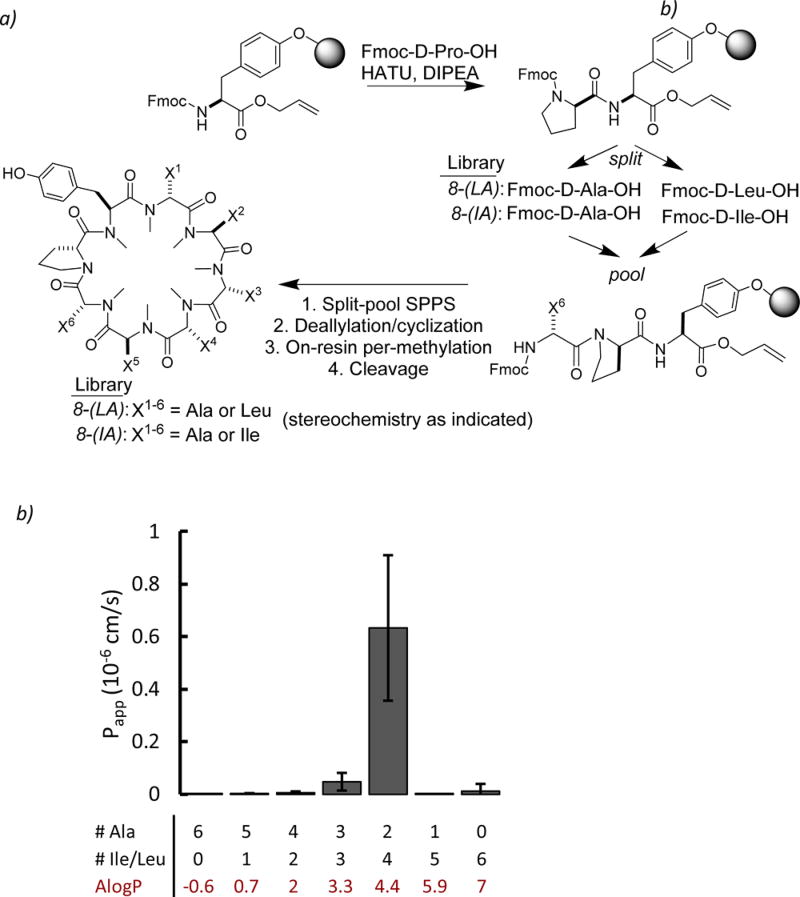
Figure 1
Figure 1
Octapeptide split pool library. (a) Split-pool synthetic scheme for permethylated Ala scan library. All library members contained a Tyr and Pro residue, and the remaining six positions were Ala, Leu, or Ile. (b) PAMPA permeability of Ala scan library for each unique composition. Di-Ala substitution was the dominantly permeable species in Leu- and Ile-containing library subpools.
Figure 2
Figure 2
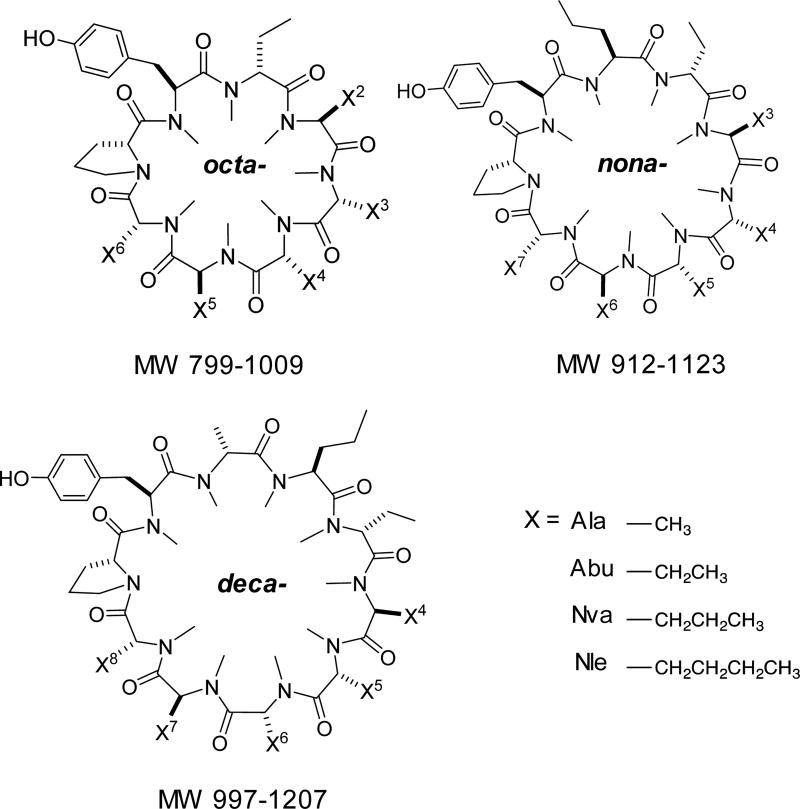
Lipophilicity scanning library.
Figure 3
Figure 3
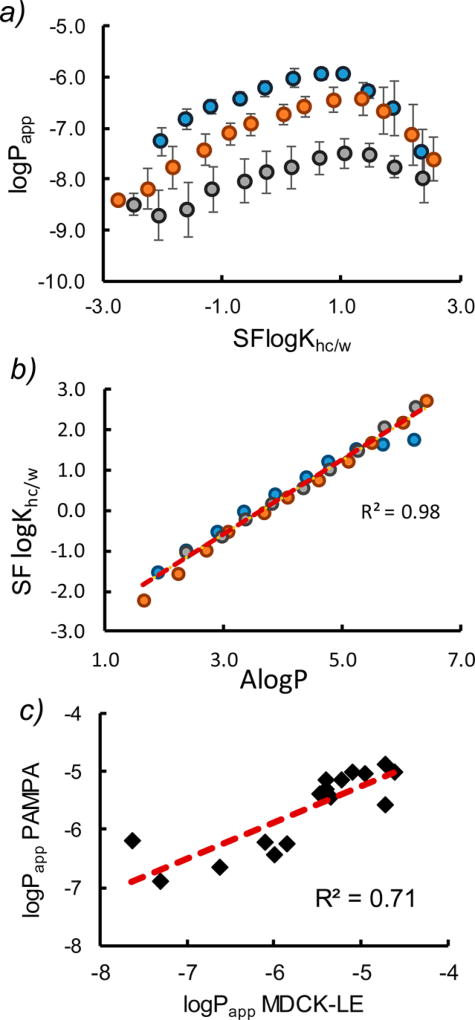
Variable ring size lipophilicity scanning library. All plots include octa- (blue), nona- (orange), and decapeptides (gray). (a) LogPapp vs SFlogKhc/w should be a linear relationship (eq 1), and we observe deviation from linearity in each system at logKhc/w > 1. (b) Experimental 1,9-decadiene partition coefficients (SFlogKhc/w) vs AlogP. The linear regression (broken red line) was used to extrapolate values outside the detection limits. (c) LogPapp of PAMPA vs MDCK-LE for individual compounds. The linear shape of the data suggests that the PAMPA assay is correlated with the more biologically relevant cell-based assay. The trends of individual compounds were in agreement with those observed in the mixtures (Table S1).
Figure 4
Figure 4
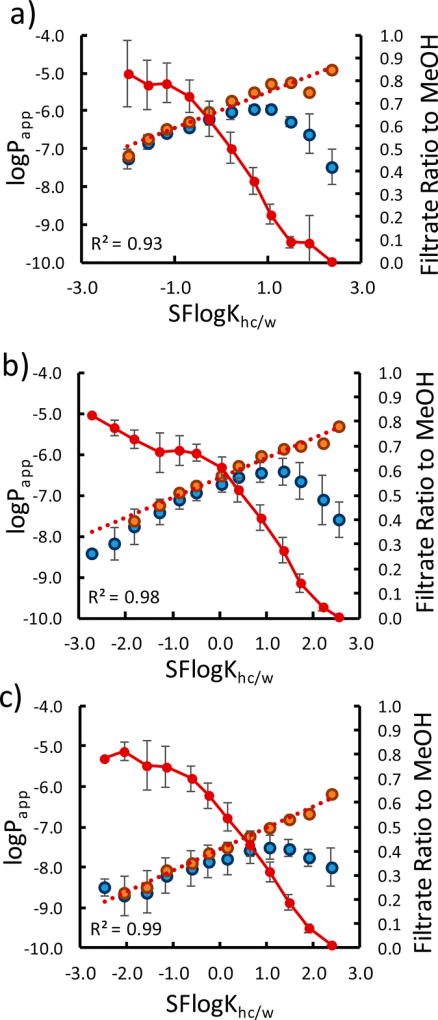
Solubility-adjusted intrinsic permeabilities. Filtration solubility (unbroken red lines) and logPapp for the (a) octa-, (b) nona-, and (c) decapeptides (Figure 2) (blue markers). Solubility-adjusted P0 values were obtained by dividing the Papp by the relative solubility in MeOH for each point (orange markers). The linearity of P0 and Khc/w is indicated by a linear fit of the solubility-adjusted values (red broken lines).
Figure 5
Figure 5
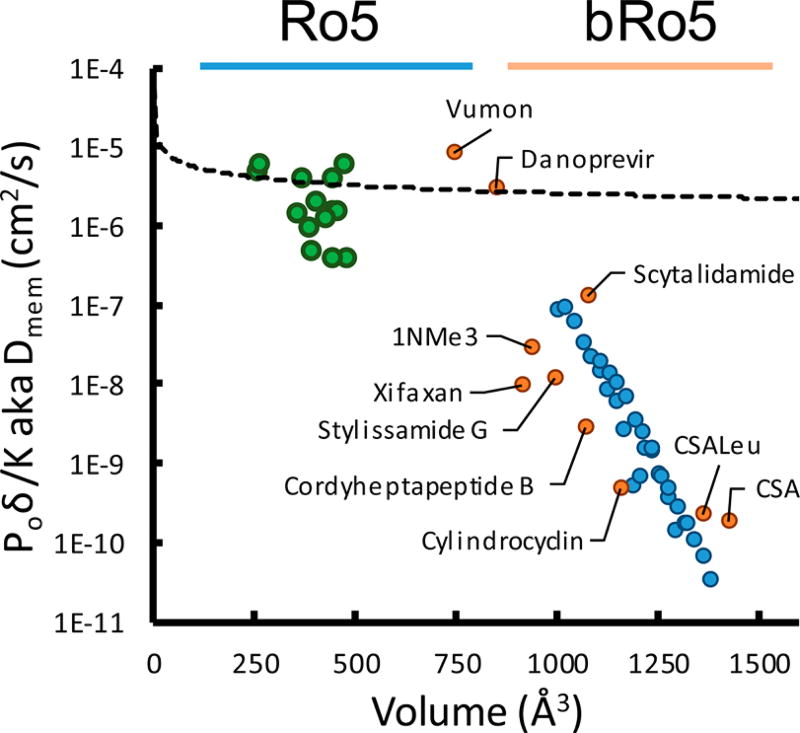
Membrane diffusion vs molecular volume. Diffusion was determined by eq 4 using experimental values of P0 and Khc/w. The volume was calculated from a 2D structure using a parametrized method. Small Ro5 molecules (green points) roughly follow an exponential trend, whereas the bRo5 lipophilicity scanning library members (Figure 2) (blue points) are subject to a much steeper size penalty. A selection of unrelated synthetic and natural products was subjected to the same analysis to ensure the trends are general (orange points).
Figure 6
Figure 6
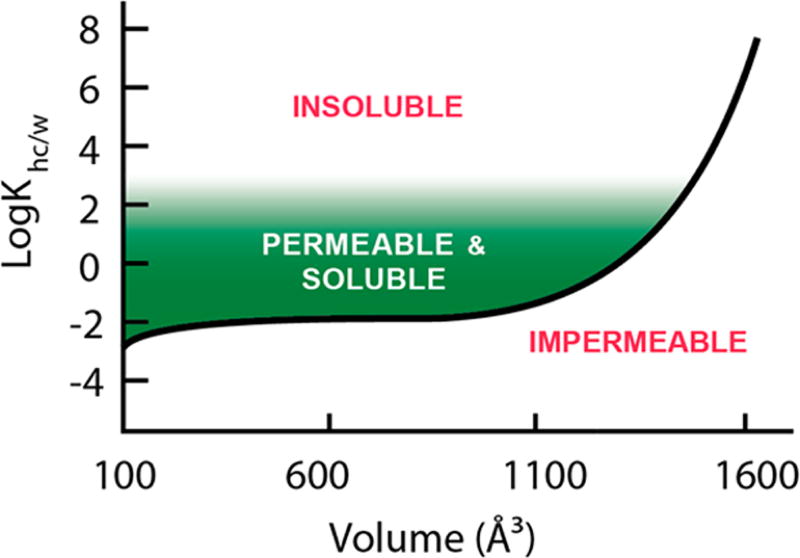
Property space for passive permeability constrained by polarity, solubility, and molecular volume. The black line represents the lipophilicity required (logKmem) to achieve a permeability of 1 × 10⁻⁶ cm/sec for a given volume. The required lipophilicity to overcome the molecular size penalty we observe places an operational limit on molecular volume ~1500 Å3 (~MW 1200).

References

    1. Lipinski CA, Lombardo F, Dominy BW, Feeney PJ. Experimental and Computational Approaches to Estimate Solubility and Permeability in Drug Discovery and Development Settings. Adv. Drug Delivery Rev. 1997;23:3–25. - PubMed
    1. Doak BCC, Over BB, Giordanetto F, Kihlberg J. Oral Druggable Space beyond the Rule of 5: Insights from Drugs and Clinical Candidates. Chem. Biol. 2014;21:1115–1142. - PubMed
    1. Guimarães CRW, Mathiowetz AM, Shalaeva M, Goetz G, Liras S. Use of 3D Properties to Characterize Beyond Rule-of-5 Property Space for Passive Permeation. J. Chem. Inf. Model. 2012;52:882–890. - PubMed
    1. Villar EA, Beglov D, Chennamadhavuni S, Porco JA, Kozakov D, Vajda S, Whitty A. How Proteins Bind Macrocycles. Nat. Chem. Biol. 2014;10:723–731. - PMC - PubMed
    1. Overton E. No Title. Vierteljahrsschr. Naturforsch. Ges. Zurich. 1899;44:88–135.