


Patient-Reported Outcomes of Periacetabular Osteotomy from the Prospective ANCHOR Cohort Study
- PMID: 28060231
- PMCID: PMC5198872
- DOI: 10.2106/JBJS.15.00798
Patient-Reported Outcomes of Periacetabular Osteotomy from the Prospective ANCHOR Cohort Study
Abstract
Background: Current literature describing the periacetabular osteotomy (PAO) is mostly limited to retrospective case series. Larger, prospective cohort studies are needed to provide better clinical evidence regarding this procedure. The goals of the current study were to (1) report minimum 2-year patient-reported outcomes (pain, hip function, activity, overall health, and quality of life), (2) investigate preoperative clinical and disease characteristics as predictors of clinical outcomes, and (3) report the rate of early failures and reoperations in patients undergoing contemporary PAO surgery.
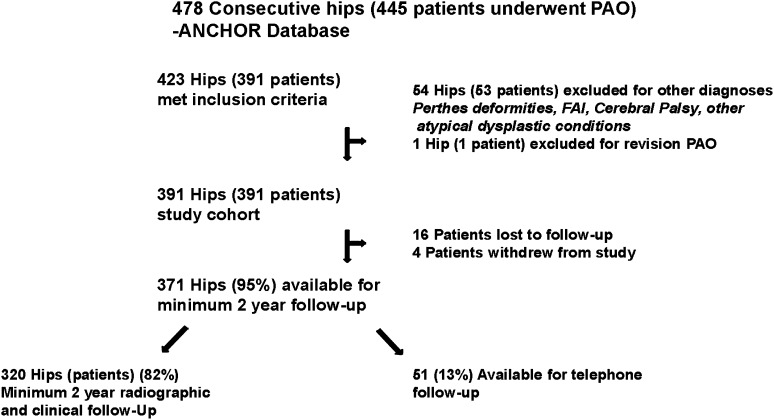
Methods: A large, prospective, multicenter cohort of PAO procedures was established, and outcomes at a minimum of 2 years were analyzed. A total of 391 hips were included for analysis (79% of the patients were female, and the average patient age was 25.4 years). Patient-reported outcomes, conversion to total hip replacement, reoperations, and major complications were documented. Variables with a p value of ≤0.10 in the univariate linear regressions were included in the multivariate linear regression. The backward stepwise selection method was used to determine the final risk factors of clinical outcomes.
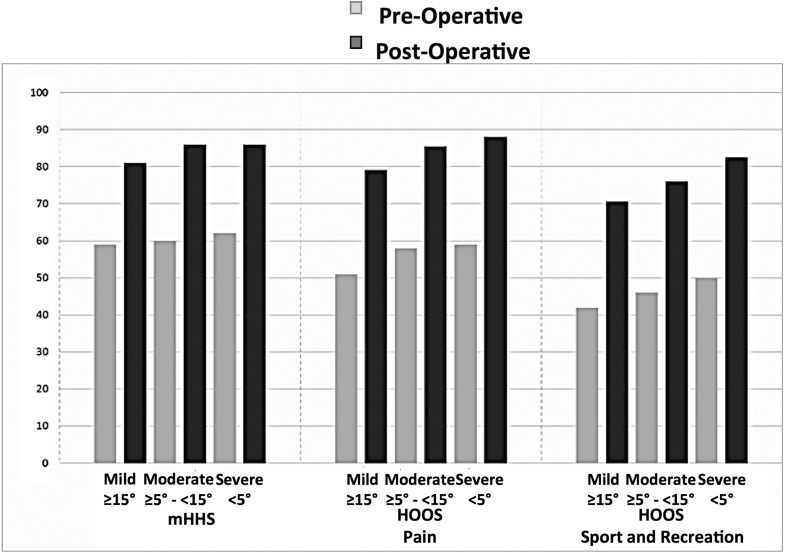
Results: Clinical outcome analysis demonstrated major clinically important improvements in pain, function, quality of life, overall health, and activity level. Increasing age and a body mass index status of overweight or obese were predictive of improved results for certain outcome metrics. Male sex and mild acetabular dysplasia were predictive of lesser improvements in certain outcome measures. Three (0.8%) of the hips underwent early conversion to total hip arthroplasty, 12 (3%) required reoperation, and 26 (7%) experienced a major complication.
Conclusions: This large, prospective cohort study demonstrated the clinical success of contemporary PAO surgery for the treatment of symptomatic acetabular dysplasia. Patient and disease characteristics demonstrated predictive value that should be considered in surgical decision-making.
Level of evidence: Therapeutic Level IV. See Instructions for Authors for a complete description of levels of evidence.
Figures
References
-
- Ganz R, Klaue K, Vinh TS, Mast JW. A new periacetabular osteotomy for the treatment of hip dysplasias. Technique and preliminary results. Clin Orthop Relat Res. 1988. July;232:26-36. - PubMed
-
- Ninomiya S, Tagawa H. Rotational acetabular osteotomy for the dysplastic hip. J Bone Joint Surg Am. 1984. March;66(3):430-6. - PubMed
-
- Salter RB. The classic. Innominate osteotomy in the treatment of congenital dislocation and subluxation of the hip by Robert B. Salter, J. Bone Joint Surg. (Brit) 43B:3:518, 1961. Clin Orthop Relat Res. 1978. Nov-Dec;137:2-14. - PubMed
-
- Steel HH. Triple osteotomy of the innominate bone. J Bone Joint Surg Am. 1973. March;55(2):343-50. - PubMed
Publication types
MeSH terms
Grants and funding
LinkOut - more resources
Full Text Sources
Other Literature Sources
Medical
Research Materials
