


Prophylactic Melatonin for Delirium in Intensive Care (Pro-MEDIC): study protocol for a randomised controlled trial
- PMID: 28061873
- PMCID: PMC5219661
- DOI: 10.1186/s13063-016-1751-0
Prophylactic Melatonin for Delirium in Intensive Care (Pro-MEDIC): study protocol for a randomised controlled trial
Abstract
Background: Delirium is an acute state of brain dysfunction characterised by fluctuating inattention and cognitive disturbances, usually due to illness. It occurs commonly in the intensive care unit (ICU), and it is associated with greater morbidity and mortality. It is likely that disturbances of sleep and of the day-night cycle play a significant role. Melatonin is a naturally occurring, safe and cheap hormone that can be administered to improve sleep. The main aim of this trial will be to determine whether prophylactic melatonin administered to critically ill adults, when compared with placebo, decreases the rate of delirium.
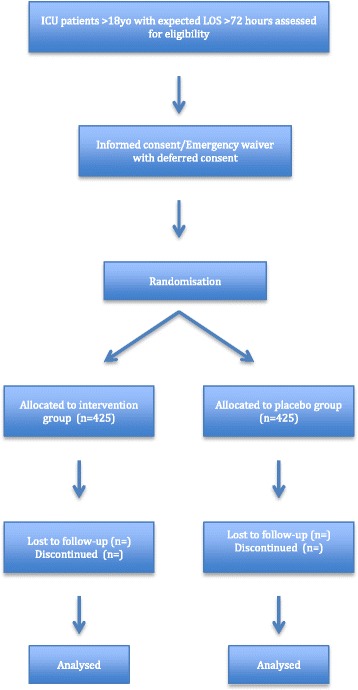
Methods: This trial will be a multi-centre, randomised, placebo-controlled study conducted in closed ICUs in Australia. Our aim is to enrol 850 adult patients with an expected ICU length of stay (LOS) of 72 h or more. Eligible patients for whom there is consent will be randomised to receive melatonin 4 mg enterally or placebo in a 1:1 ratio according to a computer-generated randomisation list, stratified by site. The study drug will be indistinguishable from placebo. Patients, doctors, nurses, investigators and statisticians will be blinded. Melatonin or placebo will be administered once per day at 21:00 until ICU discharge or 14 days after enrolment, whichever occurs first. Trained staff will assess patients twice daily to determine the presence or absence of delirium using the Confusion Assessment Method for the ICU score. Data will also be collected on demographics, the overall prevalence of delirium, duration and severity of delirium, sleep quality, participation in physiotherapy sessions, ICU and hospital LOS, morbidity and mortality, and healthcare costs. A subgroup of 100 patients will undergo polysomnographic testing to further evaluate the quality of sleep.
Discussion: Delirium is a significant issue in ICU because of its frequency and associated poorer outcomes. This trial will be the largest evaluation of melatonin as a prophylactic agent to prevent delirium in the critically ill population. This study will also provide one of the largest series of polysomnographic testing done in ICU.
Trial registration: Australian New Zealand Clinical Trial Registry (ANZCTR) number: ACTRN12616000436471 . Registered on 20 December 2015.
Keywords: Delirium; Intensive care unit; Melatonin; Sleep.
Figures
References
-
- American Psychiatric Association . Diagnostic and statistical manual of mental disorders. 5. Washington, DC: American Psychiatric Association; 2013.
-
- Devlin JW, Roberts RJ, Fong JJ, Skrobik Y, Riker RR, Hill NS, et al. Efficacy and safety of quetiapine in critically ill patients with delirium: a prospective, multicenter, randomized, double-blind, placebo-controlled pilot study. Crit Care Med. 2010;38(2):419–27. doi: 10.1097/CCM.0b013e3181b9e302. - DOI - PubMed
-
- Girard TD, Pandharipande PP, Carson SS, Schmidt GA, Wright PE, Canonico AE, et al. Feasibility, efficacy, and safety of antipsychotics for intensive care unit delirium: the MIND randomized, placebo-controlled trial. Crit Care Med. 2010;38(2):428–37. doi: 10.1097/CCM.0b013e3181c58715. - DOI - PMC - PubMed
Publication types
MeSH terms
Substances
Associated data
LinkOut - more resources
Full Text Sources
Other Literature Sources
Medical
