


Disposal practices of unused and expired pharmaceuticals among general public in Kabul
- PMID: 28061902
- PMCID: PMC5219664
- DOI: 10.1186/s12889-016-3975-z
Disposal practices of unused and expired pharmaceuticals among general public in Kabul
Erratum in
-
Erratum to: Disposal practices of unused and expired pharmaceuticals among general public in Kabul.BMC Public Health. 2017 Mar 6;17(1):231. doi: 10.1186/s12889-017-4139-5. BMC Public Health. 2017. PMID: 28264706 Free PMC article. No abstract available.
Abstract
Background: Most of the medicine users remain unaware about the disposal of unused or expired medicines. The aim of this study was to know the disposal practices of unused and expired medicines among the general public in Kabul.
Methods: This was a descriptive, cross-sectional survey, conducted through face-to-face interviews using prevalidated structured questionnaire. Returned questionnaires were double-checked for accuracy. Statistical Package for Social Science (SPSS) version 23 was used for statistical analysis.
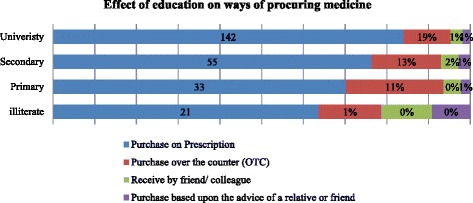
Results: Total of 301 valid questionnaires were returned with a response rate of 100% in which 73.4% men and 26.6% women participated. More than half of the respondents were university graduates. Interestingly, 83.4% of the interviewees purchased medicines on the prescription of which 47.2% were university graduates, while 14.6% purchased medicine over the counter. Among the respondents, 46.5/100 purchased antibiotics and the remaining purchased NSAIDs, anti-hypertensive and anti-diabetic medicines. Significantly, 97/100 checked the expiry date of medicine before buying. Majority (95.3%) of the respondents' stored medicines at home. 77.7% of the respondents discarded the expired medicines in household trash. Majority of respondents held government responsible for creation of awareness for proper medicine disposal. Almost entire sample (98%) felt that improper disposal of unused and expired medicines can affect the environment and health.
Conclusion: Gaps exist in practices, therefore robust, safe and cost-effective pharmaceutical waste management program supported with media campaign is needed. Healthcare practitioners and community pharmacists should offer training to educate customers on standard medicine disposal practices.
Keywords: Afghanistan; Disposal; Expired; Medicine; Pharmaceutical; Practices; Unused.
Figures
References
-
- WHO. Challenges in expanding access to essential medicines; 2004. 2014. http://apps.who.int/medicinedocs/en/d/Js5571e/2.html. Accessed 30 June 2016.
-
- WHO. The world medicines situation. 2004. http://apps.who.int/medicinedocs/pdf/s6160e/s6160e.pdf Accessed 30 June 2016.
MeSH terms
Substances
LinkOut - more resources
Full Text Sources
Other Literature Sources
Medical
