. 2017 Jan 26;129(4):473-483.
doi: 10.1182/blood-2016-07-729954. Epub 2016 Nov 14.

Recurrent somatic mutations affecting B-cell receptor signaling pathway genes in follicular lymphoma

Affiliations

Recurrent somatic mutations affecting B-cell receptor signaling pathway genes in follicular lymphoma

Kilannin Krysiak et al. Blood. .

Abstract

Follicular lymphoma (FL) is the most common form of indolent non-Hodgkin lymphoma, yet it remains only partially characterized at the genomic level. To improve our understanding of the genetic underpinnings of this incurable and clinically heterogeneous disease, whole-exome sequencing was performed on tumor/normal pairs from a discovery cohort of 24 patients with FL. Using these data and mutations identified in other B-cell malignancies, 1716 genes were sequenced in 113 FL tumor samples from 105 primarily treatment-naive individuals. We identified 39 genes that were mutated significantly above background mutation rates. CREBBP mutations were associated with inferior PFS. In contrast, mutations in previously unreported HVCN1, a voltage-gated proton channel-encoding gene and B-cell receptor signaling modulator, were associated with improved PFS. In total, 47 (44.8%) patients harbor mutations in the interconnected B-cell receptor (BCR) and CXCR4 signaling pathways. Histone gene mutations were more frequent than previously reported (identified in 43.8% of patients) and often co-occurred (17.1% of patients). A novel, recurrent hotspot was identified at a posttranslationally modified residue in the histone H2B family. This study expands the number of mutated genes described in several known signaling pathways and complexes involved in lymphoma pathogenesis (BCR, Notch, SWitch/sucrose nonfermentable (SWI/SNF), vacuolar ATPases) and identified novel recurrent mutations (EGR1/2, POU2AF1, BTK, ZNF608, HVCN1) that require further investigation in the context of FL biology, prognosis, and treatment.


Figures

Figure 1.
Figure 1.
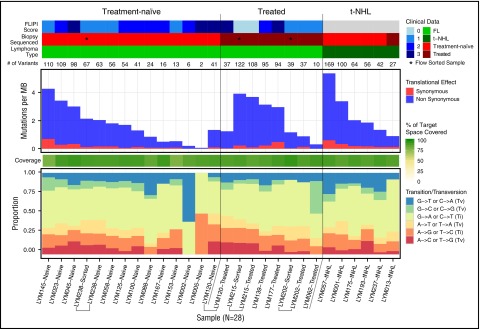
Mutation numbers and spectrum within the FL discovery sample set. Baseline genomic features of FL are shown for the exome sequenced discovery cohort. Clinical features (upper) are indicated for all 28 samples sequenced from 24 individuals. Immediately below the clinical features is a row indicating the total number of mutations per sample. Mutations per megabase sequenced (middle) is based on the total mutations within the targeted exome capture space successfully covered in each sample (80% breadth, 20× depth), with the percentage of the sequenced target region covered in each sample indicated immediately below in green. Finally, the rate of transitions and transversions in the mutations observed in each individual are shown (bottom). Bulk fresh-frozen samples were sequenced unless indicated (*) as a flow-sorted sample. Brackets group multiple samples from a single individual. MB, megabase; Ti, transition; Tv, transversion
Figure 2.
Figure 2.
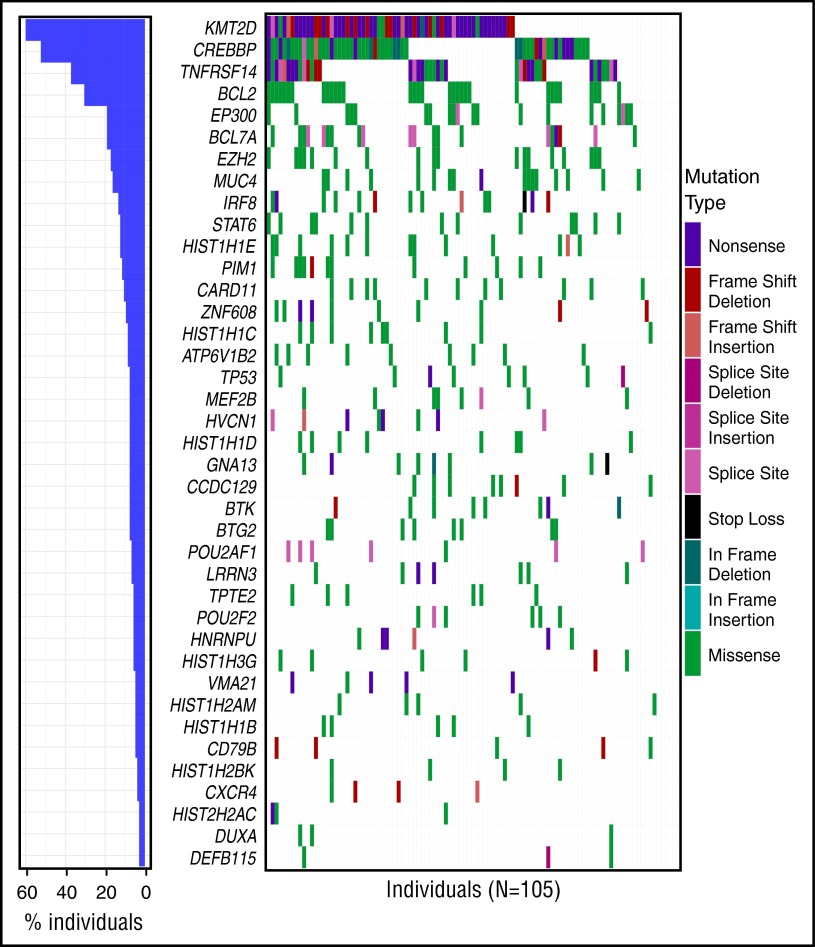
SMGs in FL. The frequency and type of mutations affecting 39 genes identified as significantly mutated in our cohort using MuSiC analysis (FDR < 0.05, convolution test method) are displayed in each row. Columns represent each patient in the cohort and are ordered by the presence of mutations in the most to least frequently mutated gene. The bar graph on the left corresponds to the frequency of mutations for that gene in the entire cohort. For genes with multiple mutations in a single patient, only 1 mutation type is shown with priority order indicated in the legend from the highest priority at the top to lowest at the bottom. For individuals with multiple samples, the union of mutations in all samples for that individual was used. The mutation waterfall plot was created using the “GenVisR” package in R.
Figure 3.
Figure 3.
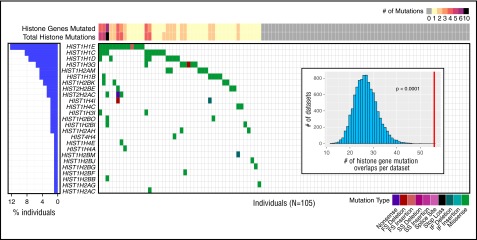
Histone gene mutations co-occur within individual patients with FL. Coding and splice site mutations in genes encoding the core histones (H2A, H2B, H3, H4) or histone linker (H1) often co-occur within patients. Each row represents a mutated histone gene, and each column represents a patient in this cohort. Histone mutations per patient are displayed at the top, indicating the total number of genes mutated (also summarized for the cohort in the bar graph on the left) and total number of mutations observed (includes multiple mutations per gene). The distribution of mutations and mutation types are indicated by colored boxes in the grid. For genes with multiple mutations in a single patient, only 1 mutation type is shown, with priority order indicated in the legend from the highest priority at the left to lowest at the right. Visualization created using GenVisR. (Inset) Histogram depicts the distribution of expected total histone gene mutation co-occurrences from 10 000 randomly permutated datasets with respect to the observed total co-occurrence in this cohort indicated by a red line (estimated P value < .0001). Although some patients had more than 1 mutation per histone gene, as indicated at the top, genes were considered mutated or not mutated for co-occurrence analysis. See supplemental Table 11 for a complete list of mutations. FS, frame shift; IF, in frame; SS, splice site.
Figure 4.
Figure 4.
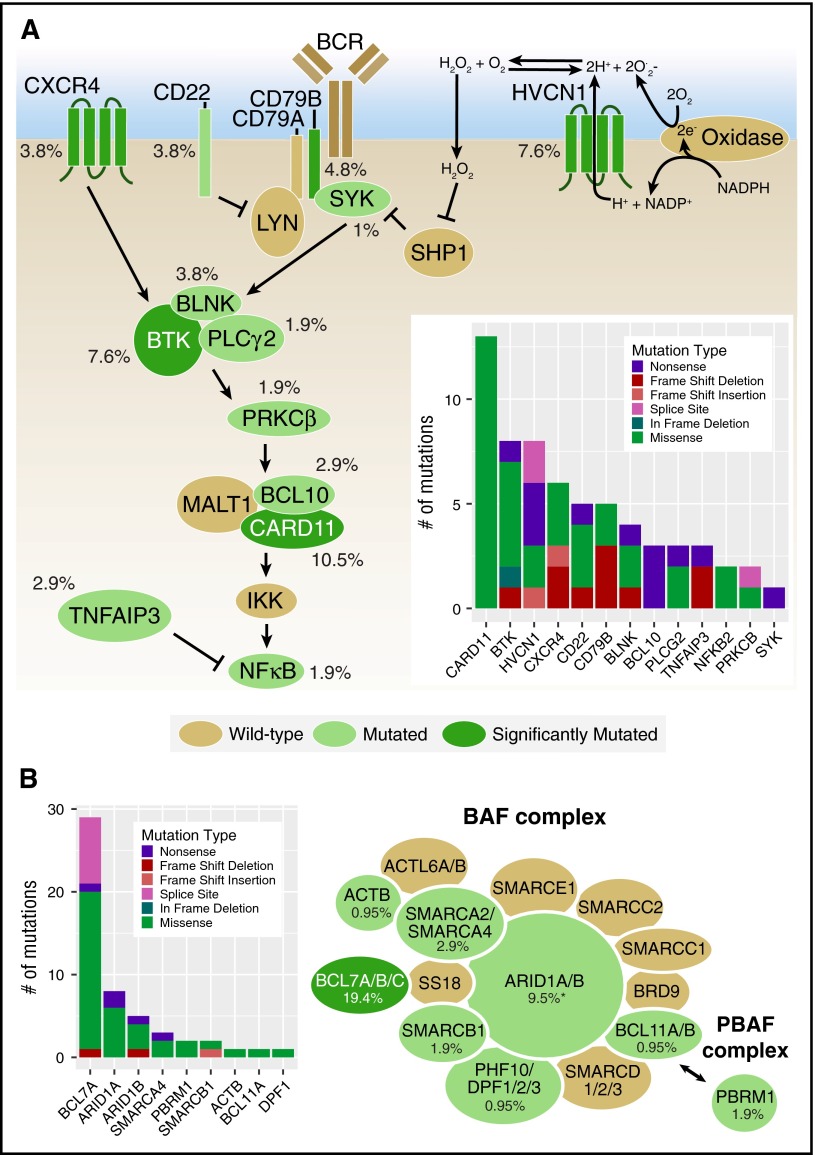
Frequencies of mutations affecting the BCR/CXCR4 signaling pathways and SWI/SNF complex in patients with FL. (A) The interconnected BCR and CXCR4 signaling pathways are shown. Genes with nonsynonymous coding or splice site mutations are depicted in green, with SMGs in dark green and the mutation frequency observed in the entire cohort (N = 105) indicated. The total number and types of mutations observed are shown in the inset bar graph. (B) Recurrent mutations affecting both BAF (BRG1-associated factor) and PBAF (polybromo BRG1-associated factor) SWI/SNF complexes were observed in our cohort and annotated as in A. See supplemental Table 11 for a complete list of mutations. *Frequency includes 2 ARID1A variants rescued after ESP filtering.
Figure 5.
Figure 5.
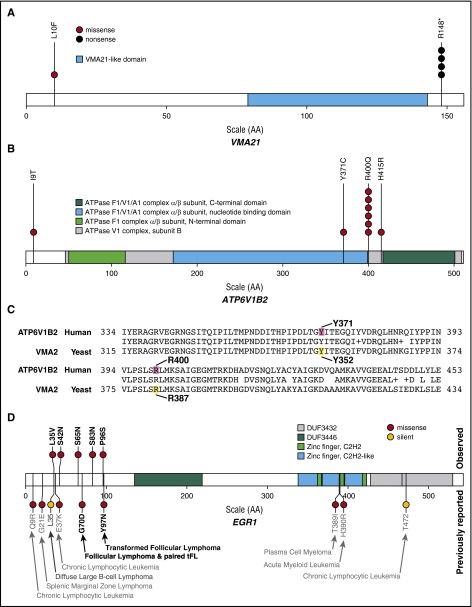
Recurrent mutations in vacuolar ATPase genes and EGR1 in patients with FL. Hotspot mutations were identified in significantly mutated vacuolar ATPase-associated genes: (A) VMA21 (R148* in 4 of 5 mutated patients; ENST00000370361) and (B) ATP6V1B2 (R400Q in 6 of 9 mutated patients; ENST00000276390). (C) BLAST alignment results illustrating highly conserved yeast Vma2p (YBR127C) amino acid residues previously shown to abrogate ATPase catalytic activity when mutated (yellow) are orthologous to amino acid residues altered by mutations in human ATP6V1B2 (ENST00000276390.2) observed in our cohort (magenta). (D) EGR1 mutations observed in this cohort (N = 105), indicated above the protein diagram, were only observed near the N-terminus of the protein (ENST00000239938). EGR1 mutations previously reported for hematopoietic malignancies in COSMIC and selected papers are depicted below the protein diagram.,,,, See supplemental Table 11 for a complete list of V-ATPase complex and EGR1 mutations.
Figure 6.
Figure 6.
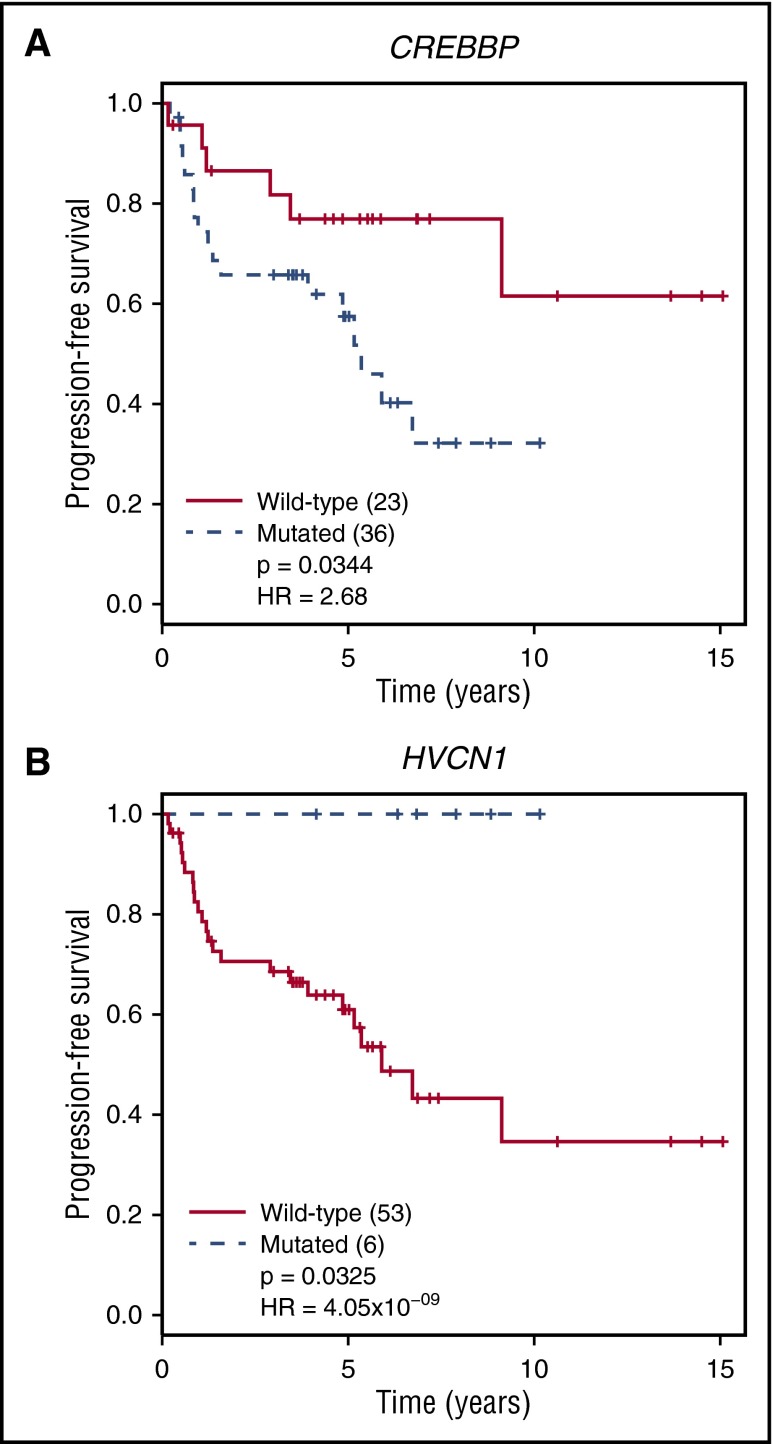
Mutations affecting PFS in treated patients with FL. Treatment-naive patients who received treatment within 1 year of diagnosis and sample collection (N = 59) were stratified by the presence or absence of coding or splice site mutations in SMGs, with a minimum of 5 mutations in this subset of patients (supplemental Table 6). Only groups showing significantly different survival are shown. (A) PFS was worse for patients harboring CREBBP mutations (P = .034; q = 0.884 after Benjamini-Hochberg correction for multiple hypothesis testing). (B) In contrast, patients with HVCN1 mutations had better PFS than those with wild-type HVCN1 (P = .033; q = 0.740).

Comment in

References

    1. Nabhan C, Aschebrook-Kilfoy B, Chiu BC, Kruczek K, Smith SM, Evens AM. The impact of race, age, and sex in follicular lymphoma: A comprehensive SEER analysis across consecutive treatment eras. Am J Hematol. 2014;89(6):633-638. - PubMed
    1. Jacobson CA, Freedman AS. Is observation dead in follicular lymphoma? Still appropriate. J Natl Compr Canc Netw. 2015;13(3):367-370. - PubMed
    1. Kahl BS, Yang DT. Follicular lymphoma: evolving therapeutic strategies. Blood. 2016;127(17):2055-2063. - PubMed
    1. Casulo C, Burack WR, Friedberg JW. Transformed follicular non-Hodgkin lymphoma. Blood. 2015;125(1):40-47. - PubMed
    1. Basso K, Dalla-Favera R. Germinal centres and B cell lymphomagenesis. Nat Rev Immunol. 2015;15(3):172-184. - PubMed

MeSH terms