Comment
. 2017 Jun;284(12):1753-1766.
doi: 10.1111/febs.14007. Epub 2017 Jan 29.

Integration of cellular ubiquitin and membrane traffic systems: focus on deubiquitylases

Affiliations
Comment

Integration of cellular ubiquitin and membrane traffic systems: focus on deubiquitylases

Michael J Clague et al. FEBS J. 2017 Jun.

Abstract

The cell is comprised of integrated multilevel protein networks or systems. The ubiquitin, protein homeostasis and membrane trafficking systems are highly integrated. Here, we look at the influence of reversible ubiquitylation on membrane trafficking and organelle dynamics. We review the regulation of endocytic sorting, selective autophagy and the secretory pathway by ubiquitin signals, with a particular focus on detailing the contribution of deubiquitylating enzymes.

Keywords: autophagy; deubiquitylase; endocytosis; mitophagy; ubiquitin.


Figures

Figure 1
Figure 1
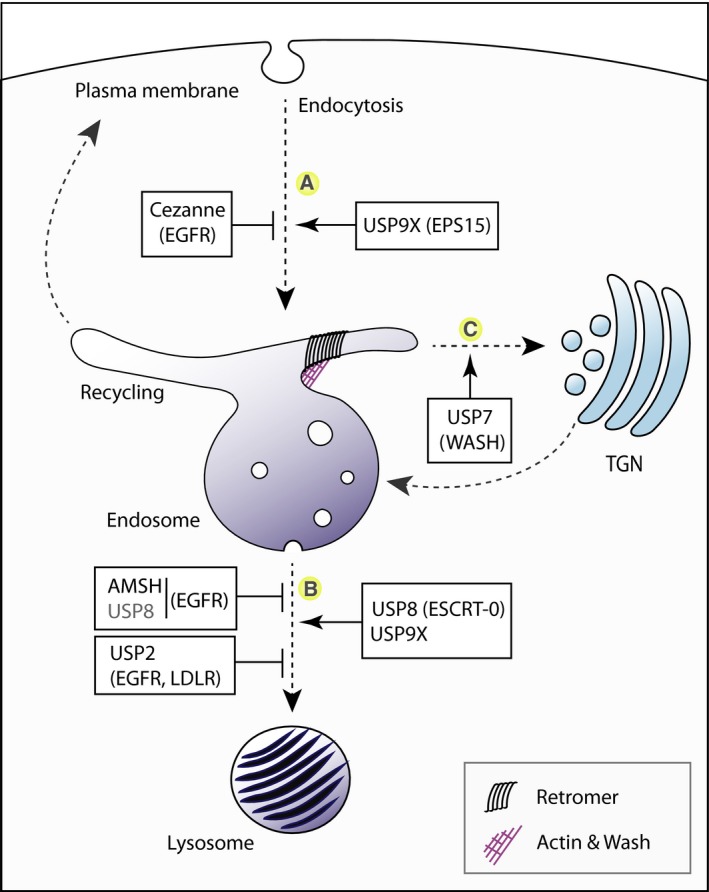
DUBs control trafficking through the endocytic pathway. Depicted are those DUBs that have been shown to affect (A) the internalisation process of a variety of transmembrane proteins (e.g. EGFR), (B) endo‐lysosomal sorting of cargo (e.g. EGFR) by the ESCRT‐machinery, leading to lysosomal degradation and (C) retromer and WASH‐dependent recycling of cargo proteins to the TGN (e.g. Mannose‐6‐Phosphate receptor). Proposed substrates are shown in brackets. Note that USP8 has been proposed to positively and negatively regulate endolysosomal trafficking, possibly reflecting its dual role in deubiquitylating both the ESCRT‐0 HRS/STAM complex and the EGFR itself. Dashed arrows show the path taken by cargo along the endocytic trafficking routes. Other DUBs implicated in endocytic trafficking of specific cargo, for example, USP10 and USP46 are not shown.
Figure 2
Figure 2
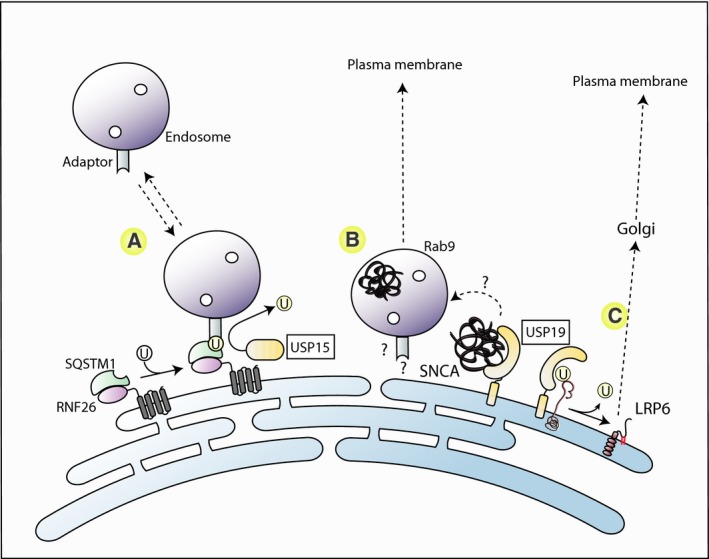
DUB activities associated with endoplasmic reticulum (ER)‐associated vesicles. (A) The integral ER protein RNF26 is proposed to ubiquitylate SQSTM1/p62, which in turn functions to tether a variety of vesicles including endosomes via endosomal ubiquitin‐binding adaptors, in the perinuclear area. USP15, which is a cytoplasmic protein is thought to release the vesicles by deubiquitylating SQSTM1. (B) The ER transmembrane protein USP19 has been suggested to act as a chaperone to promote the transfer of misfolded alpha‐synuclein (SNCA) into the lumen of RAB9‐positive late endosomal vesicles, which subsequently exocytose their content by fusion with the plasma membrane via a noncanonical MAPS pathway. (C) USP19 engages in a number of quality control pathways, including ERAD (not shown) and the ubiquitin‐dependent ER‐exit of the palmitoylated and glycosylated LRP6 transmembrane protein via vesicular carriers.
Figure 3
Figure 3
Selective autophagy is regulated by mutiple DUBs. (A) Mitophagy is triggered by the activation of PINK1 and Parkin leading to the accumulaton of Lys6, Lys11‐ and Lys63‐linked Ub chains, containing pUb, on the outer mitochondrial membrane. These promote the association of ubiquitin‐binding adaptor proteins that recruit LC3‐decorated autophagic membranes. USP30 and USP15 have been proposed to counteract this process by removing ubiquitin from Parkin substrates. USP8 has been proposed to remove inhibitory Lys6‐linked ubiquitin chains from Parkin. (B) The endo‐lysosomal damage response ensures the clearance of damaged lysosomes via autophagy. Lys63‐linked chains are proposed to act as an enabling ubiquitin modification in this process and promote the recruitment of the autophagic machinery. In contrast, Lys48‐linked chains associated with some of the damaged lysosomes need to be removed by the DUB YOD1, a component of the Endo‐Lysosomal Damage Response complex (ELDR). (C) Misfolded alpha‐synuclein aggregates have been shown to accumulate Lys63‐linked ubiquitin chains which promote its degradation within lysosomes. USP8 is proposed to remove these ubiquitin chains and interfere with the clearance of alpha‐synuclein aggregates.

Comment on

References

    1. Clague MJ & Urbe S (2010) Ubiquitin: same molecule, different degradation pathways. Cell 143, 682–685. - PubMed
    1. Komander D & Rape M (2012) The ubiquitin code. Annu Rev Biochem 81, 203–229. - PubMed
    1. Heride C, Urbe S & Clague MJ (2014) Ubiquitin code assembly and disassembly. Curr Biol 24, R215–R220. - PubMed
    1. Husnjak K & Dikic I (2012) Ubiquitin‐binding proteins: decoders of ubiquitin‐mediated cellular functions. Annu Rev Biochem 81, 291–322. - PubMed
    1. Clague MJ, Heride C & Urbe S (2015) The demographics of the ubiquitin system. Trends Cell Biol 25, 417–426. - PubMed

LinkOut - more resources