


Addendum guidelines for the prevention of peanut allergy in the United States: Report of the National Institute of Allergy and Infectious Diseases-sponsored expert panel
- PMID: 28065278
- PMCID: PMC5226648
- DOI: 10.1016/j.jaci.2016.10.010
Addendum guidelines for the prevention of peanut allergy in the United States: Report of the National Institute of Allergy and Infectious Diseases-sponsored expert panel
Abstract
Background: Food allergy is an important public health problem because it affects children and adults, can be severe and even life-threatening, and may be increasing in prevalence. Beginning in 2008, the National Institute of Allergy and Infectious Diseases, working with other organizations and advocacy groups, led the development of the first clinical guidelines for the diagnosis and management of food allergy. A recent landmark clinical trial and other emerging data suggest that peanut allergy can be prevented through introduction of peanut-containing foods beginning in infancy.
Objectives: Prompted by these findings, along with 25 professional organizations, federal agencies, and patient advocacy groups, the National Institute of Allergy and Infectious Diseases facilitated development of addendum guidelines to specifically address the prevention of peanut allergy.
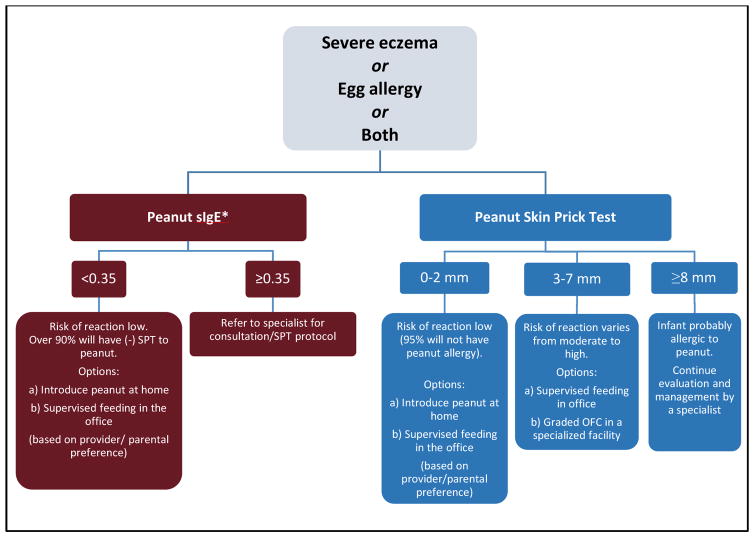
Results: The addendum provides 3 separate guidelines for infants at various risk levels for the development of peanut allergy and is intended for use by a wide variety of health care providers. Topics addressed include the definition of risk categories, appropriate use of testing (specific IgE measurement, skin prick tests, and oral food challenges), and the timing and approaches for introduction of peanut-containing foods in the health care provider's office or at home. The addendum guidelines provide the background, rationale, and strength of evidence for each recommendation.
Conclusions: Guidelines have been developed for early introduction of peanut-containing foods into the diets of infants at various risk levels for peanut allergy.
Keywords: Food; allergy; guidelines; peanut; prevention.
Published by Elsevier Inc.
Figures
Comment in
-
LEAPing forward with the new guidelines.J Allergy Clin Immunol. 2017 Jan;139(1):52-53. doi: 10.1016/j.jaci.2016.11.005. J Allergy Clin Immunol. 2017. PMID: 28065282 No abstract available.
References
-
- Sicherer SH, Muñoz-Furlong A, Burks AW, Sampson HA. Prevalence of peanut and tree nut allergy in the US determined by a random digit dial telephone survey. J Allergy Clin Immunol. 1999 Apr;103(4):559–62. - PubMed
-
- Gupta RS, Springston EE, Warrier MR, Smith B, Kumar R, Pongracic J, Holl JL. The prevalence, severity, and distribution of childhood food allergy in the United States. Pediatrics. 2011 Jul;128(1):e9–17. - PubMed
-
- Bock SA, Muñoz-Furlong A, Sampson HA. Fatalities due to anaphylactic reactions to foods. J Allergy Clin Immunol. 2001 Jan;107(1):191–3. - PubMed
-
- Bock SA, Muñoz-Furlong A, Sampson HA. Further fatalities caused by anaphylactic reactions to food, 2001–2006. J Allergy Clin Immunol. 2007 Apr;119(4):1016–8. - PubMed
APPENDIX C: TIER 1 REFERENCES
-
- Koplin JJ, Peters RL, Dharmage SC, Gurrin L, Tang MLK, Ponsonby AL, et al. Understanding the feasibility and implications of implementing early peanut introduction for prevention of peanut allergy. J Allergy Clin Immunol. 2016 May 2; doi: 10.1016/j.jaci.2016.04.011. pii: S0091-6749(16)30195-6. Epub ahead of print. - DOI - PubMed
Publication types
MeSH terms
Substances
Grants and funding
LinkOut - more resources
Full Text Sources
Other Literature Sources
Medical
