


Laparoscopic Roux-en-Y gastric bypass in adolescents with severe obesity (AMOS): a prospective, 5-year, Swedish nationwide study
- PMID: 28065734
- PMCID: PMC5359414
- DOI: 10.1016/S2213-8587(16)30424-7
Laparoscopic Roux-en-Y gastric bypass in adolescents with severe obesity (AMOS): a prospective, 5-year, Swedish nationwide study
Erratum in
-
Correction to Lancet Diabetes Endocrinol 2017: 5: 174-83.Lancet Diabetes Endocrinol. 2017 May;5(5):e3. doi: 10.1016/S2213-8587(17)30118-3. Lancet Diabetes Endocrinol. 2017. PMID: 28434494 No abstract available.
Abstract
Background: Severe obesity in adolescence is associated with reduced life expectancy and impaired quality of life. Long-term benefits of conservative treatments in adolescents are known to be modest, whereas short-term outcomes of adolescent bariatric surgery are promising. We aimed to compare 5-year outcomes of adolescent surgical patients after Roux-en-Y gastric bypass with those of conservatively treated adolescents and of adults undergoing Roux-en-Y gastric bypass, in the Adolescent Morbid Obesity Surgery (AMOS) study.
Methods: We did a nationwide, prospective, non-randomised controlled study of adolescents (aged 13-18 years) with severe obesity undergoing Roux-en-Y gastric bypass at three specialised paediatric obesity treatment centres in Sweden. We compared clinical outcomes in adolescent surgical patients with those of matched adolescent controls undergoing conservative treatment and of adult controls undergoing Roux-en-Y gastric bypass. The primary outcome measure was change in BMI over 5 years. We used multilevel mixed-effect regression models to assess longitudinal changes. This trial is registered with ClinicalTrials.gov, number NCT00289705.
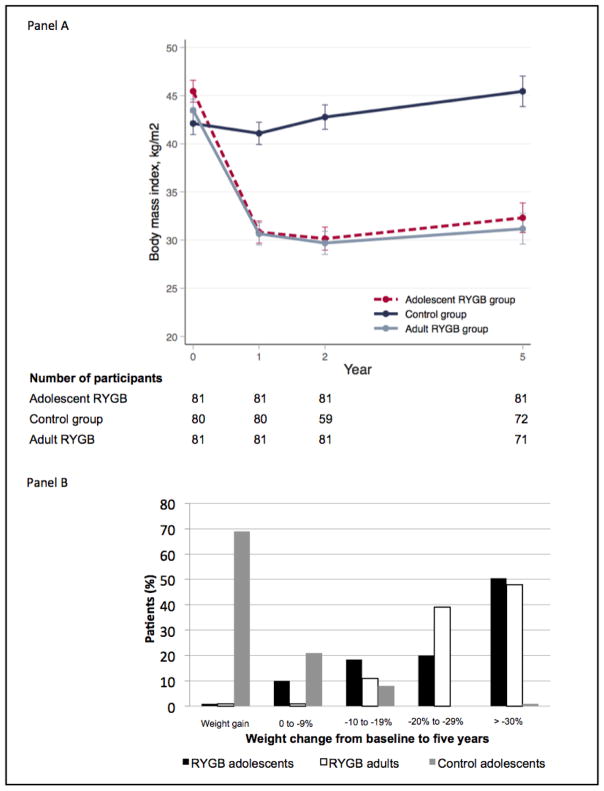
Findings: Between April, 2006, and May, 2009, 100 adolescents were recruited to the study, of whom 81 underwent Roux-en-Y gastric bypass (mean age 16·5 years [SD 1·2], bodyweight 132·8 kg [22·1], and BMI 45·5 kg/m2 [SD 6·1]). 80 matched adolescent controls and 81 matched adult controls were enrolled for comparison of outcomes. The change in bodyweight in adolescent surgical patients over 5 years was -36·8 kg (95% CI -40·9 to -32·8), resulting in a reduction in BMI of -13·1 kg/m2 (95% CI -14·5 to -11·8), although weight loss less than 10% occurred in nine (11%). Mean BMI rose in adolescent controls (3·3 kg/m2, 95% CI 1·1-4·8) over the 5-year study period, whereas the BMI change in adult controls was similar to that in adolescent surgical patients (mean change -12·3 kg/m2, 95% CI -13·7 to -10·9). Comorbidities and cardiovascular risk factors in adolescent surgical patients showed improvement over 5 years and compared favourably with those in adolescent controls. 20 (25%) of 81 adolescent surgical patients underwent additional abdominal surgery for complications of surgery or rapid weight loss and 58 (72%) showed some type of nutritional deficiency; health-care consumption (hospital attendances and admissions) was higher in adolescent surgical patients compared with adolescent controls. 20 (25%) of 81 adolescent controls underwent bariatric surgery during the 5-year follow-up.
Interpretation: Adolescents with severe obesity undergoing Roux-en-Y gastric bypass had substantial weight loss over 5 years, alongside improvements in comorbidities and risk factors. However, gastric bypass was associated with additional surgical interventions and nutritional deficiencies. Conventional non-surgical treatment was associated with weight gain and a quarter of patients had bariatric surgery within 5 years.
Funding: Swedish Research Council; Swedish Governmental Agency for Innovation Systems; National Board of Health and Welfare; Swedish Heart and Lung Foundation; Swedish Childhood Diabetes Foundation; Swedish Order of Freemasons Children's Foundation; Stockholm County Council; Västra Götaland Region; Mrs Mary von Sydow Foundation; Stiftelsen Göteborgs Barnhus; Stiftelsen Allmänna Barnhuset; and the US National Institute of Diabetes, Digestive, and Kidney Diseases (National Institutes of Health).
Copyright © 2017 Elsevier Ltd. All rights reserved.
Conflict of interest statement
Conflicts of interest:
Figures
Comment in
-
Pros and cons of bariatric surgery in adolescents.Lancet Diabetes Endocrinol. 2017 Mar;5(3):152-154. doi: 10.1016/S2213-8587(16)30425-9. Epub 2017 Jan 6. Lancet Diabetes Endocrinol. 2017. PMID: 28065735 No abstract available.
-
Obesity: Assessing the long-term outcomes of bariatric surgery in adolescents.Nat Rev Endocrinol. 2017 Mar;13(3):125. doi: 10.1038/nrendo.2017.2. Epub 2017 Jan 20. Nat Rev Endocrinol. 2017. PMID: 28106151 No abstract available.
-
Bariatric surgery in adolescents.Lancet Diabetes Endocrinol. 2017 May;5(5):326. doi: 10.1016/S2213-8587(17)30112-2. Lancet Diabetes Endocrinol. 2017. PMID: 28434486 No abstract available.
-
Bariatric surgery in adolescents - Author's reply.Lancet Diabetes Endocrinol. 2017 May;5(5):326-327. doi: 10.1016/S2213-8587(17)30111-0. Lancet Diabetes Endocrinol. 2017. PMID: 28434487 No abstract available.
References
-
- van Dam RM, Willett WC, Manson JE, Hu FB. The relationship between overweight in adolescence and premature death in women. Annals of internal medicine. 2006;145(2):91–7. - PubMed
-
- Juonala M, Magnussen CG, Berenson GS, et al. Childhood adiposity, adult adiposity, and cardiovascular risk factors. The New England journal of medicine. 2011;365(20):1876–85. - PubMed
-
- Skinner AC, Perrin EM, Moss LA, Skelton JA. Cardiometabolic Risks and Severity of Obesity in Children and Young Adults. The New England journal of medicine. 2015;373(14):1307–17. - PubMed
Publication types
MeSH terms
Associated data
Grants and funding
LinkOut - more resources
Full Text Sources
Other Literature Sources
Medical
Research Materials
Miscellaneous
