. 2016 Dec 21:8:309.
doi: 10.3389/fnagi.2016.00309. eCollection 2016.

The Effect of Aging on Muscular Dynamics Underlying Movement Patterns Changes

Affiliations

The Effect of Aging on Muscular Dynamics Underlying Movement Patterns Changes

Carlijn A Vernooij et al. Front Aging Neurosci. .

Abstract

Introduction: Aging leads to alterations not only within the complex subsystems of the neuro-musculo-skeletal system, but also in the coupling between them. Here, we studied how aging affects functional reorganizations that occur both within and between the behavioral and muscular levels, which must be coordinated to produce goal-directed movements. Using unimanual reciprocal Fitts' task, we examined the behavioral and muscular dynamics of older adults (74.4 ± 3.7 years) and compared them to those found for younger adults (23.2 ± 2.0 years). Methods: To achieve this objective, we manipulated the target size to trigger a phase transition in the behavioral regime and searched for concomitant signatures of a phase transition in the muscular coordination. Here, muscular coordination was derived by using the method of muscular synergy extraction. With this technique, we obtained functional muscular patterns through non-negative matrix factorization of the muscular signals followed by clustering the resulting synergies. Results: Older adults showed a phase transition in behavioral regime, although, in contrast to young participants, their kinematic profiles did not show a discontinuity. In parallel, muscular coordination displayed two typical signatures of a phase transition, that is, increased variability of coordination patterns and a reorganization of muscular synergies. Both signatures confirmed the existence of muscular reorganization in older adults, which is coupled with change in dynamical regime at behavioral level. However, relative to young adults, transition occurred at lower index of difficulty (ID) in older participants and the reorganization of muscular patterns lasted longer (over multiple IDs). Discussion: This implies that consistent changes occur in coordination processes across behavior and muscle. Furthermore, the repertoire of muscular patterns was reduced and somewhat modified for older adults, relative to young participants. This suggests that aging is not only related to changes in individual muscles (e.g., caused by dynapenia) but also in their coordination.

Keywords: Fitts' task; coordination patterns; dynamical regime; functional connectivity dynamics; muscle synergy.


Figures

Figure 1
Figure 1
(A) Reconstructed angle diagrams as a function of ID averaged across participants. The horizontal axes represent normalized position (x); the vertical axes normalized velocity (y). The color coding (right side of the panel) represents the maximum angle in degrees between adjacent vectors. Red areas indicate the existence of locally opposing angles and imply the presence of a fixed point. Its absence implies the existence of a limit cycle. (B) The maximum angle in degrees between adjacent vectors as a function of ID averaged across participants (θmax) for both young (light gray and dotted line) and older (dark gray and solid line) adults. The horizontal axis represents ID; the vertical θmax (degrees). Error bars denote 1 standard deviation.
Figure 2
Figure 2
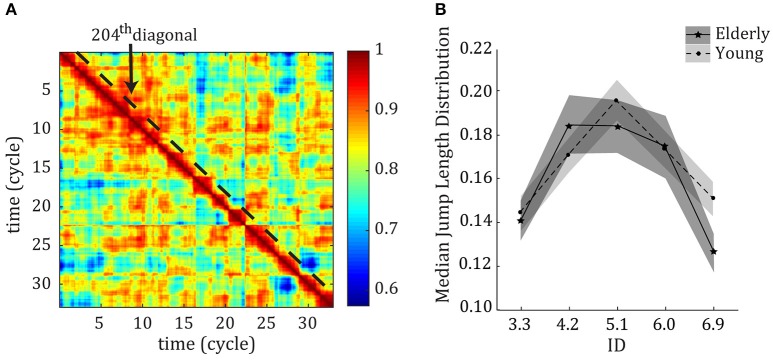
(A) Example of an FCD matrix, including the 204th diagonal over which the data was analyzed. (B) Median Jump length distribution (JLD) curve of the FCD per ID across young (dotted line) and older (solid line) participants P < 0.05. Error bars denote 1 standard deviation.
Figure 3
Figure 3
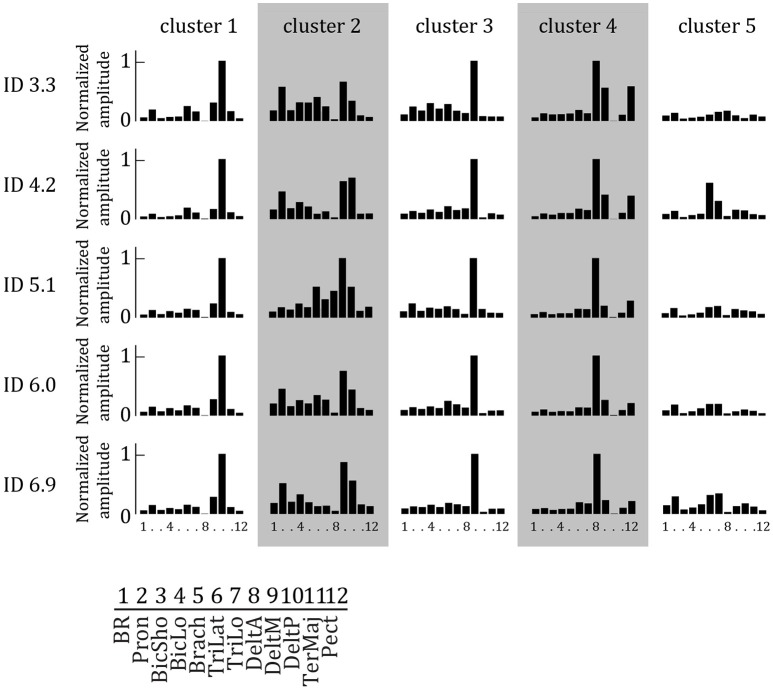
Synergy weights extracted by NNMF as a function of ID averaged per cluster. Per synergy, the normalized weight of each of the 12 muscles is represented. Each muscle is activated in multiple synergies. Higher bars indicate increased weight.
Figure 4
Figure 4
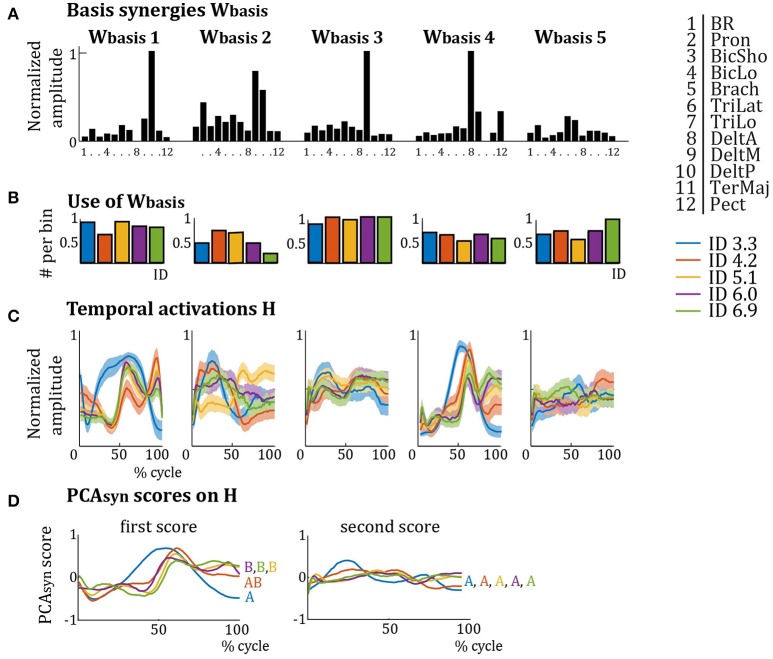
(A) Synergy weights from Figure 3 averaged per cluster (Wbasis). Per basis synergy, the normalized weight of each of the 12 muscles is represented. Higher bars indicate increased weight. (B) Normalized frequency of use of the basis synergies per ID. (C) Average temporal activation components over a movement cycle per basis synergy per ID. Darker colors represent lower IDs. (D) First and second PCAsyn scores on the temporal activations H of (B). The first PCAsyn score shows a clear difference between the activations of the IDs, activations with significant correlations (p << 0.001) are grouped by letters (A,B), whereas the second PCAsyn score does not (all activations are correlated with all others).
Figure 5
Figure 5
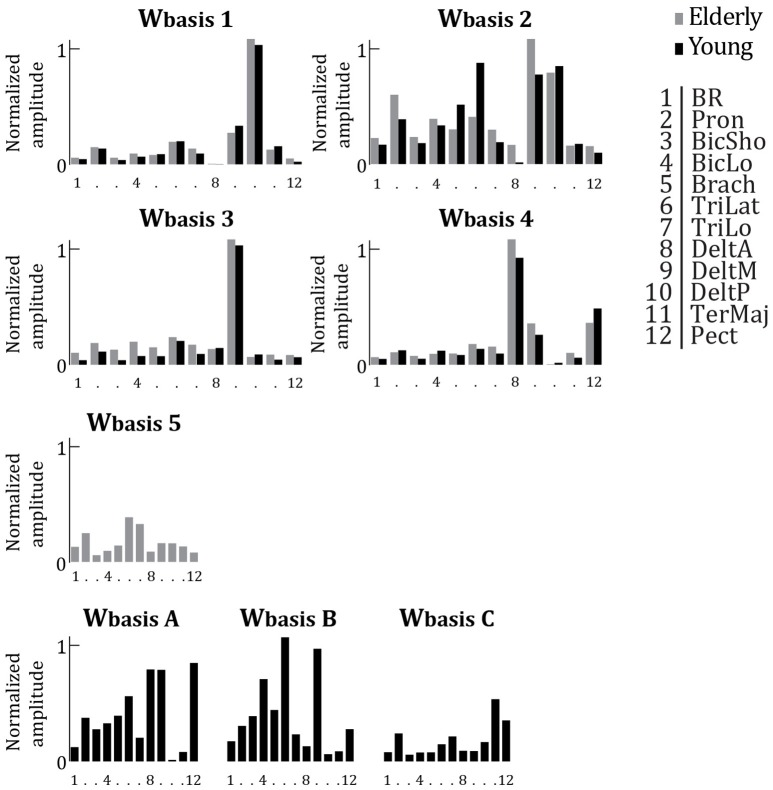
Averaged synergy activation coefficients (Wbasis), replotted from Figure 4 (older adults, gray bars) and replotted from Vernooij et al. (2016) (young adults, black bars). Per basis synergy, the normalized activity of each of the 12 muscles is represented. Higher bars indicate increased strength of activity. Synergies are grouped based on correlation. Those synergies which were not significantly correlated to a synergy from the other age group are plotted separately (Wbasis 5 and Wbasis A, B, & C).

References

    1. Babcock R. L., Salthouse T. A. (1990). Effects of increased processing demands on age differences in working memory. Psychol. Aging 5, 421–428. 10.1037/0882-7974.5.3.421 - DOI - PubMed
    1. Baltes P. B., Cornelius S. W., Spiro A., Nesselroade J. R., Willis S. L. (1980). Integration versus differentiation of fluid/crytallized intelligence in old age. Dev. Psychol. 16, 625–635. 10.1037/0012-1649.16.6.625 - DOI
    1. Baltes P. B., Lindenberger U. (1997). Emergence of a powerful connection between sensory and cognitive functions across the adult life span: a new window to the study of cognitive aging? Psychol. Aging 12, 12–21. 10.1037/0882-7974.12.1.12 - DOI - PubMed
    1. Cappellini G., Ivanenko Y. P., Poppele R. E., Lacquaniti F. (2006). Motor patterns in human walking and running. J. Neurophysiol. 95, 3426–3437. 10.1152/jn.00081.2006 - DOI - PubMed
    1. Clark B. C., Manini T. M. (2012). What is dynapenia? Nutrition 28, 495–503. 10.1016/j.nut.2011.12.002 - DOI - PMC - PubMed

LinkOut - more resources