. 2016 Dec 22:7:492.
doi: 10.3389/fphar.2016.00492. eCollection 2016.

The Synergistic Enhancing-Memory Effect of Donepezil and S 38093 (a Histamine H3 Antagonist) Is Mediated by Increased Neural Activity in the Septo-hippocampal Circuitry in Middle-Aged Mice

Affiliations

The Synergistic Enhancing-Memory Effect of Donepezil and S 38093 (a Histamine H3 Antagonist) Is Mediated by Increased Neural Activity in the Septo-hippocampal Circuitry in Middle-Aged Mice

Aurore Sors et al. Front Pharmacol. .

Abstract

Donepezil, an acetylcholinesterase inhibitor, induces only moderate symptomatic effects on memory in Alzheimer's disease patients. An alternative strategy for treatment of cognitive symptoms could be to act simultaneously on both histaminergic and cholinergic pathways, to create a synergistic effect. To that aim, 14 month old C57/Bl6 mice were administered per oesophagy during nine consecutive days with Donepezil (at 0.1 and 0.3 mg/kg) and S 38093 (at 0.1, 0.3, and 1.0 mg/kg), a H3 histaminergic antagonist developed by Servier, alone or in combination and tested for memory in a contextual memory task that modelized the age-induced memory dysfunction. The present study shows that the combination of Donepezil and S 38093 induced a dose-dependent synergistic memory-enhancing effect in middle-aged mice with a statistically higher size of effect never obtained with compounds alone and without any pharmacokinetic interaction between both compounds. We demonstrated that the memory-enhancing effect of the S 38093 and Donepezil combination is mediated by its action on the septo-hippocampal circuitry, since it canceled out the reduction of CREB phosphorylation (pCREB) observed in these brain areas in vehicle-treated middle-aged animals. Overall, the effects of drug combinations on pCREB in the hippocampus indicate that the synergistic promnesiant effects of the combination on memory performance in middle-aged mice stem primarily from an enhancement of neural activity in the septo-hippocampal system.

Keywords: CREB; acetylcholine; amnesia; cognitive aging; hippocampus; histamine; microdialysis; septum.


Figures
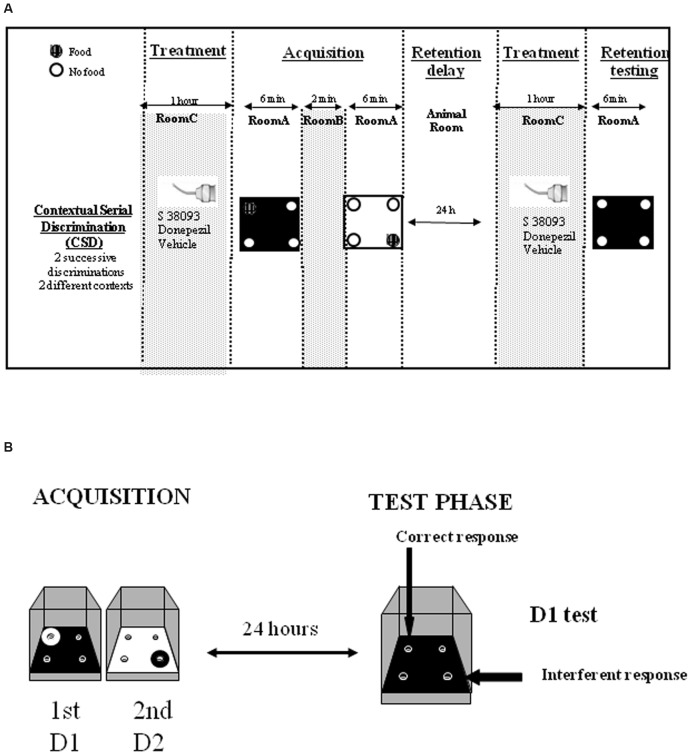
FIGURE 1
FIGURE 1
(A) Contextual serial discrimination: at the acquisition phase, mice performed two consecutive spatial discriminations varying by the color and texture of the floor, i.e., D1: Discrimination 1 and D2: Discrimination 2. For each discrimination, only one hole out of the four holes of the apparatus was baited (hashed circles). The two discrimination were separated by a 2 min delay interval during which animals are placed in room B. A 24-h delay was interpolated between the acquisition and test phases, during which mice were returned in the colony room. 1 h prior to acquisition and test phases, mice received a per se administration of the compounds or vehicle solution in a chamber placed in a room (room C) different from the one in which the behavioral experiments was conducted (room A). Subsequently, mice were submitted to the test phase in which they were replaced on the floor of the first discrimination without any food pellet in the apparatus. (B) Two types of responses were calculated: (i) correct responses corresponding to head-dips into the hole baited at the acquisition of the first discrimination (D1), on the same floor context; (ii) interference responses corresponding to head-dips into the hole baited at the other (second) discrimination (D2). These two parameters allow calculus of the SCM score.
FIGURE 2
FIGURE 2
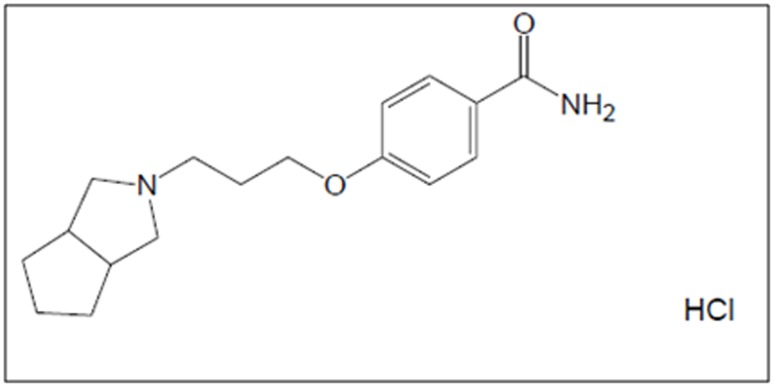
Chemical formula of S 38093 (C17H24N2O2, HCl).
FIGURE 3
FIGURE 3
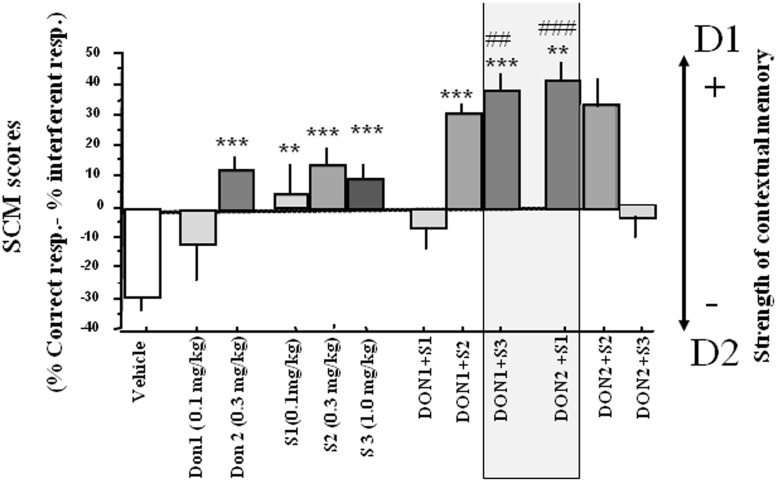
Effects of S 38093, Donepezil and combinations on SCM scores in middle-aged mice (Experiment 1). SCM scores are expressed as mean ± SE. SCM scores are obtained by calculation (% of correct responses – % of interferent responses). As can be seen, the lowest S 38093 dose combined with the highest Donepezil dose (DON 2 + S1), and inversely (DON 1 + S3), significantly increased SCM scores as compared to Vehicle and compounds alone. ∗∗p < 0.01 and ∗∗∗p < 0.001 as compared to vehicle; ##p < 0.05 and ###p < 0.01 respectively as compared to compounds alone.
FIGURE 4
FIGURE 4
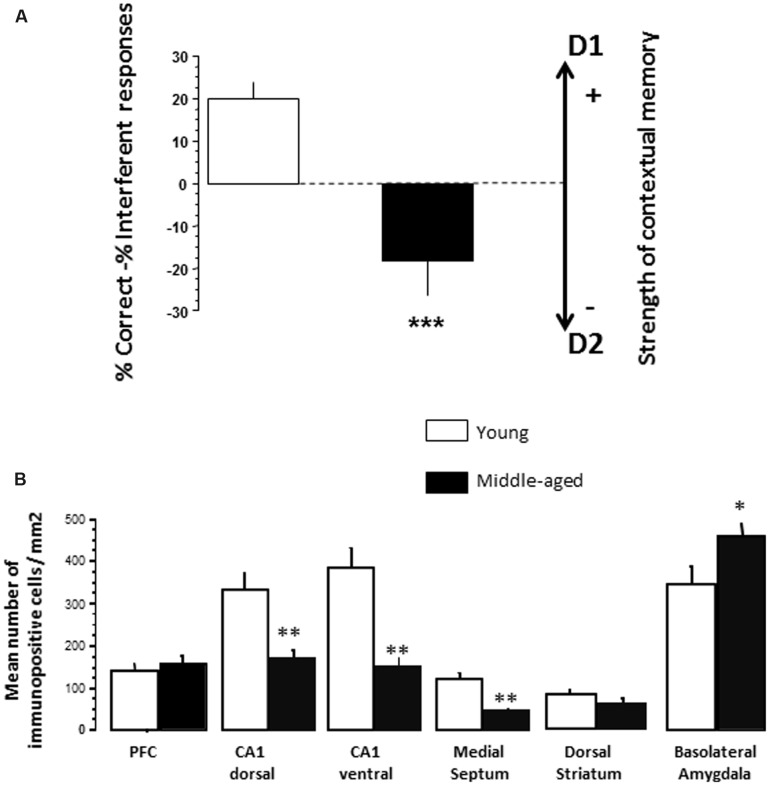
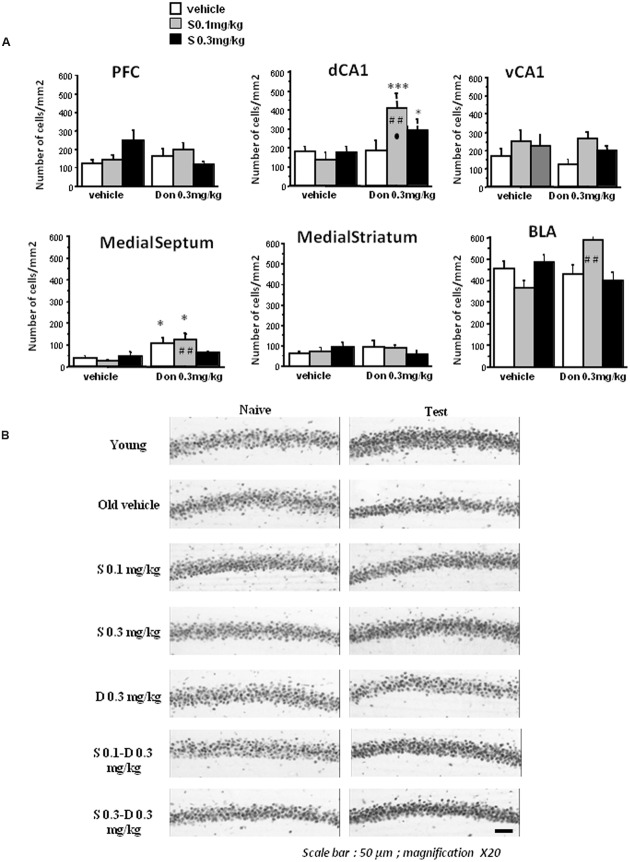
(A) Effects of aging on SCM scores (Experiment 2). As can be seen, 14 months-old middle-aged mice exhibited a significant reduction of SCM score as compared to 5 months-old young-adult mice. Between-groups difference: ∗∗∗p < 0.001. (B) Effects of aging on pCREB immunoreactivities. Counting was made in the PFC, dCA1, vCA1, medial septum, dorsal striatum, and BLA. No significant differences were observed between the groups in all brain areas in naïve condition (data not shown). Middle-aged mice showed reduced behavioral testing-related pCREB immunoreactivities in the dCA1, vCA1, and medial septum as compared to young adult mice. In contrast, a significant increase of pCREB was observed in the BLA in middle-aged animals, as compared to young ones. Results are expressed as mean number of positive pCREB nuclei per mm2. p < 0.05, ∗∗p < 0.01.
FIGURE 5
FIGURE 5
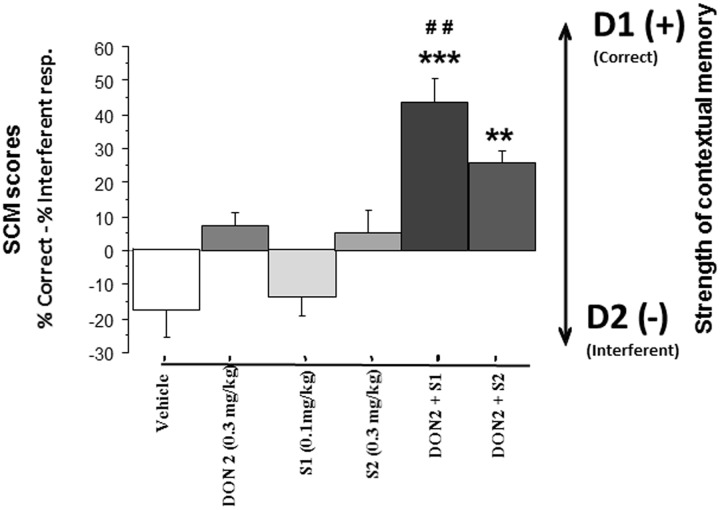
Effects of S 38093, Donepezil and combinations on SCM scores in middle-aged mice (Experiment 2). SCM scores are expressed as mean ± SE. SCM scores are obtained by calculation (% of correct responses – % of interferent responses). As can be seen, the lowest S 38093 dose combined with Donepezil significantly increased SCM scores as compared to Vehicle and compounds (Donepezil and S 38093) alone. Combination of Donepezil and the higher S 38093 dose induced a significant increase of SCM score as compared to vehicle only. ∗∗p < 0.01 and ∗∗∗p < 0.001 as compared to vehicle; ##p < 0.01 as compared to Donepezil and S 38093 alone.
FIGURE 6
FIGURE 6
Effects of S 38093, Donepezil and combinations on pCREB immunoreactivities in middle-aged mice. (A) Counting was made in the PFC, dCA1, vCA1, medial septum, dorsal striatum, and BLA. No significant differences were observed between the groups in all brain areas in naïve condition (data not shown). As can be seen, the lowest S 38093 dose combined with Donepezil significantly increased pCREB immunopositive cells as compared to vehicles and compounds (Donepezil and S 38093) alone. A significant increase of immunopositive cells was also observed in the BLA with the same combination as compared to compounds alone (Donepezil or S 38093). Combination of Donepezil and the higher S 38093 dose induced a significant increase of pCREB immunopositive cells as compared to vehicles only. p < 0.05 and ∗∗∗p < 0.001 as compared to vehicles; ##p < 0.01 as compared to Donepezil and p < 0.05 as compared to S 38093 alone. (B) Representative photomicrographs showing pCREB immunoreactivities in the dCA1 of the hippocampus in young adult and middle-aged mice after administration of S 38093 (0.1 and 0.3 mg/kg), Donepezil (0.3 mg/kg) and combinations both in naïve and test conditions. Magnification X20, Scale bar: 50 μm.

References

    1. Arrang J. M., Garbarg M., Schwartz J. C. (1983). Auto-inhibition of brain histamine release mediated by a novel class (H3) of histamine receptor. Nature 302 832–837. 10.1038/302832a0 - DOI - PubMed
    1. Barsegyan A., Mackenzie S. M., Kurose B. D., McGaugh J. L., Roozendaal B. (2010). Glucocorticoids in the prefrontal cortex enhance memory consolidation and impair working memory by a common neural mechanism. Proc. Natl. Acad. Sci. U.S.A. 107 16655–16660. 10.1073/pnas.1011975107 - DOI - PMC - PubMed
    1. Bartus R. T., Dean R. L., III, Beer B., Lippa A. S. (1982). The cholinergic hypothesis of geriatric memory dysfunction. Science 217 408–414. 10.1126/science.7046051 - DOI - PubMed
    1. Baudonnat M., Guillou J. L., Husson M., Vandesquille M., Corio M., Decorte L., et al. (2011). Disrupting effect of drug-induced reward on spatial but not cue-guided learning: implication of the striatal protein kinase A/cAMP response element-binding protein pathway. J. Neurosci. 31 16517–16528. 10.1523/JNEUROSCI.1787-11.2011 - DOI - PMC - PubMed
    1. Benito E., Barco A. (2010). CREB’s control of intrinsic and synaptic plasticity: implications for CREB-dependent memory models. Trends Neurosci. 33 230–240. 10.1016/j.tins.2010.02.001 - DOI - PubMed