. 2016 Dec 22:7:1954.
doi: 10.3389/fpsyg.2016.01954. eCollection 2016.

The Transition to Minimal Consciousness through the Evolution of Associative Learning

Affiliations

The Transition to Minimal Consciousness through the Evolution of Associative Learning

Zohar Z Bronfman et al. Front Psychol. .

Abstract

The minimal state of consciousness is sentience. This includes any phenomenal sensory experience - exteroceptive, such as vision and olfaction; interoceptive, such as pain and hunger; or proprioceptive, such as the sense of bodily position and movement. We propose unlimited associative learning (UAL) as the marker of the evolutionary transition to minimal consciousness (or sentience), its phylogenetically earliest sustainable manifestation and the driver of its evolution. We define and describe UAL at the behavioral and functional level and argue that the structural-anatomical implementations of this mode of learning in different taxa entail subjective feelings (sentience). We end with a discussion of the implications of our proposal for the distribution of consciousness in the animal kingdom, suggesting testable predictions, and revisiting the ongoing debate about the function of minimal consciousness in light of our approach.

Keywords: evolution of associative learning; evolution of consciousness; evolutionary transitions; learning and consciousness; the distribution problem.


Figures
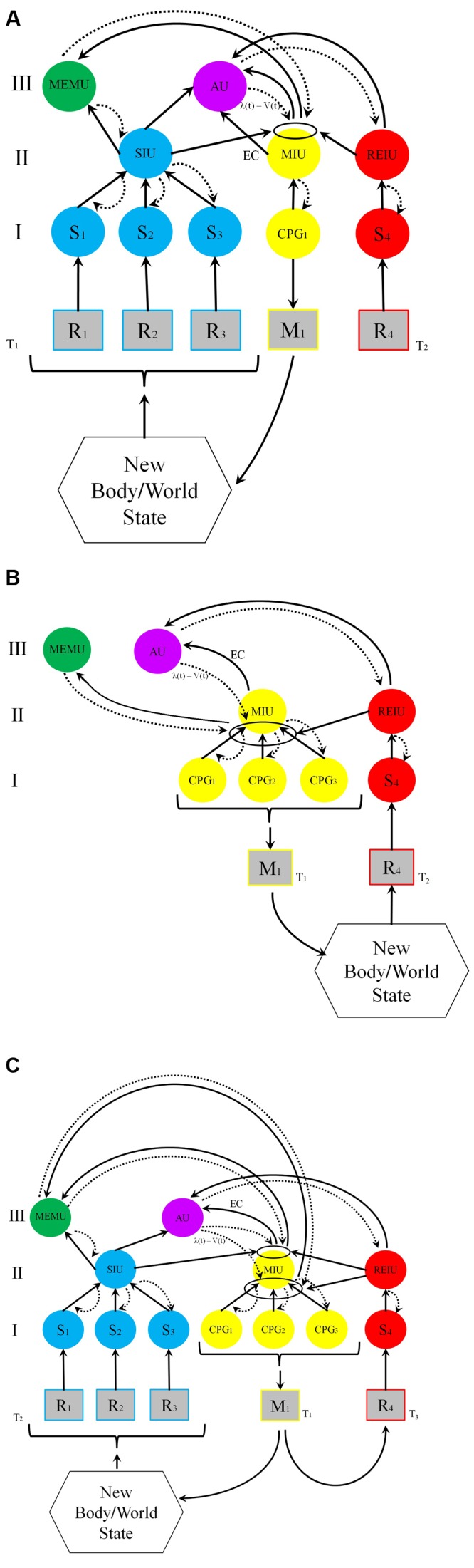
FIGURE 1
FIGURE 1
Models of first-order UAL. Functional units are depicted as circles; receptors and effectors are depicted as squares. Solid arrows denote bottom-up and lateral interactions; dashed arrows denote top–down interactions. The ellipses are the local loci of conjunction. I, II, and III are distinct hierarchical functional levels. R, receptor (e.g., retinal cell); M, effector (e.g., Muscle); S, primary units processing sensory information; CPG, Central Pattern Generator; SIU, Sensory Integrating Unit (all sensory exteroceptive and interoceptive information); MIU, Motor (action) Integrating Unit proprioceptive and interocpetive information); REIU, Reinforcing Integrating Unit; AU, Association Unit (motor-sensory integration); MEMU, dedicated Memory Unit. (A) World learning. Following an animal’s activity (e.g., saccades and exploratory touch) at time T1, a compound CS (e.g., a black, round and rigid ball) is processed in the sensory integrating unit, SIU. The CS comprises several perceptual elements received by receptors R1,2,3 and processed by sensory neural units S1,2,3. The construction of the compound stimulus (in the SIU unit, blue) is obtained via hierarchical predictive coding: the novel aspects of bottom-up information (depicted by ascending solid black arrows) are combined with top–down predictions (depicted by dashed curved arrows), based on available perceptual information in SIU, and on mnemonic and contextual information in the memory unit, MEMU (green). At T2, a reinforcing stimulus (a US such as food) activates the reinforcing unit, REIU (red), via receptor R4 and sensory unit S4. The SIU, MIU and the REIU systems activate the association unit, AU (violet), that constructs the updated model of the world at T2, and sends a PE to the local association unit (the ellipse). The PE is based on the discrepancy signal sent from the SIU and the EC (efference copy) signal sent from MIU [PE is the difference between the received reward λ, and the reward prediction V at time T1, λ(t) – V(t)]. When the discrepancy is non-zero, the strength of the association between the SIU and MIU will increase in proportion to the magnitude of the prediction error. This association circuit reconstructs engrams in MEMU. When the REIU activates the motor integrating unit MIU, it sends a signal to the effector, leading to the response via the activation of a lower-level central pattern generator unit (CPG1), which activates the effector M1. On later encounters with the stimulus, the SIU-MIU relation is primed for activity by the MEMU engrams. As a result, the compound CS will now elicit the adaptive M1 activity. (B) Self-learning. At time T1, a compound action carried out by M1 (e.g., pressing a button, turning a dial, and jumping) is originated by unit MIU, based on temporal and spatial combinations of various action patterns (implemented by central pattern generators, CPGs). This compound action pattern, which is influenced by past behaviors (engrams in MEMU), has reinforcing effects depending on present context, and is memorized both at the level of the local circuit (ellipse) and in the dedicated memory unit MEMU. As in A, the relation between the compound motor pattern and the reinforcer is processed in AU, which send a PE to the association locus. (C) Combination of self and world learning, typical of most classical and operant conditioning. The action results in an altered world-state, which in turn leads to the perception of a compound CS at time T2 (same process as in A). If at time T3 reinforcement of both compound movement pattern and compound percept occurs, prediction-errors that are sent to the association loci between MIU and SIU are strengthened, and both the compound CS percept the compound action pattern directed toward it will be learned.

References

    1. Abraham A. D., Neve K. A., Lattal K. M. (2014). Dopamine and extinction: a convergence of theory with fear and reward circuitry. Neurobiol. Learn. Mem. 108 65–77. 10.1016/j.nlm.2013.11.007 - DOI - PMC - PubMed
    1. Agrillo C., Piffer L., Bisazza A. (2010). Large number discrimination by mosquitofish. PLoS ONE 5:e15232 10.1371/journal.pone.0015232 - DOI - PMC - PubMed
    1. Ardiel E. L., Rankin C. H. (2010). An elegant mind: learning and memory in Caenorhabditis elegans. Learn. Mem. 17 191–201. 10.1101/lm.960510 - DOI - PubMed
    1. Baars B. J. (1993). A cognitive Theory of Consciousness. Cambridge: Cambridge University Press.
    1. Barron A. B., Klein C. (2016). What insects can tell us about the origins of consciousness. Proc. Natl. Acad. Sci. U.S.A. 113 4900–4908. 10.1073/pnas.1520084113 - DOI - PMC - PubMed

LinkOut - more resources
