Review
. 2016 Dec 21:7:624.
doi: 10.3389/fimmu.2016.00624. eCollection 2016.

Immunity to Avian Leukosis Virus: Where Are We Now and What Should We Do?

Affiliations
Review

Immunity to Avian Leukosis Virus: Where Are We Now and What Should We Do?

Min Feng et al. Front Immunol. .

Abstract

Avian leukosis virus (ALV) is an avian oncogenic retrovirus causing enormous economic losses in the global poultry industry. Although ALV-related research has lasted for more than a century, there are no vaccines to protect chickens from ALV infection. The interaction between chickens and ALV remains not fully understood especially with regard to the host immunity. The current review provides an overview of our current knowledge of innate and adaptive immunity induced by ALV infection. More importantly, we have pointed out the unknown area involved in ALV-related studies, which is worthy of our serious exploring in future.

Keywords: ALV; adaptive immunity; chicken; innate immunity; retrovirus.


Figures
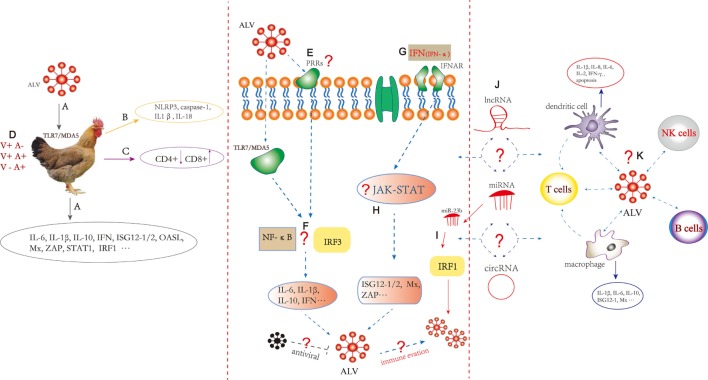
Figure 1
Figure 1
Innate and adaptive immune responses induced by Avian leukosis virus (ALV). (A) ALV infection in chickens may be recognized by TLR7 and melanoma differentiation-associated gene 5, followed by induction of innate immunity including differential expression of cytokine and interferon-stimulated genes (ISGs). (B) The expression of caspase-1 combined with adaptor NLRP3, IL-1β, and IL-18 increased in ALV-J-infected chick livers. (C) CD4+ T cell numbers decreased and CD8+ T cell numbers increased in the ALV-J-infected chicken spleen. (D) Infection with ALV results in three classical in vivo infection profiles including (1) V+A− (viremia, no neutralizing antibody); (2) V+A+ (viremia, with neutralizing antibody); and (3) V−A+ (no viremia, with neutralizing antibody). (E) The specific pathogen recognition receptors (PRRs) to recognize ALV pathogen-associated molecular patterns should be further studied. (F) ALV-A/B/J infection can increase chicken interferon regulatory factors 3 (IRF3) promoter activity in DF-1 cells. Transcription factor such as IRF3 and NF-κB responses to ALV should be further clarified. (G) DF-1 cells pretreated with recombinant chicken IFN-α can inhibit the replication of ALV-A/B/J. (H) Immune signaling pathway such as PRRs signaling pathway (toll-like receptor, RIG-I-like receptors, interferon-γ-inducible protein 16, and cyclic GMP-AMP synthase) and JAK-STAT signaling pathway responses to ALV should be clarified; the specific mechanism of the inflammatory response, particularly the role of inflammasomes in sensing ALV should be further studied. What immune evasion strategies were used by ALV? Which antiviral factors inhibit the production of ALV? (I) miR-23b promotes ALV-J replication by targeting IRF1. (J) What is the role of non-coding RNAs including miRNA, long non-coding RNA, and circular RNA in the regulation of innate and adaptive immunity induced by ALV? (K) ALV-J can infect chicken dendritic cells (DCs) during the early stages of differentiation and can trigger apoptosis. ALV-J inhibits the differentiation and maturation of DCs and alters cytokine expression that includes IL-1β, IL-8, and IFN-γ. Chicken macrophages are susceptible to ALV-J, and IL-1β, IL-6, ISG12-1, and Mx were altered. The interaction between ALV and macrophages, DCs, natural killer, B cells, CD4+, and CD8+ T cells needs to be further explored. The dotted line represents remaining processes not fully understood.

References

    1. Payne LN, Nair V. The long view: 40 years of Avian leukosis research. Avian Pathol (2012) 41:11–9. 10.1080/03079457.2011.646237 - DOI - PubMed
    1. Malhotra S, Justice JT, Lee N, Li Y, Zavala G, Ruano M, et al. Complete genome sequence of an American Avian leukosis virus subgroup J isolate that causes hemangiomas and myeloid leukosis. Genome Announc (2015) 3:e01586–14. 10.1128/genomeA.01586-14 - DOI - PMC - PubMed
    1. Pandiri AR, Gimeno IM, Mays JK, Reed WM, Fadly AM. Reversion to subgroup J Avian leukosis virus viremia in seroconverted adult meat-type chickens exposed to chronic stress by adrenocorticotrophin treatment. Avian Dis (2012) 56:578–82. 10.1637/9949-092611-ResNote.1 - DOI - PubMed
    1. Zeng X, Liu L, Hao R, Han C. Detection and molecular characterization of J subgroup Avian leukosis virus in wild ducks in China. PLoS One (2014) 9:e94980. 10.1371/journal.pone.0094980 - DOI - PMC - PubMed
    1. Li Y, Liu X, Liu H, Xu C, Liao Y, Wu X, et al. Isolation, identification, and phylogenetic analysis of two Avian leukosis virus subgroup J strains associated with hemangioma and myeloid leukosis. Vet Microbiol (2013) 166:356–64. 10.1016/j.vetmic.2013.06.007 - DOI - PubMed

LinkOut - more resources
