Review
. 2016 Nov;8(11):3452-3456.
doi: 10.21037/jtd.2016.11.32.

Update in the extraction of airway foreign bodies in adults

Affiliations
Review

Update in the extraction of airway foreign bodies in adults

Montserrat Blanco Ramos et al. J Thorac Dis. 2016 Nov.

Abstract

Foreign body (FB) aspiration into the airway is lees common in adults than children. Nevertheless its incidence does not decrease through time. We present clinical relevant aspects of airway FBs on the basis of a selective review of pertinent literature retrieved by a search in the PubMed database. The most common aspirated FBs by adults are organics, especially fragments of bones and seeds. Symptoms usually are cough, chocking and dyspnea. Right localization, especially bronchus intermedius and right lower lobe, is more frequent. Chest radiography can be normal in up to 20% of the cases and FBs can be detected in 26% of the patients. FBs can safely remove in the majority of patients under flexible bronchoscopy. Surgical treatment must be reserved for cases in which bronchoscope fails or there are irreversible bronchial or lung complications.

Keywords: Bronchoaspiration; fibrobronchoscopy; foreign body (FB); rigid bronchoscopy.


Conflict of interest statement

The authors have no conflicts of interest to declare.

Figures
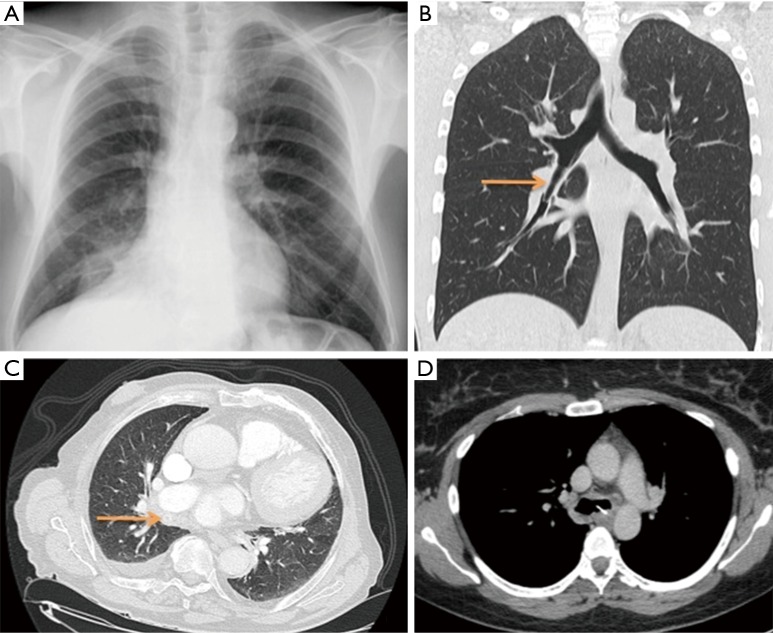
Figure 1
Figure 1
Radiological images showing complications and/or different radiopaque foreign bodies. (A) Posteroanterior chest radiograph. We can observe a consolidation in the medium lobe caused by chicken bone; (B) coronal image of CT. Arrow is showing a Bic cap lodged in the bronchus intermedius; (C) axial image of CT. Right pleural effusion and a cherry pit indicated by arrow; (D) axial image of CT. We can observe a deer bone lodged in left main bronchus. CT, computed tomography.
Figure 2
Figure 2
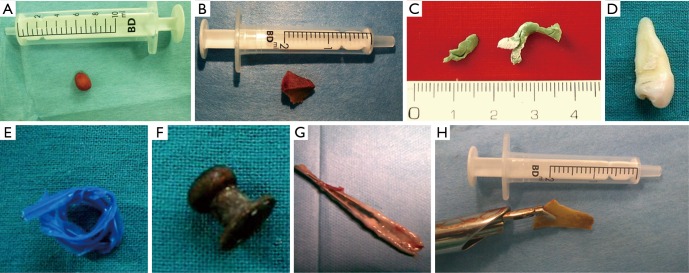
Different FBs removed by flexible or rigid bronchoscope. (A) Cherry pit from an older patient; (B) fragment of a pork bone; (C) bronchial mold made from synthetic material used to make a dental prosthesis; (D) a dental piece removed from a patient with craneoencephalic traumatism; (E) plastic device used to close some bags with manufactured products; (F) a rivet; (G) hair clip removed from a patient with tracheostomy; (H) deer bone lodged for two years in the airway. FB, foreign body.

References

    1. Yalçin S, Karnak I, Ciftci AO, et al. Foreign body ingestion in children: an analysis of pediatric surgical practice. Pediatr Surg Int 2007;23:755-61. 10.1007/s00383-007-1958-y - DOI - PubMed
    1. Zhijun C, Fugao Z, Niankai Z, et al. Therapeutic experience from 1428 patients with pediatric tracheobronchial foreign body. J Pediatr Surg 2008;43:718-21. 10.1016/j.jpedsurg.2007.10.010 - DOI - PubMed
    1. Salih AM, Alfaki M, Alam-Elhuda DM. Airway foreign bodies: A critical review for a common pediatric emergency. World J Emerg Med 2016;7:5-12. 10.5847/wjem.j.1920-8642.2016.01.001 - DOI - PMC - PubMed
    1. Lin L, Lv L, Wang Y, et al. The clinical features of foreign body aspiration into the lower airway in geriatric patients. Clin Interv Aging 2014;9:1613-8. - PMC - PubMed
    1. Debeljak A, Sorli J, Music E, et al. Bronchoscopic removal of foreign bodies in adults: experience with 62 patients from 1974-1998. Eur Respir J 1999;14:792-5. 10.1034/j.1399-3003.1999.14d11.x - DOI - PubMed

LinkOut - more resources