. 2016 Dec 21;6(3):265-280.
doi: 10.11138/mltj/2016.6.3.265. eCollection 2016 Jul-Sep.

Imaging of the hip: a systematic approach to the young adult hip

Affiliations

Imaging of the hip: a systematic approach to the young adult hip

Sara Muñoz Chiamil et al. Muscles Ligaments Tendons J. .

Abstract

Background: Great advances in knowledge and understanding of the biomechanics of the hip, both in arthroscopic procedures and imaging techniques, have expanded and improved the diagnosis of pathologies of the young adult hip. The anatomy of the hip joint is complex due to its morphology and orientation. The inter-pretation of the images requires deep knowledge of the osseous and soft tissue anatomy: muscles, tendons, ligaments, vessels and nerves. There are multiple imaging tools. Diagnostic techniques have different utilities and often are complementary.

Methods: In this article the various diagnostic imaging techniques for evaluation of hip pathologies are discussed, their indications and usefulness, with emphasis on those resolved arthroscopically.

Conclusion: Young adult hip disorders are increasingly diagnosed and treated as arthroscopic procedures improved. Radiology is a fundamental contribution in the diagnostic process. Plain radiography (X-ray) is always the initial examination.

Level of evidence: V.

Keywords: MRI; femoro-acetabular impingement; hip X-ray; hip arthroscopy; hip dysplasia; hip imaging.


Figures

Figure 1
Figure 1
AP pelvic radiograph quality control: symmetric related to femoral heads (red line), obturator foramina (blue line), ischial spines (brown line), greater and lesser trochanter (green line).
Figure 2
Figure 2
Lordosis correction. Adecuate pelvis inclination: distance between the superior aspect of the pubic symphysis and the sacrococcygeal junction must be approximately 3 cms in men and 4 cms in women.
Figure 3
Figure 3
Fat pads of the hip, AP right hip radiograph: Gluteal fat pad (white arrow), Iliopsoas fat pad (blue arrow), Obturator fat pad (black arrow).
Figure 4
Figure 4
Osseous anatomy: Iliopubic line (blue), Ilioischial line (red), Acetabular floor (white).
Figure 5 a, b
Figure 5 a, b
a) Coxa profunda; b) Acetabular protrusion. Ilioischial line (red), acetabular floor (white), femoral head (green).
Figure 6
Figure 6
Teardrop (white arrow).
Figure 7 a–d
Figure 7 a–d
Femoral acetabular joint space (white arrow): a) AP right hip radiograph with normal superior space; b) true axial or cross-table right hip radiograph with normal posterior space; c) narrow superior space in osteoarthritis; d) narrow posterior space.
Figure 8
Figure 8
Acetabular coverage. Lateral center-edge angle of Wiberg: AP pelvic view. Angle between a line through the center of the femoral head, perpendicular to the transverse axis of the pelvis, and a second line through the center of the femoral head, passing through the most superolateral point of the sclerotic weight-bearing zone of the acetabulum (acetabular sourcil). Values of <20° indicate inadequate lateral coverage of the femoral head.
Figure 9
Figure 9
Acetabular coverage. Anterior center-edge angle of Lequesne: False profile view. Angle between a vertical line through the center of the femoral head, and a second line from the center of the femoral head, passing through the most anterior point of the acetabular sourcil. Values of <20° indicate inadequate anterior coverage of the femoral head.
Figure 10
Figure 10
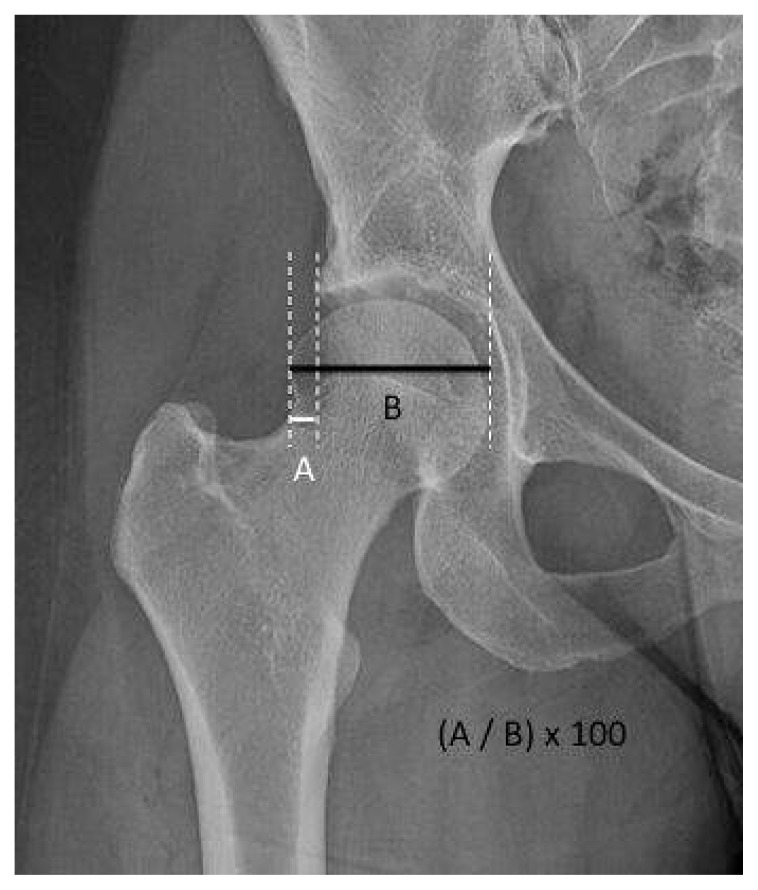
Acetabular coverage. Femoral head extrusion index: AP hip view. The percentage calculated by dividing the horizontal distance of the part of the femoral head that is lateral to the edge of acetabulum (A) by the total horizontal width of femoral head (B) and multiplied by 100.
Figure 11
Figure 11
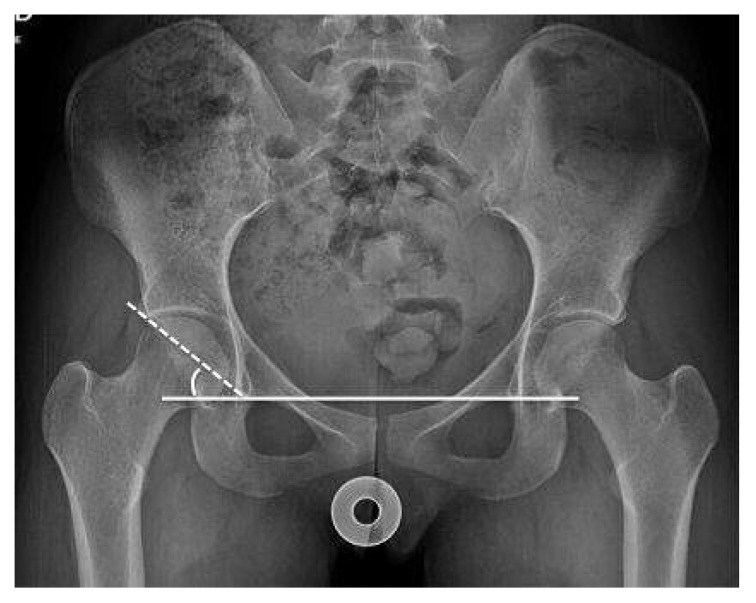
Acetabular inclination. Sharp’s angle: AP pelvic view. Angle between a line horizontal to the inferior aspect of both pelvic teardrops, and a line from the inferior aspect of the teardrop passing through the most lateral point of the acetabular sourcil.
Figure 12
Figure 12
Acetabular inclination. Tönnis angle: AP hip view. Angle between the horizontal line, and a second line connecting the inferior and lateral aspects of the acetabular sourcil.
Figure 13 a–c
Figure 13 a–c
Borderline dysplastic hip; a) AP pelvic view and b) AP hip view: greater obliquity of the acetabular roof, subtle loss of sphericity of the femoral head, lateral undercoverage, shortening of the femoral neck in b. c) Hip MRI coronal proton density with fat saturation (PD FS): also shows compensatory prominent labrum and capsule.
Figure 14 a, b
Figure 14 a, b
Acetabular retroversion; a) crossover sign, acetabular anterior wall (white line), acetabular posterior wall (dashed line); b) posterior wall sign, center of femoral head (dot) acetabular posterior wall (dashed line).
Figure 15 a, b
Figure 15 a, b
Loss of the anterior femoral offset; a) cross-table view, femoral offset (dashed line), bony prominence or bump (arrow); b) Hip MRI axial oblique PD FS. Alpha angle (red), bump (arrow).
Figure 16
Figure 16
Pistol-grip deformity.
Figure 17 a, b
Figure 17 a, b
Fibrocystic changes in the femoral offset (arrow).
Figure 18 a, b
Figure 18 a, b
a) Coxa valga; b) Coxa vara.
Figure 19 a–d
Figure 19 a–d
Osteoarthritis a, b) AP hip view; c,d) hip MRI coronal and sagittal PD FS of the same patient than b.
Figure 20 a, b
Figure 20 a, b
Hip ultrasound; a) joint effusion and sinovitis in anterior femoro acetabular articular recess; b) needle injection under ultrasound guidance in anterior femoro acetabular articular recess.
Figure 21 a–c
Figure 21 a–c
Osteoid osteoma in the acetabular floor (red arrow) in a 9-year-old girl with normal radiographs and left hip pain; a, b) pelvis CT axial and coronal views show the small bony lesion; c) hip MRI coronal PD FS and axial T1 FS with intravenous gadolinium, also show marrow edema and hyperemia, synovitis and periostitis.
Figure 22 a–c
Figure 22 a–c
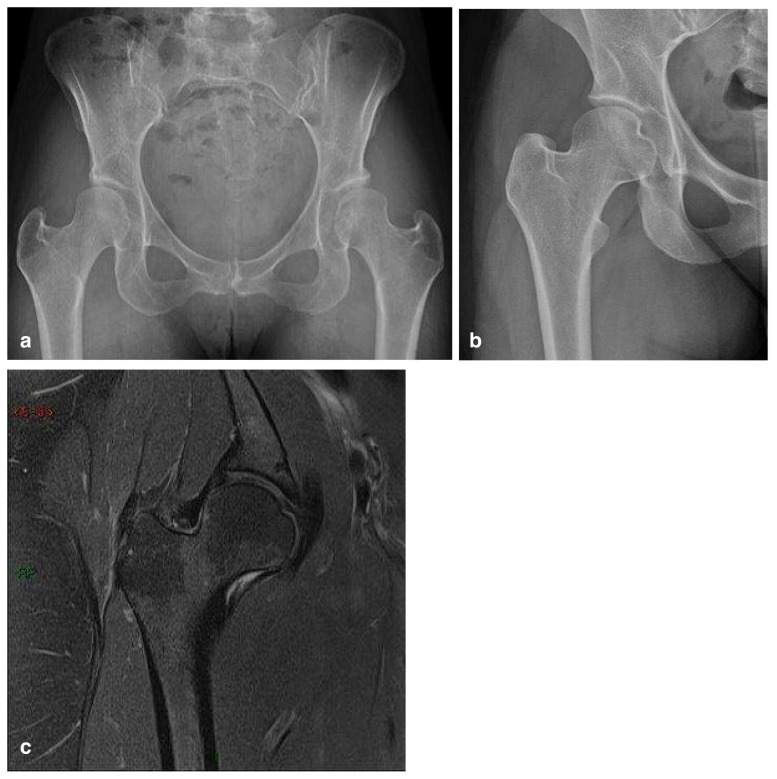
Osteonecrosis of the femoral head; a) hip AP view; b) hip MRI coronal T1; c) hip MRI coronal PD FS.
Figure 23 a, b
Figure 23 a, b
Painful greater trochanter syndrome; a, b) hip MRI coronal and axial PD FS, bursitis (red arrow), gluteus mimimus tendinopathy (white arrow).
Figure 24
Figure 24
MR arthrography of the hip. Axial PD FS with intraarticular saline solution as contrast medium.
Figure 25 a, b
Figure 25 a, b
MR arthrography of the hip; a) sagittal PD FS, labral tear (red arrow); b) axial PD FS, labral tear (red arrow), perilabral cyst (white arrow).
Figure 26
Figure 26
MR arthrography of the hip. Sagittal PD FS, full thickness cartilage lesion filled with fluid (red arrow), perilabral cyst (white arrow).
Figure 27
Figure 27
dGEMRIC T1 map of femoroacetabular cartilage.
Figure 28
Figure 28
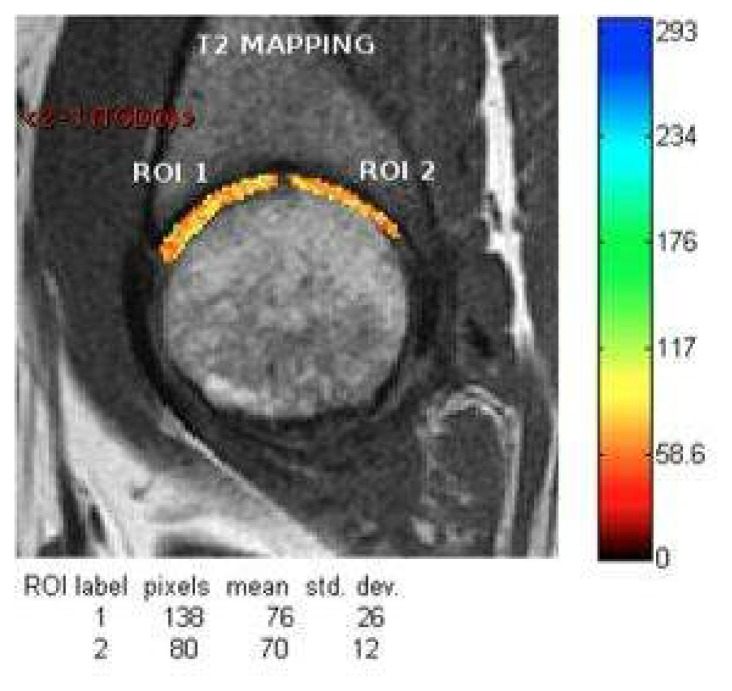
T2 map of femoroacetabular cartilage.

References

    1. Clohisy JC-H. A systematic approach to the plain radiographic evaluation of the young adult hip. The Journal Bone and Joint Surgery Am. 2008;90:47–66. - PMC - PubMed
    1. Karrasch C, Lynch S. Practical Approach to Hip Pain. Medical Clinics of North America. 2014;98:737–754. - PubMed
    1. Karantanas A. Imaging of the Hip. Journal Rentgenologiya i Radiologya. 2012;51:220.
    1. Padulo J, Oliva F, Frizziero A, Maffulli N. Muscles, Ligaments and Tendons Journal. Basic principles and recommendations in clinical and field science research: 2016 Update. MLTJ. 2016;6(1):1–5. - PMC - PubMed
    1. Dimmick S, Stevens KJ, Brazier D, Anderson SE. Femoroacetabular Impingement. Radiologic Clinics. 2013;51:337–352. - PubMed

LinkOut - more resources