Review
. 2017 Jan 5;8(1):15.
doi: 10.3390/genes8010015.

Quorum Sensing Regulation of Competence and Bacteriocins in Streptococcus pneumoniae and mutans

Affiliations
Review

Quorum Sensing Regulation of Competence and Bacteriocins in Streptococcus pneumoniae and mutans

Erin Shanker et al. Genes (Basel). .

Abstract

The human pathogens Streptococcus pneumoniae and Streptococcus mutans have both evolved complex quorum sensing (QS) systems that regulate the production of bacteriocins and the entry into the competent state, a requirement for natural transformation. Natural transformation provides bacteria with a mechanism to repair damaged genes or as a source of new advantageous traits. In S. pneumoniae, the competence pathway is controlled by the two-component signal transduction pathway ComCDE, which directly regulates SigX, the alternative sigma factor required for the initiation into competence. Over the past two decades, effectors of cellular killing (i.e., fratricides) have been recognized as important targets of the pneumococcal competence QS pathway. Recently, direct interactions between the ComCDE and the paralogous BlpRH pathway, regulating bacteriocin production, were identified, further strengthening the interconnections between these two QS systems. Interestingly, a similar theme is being revealed in S. mutans, the primary etiological agent of dental caries. This review compares the relationship between the bacteriocin and the competence QS pathways in both S. pneumoniae and S. mutans, and hopes to provide clues to regulatory pathways across the genus Streptococcus as a potential tool to efficiently investigate putative competence pathways in nontransformable streptococci.

Keywords: bacteriocin; competence; fratricide; gene regulation; quorum sensing; transformation.


Conflict of interest statement

The authors declare no conflict of interest or any role of the funding sponsors in the composition of this manuscript. The funding sponsors had no role in the design of the study; in the collection, analyses, or interpretation of data; in the writing of the manuscript, and in the decision to publish the results.

Figures
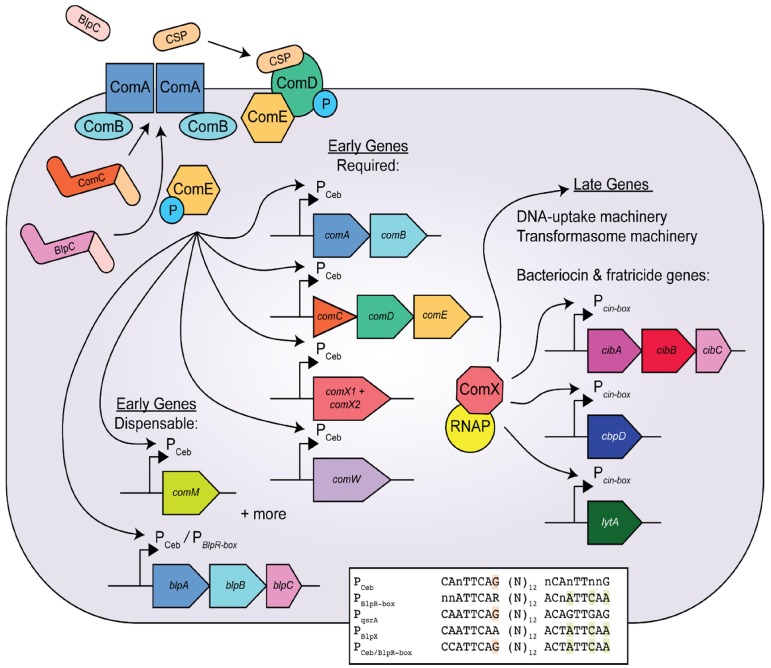
Figure 1
Figure 1
The ComABCDE quorum sensing (QS) pathway of Streptococcus pneumoniae. The two phases of competence development are controlled by ComE, for induction of early genes, and by ComX, for induction of late genes. Early genes required for competence include comE, comAB, comCDE, comX1/comX2, and comW. Dispensable early genes include comM as well as blpABC, and blpXYZ [20]. Phosphorylated ComE binds at PCeb, a promoter site containing a ComE binding site (Cbe) [14,16,21]. Wholey et al. [33] recently demonstrated dual regulation of the blpABC operon either by ComE or BlpR in S. pneumoniae (denoted by PCeb/PBlpR-box) [10]. The alignment of the upstream sequence of ComE- and BlpR-regulated genes are shown in the figure inset. The consensus sequences for PCeb- and PBlpR-box-direct-repeat binding motifs in the S. pneumoniae TIGR4 genome are compared with the upstream sequences of qsrA (locus ID: SP_1717), blpX (locus ID: SP_0544) and the direct-repeat hybrid motif (PCeb/BlpR-box) located upstream of blpA (locus ID: SP_0530). Highlighted in orange is the guanine base pair that is conserved in ComE-regulated promoters, permitting ComE to regulate expression of the blpABC [33]. Highlighted in green are base pairs conserved in the proximal motif of BlpR-regulated promoters. This sequence alignment has been adapted from Wholey et al. [33]. The late genes are directly regulated by the ComX/RNAP (RNA polymerase) complex and consist of genes required for DNA uptake, homologous recombination as well as the lytic genes, cibABC, cbpD, and lytA, encoding effectors of fratricide [20]. The ComAB complex exports and processes ComC into the mature peptide pheromone CSP [10]. Recently, ComAB was demonstrated to export and process BlpC. This connection between the bacteriocin and competence QS system pathways clarifies how BlpC activity is detected in strains lacking a functional BlpC exporter (BlpA) [33,34].
Figure 2
Figure 2
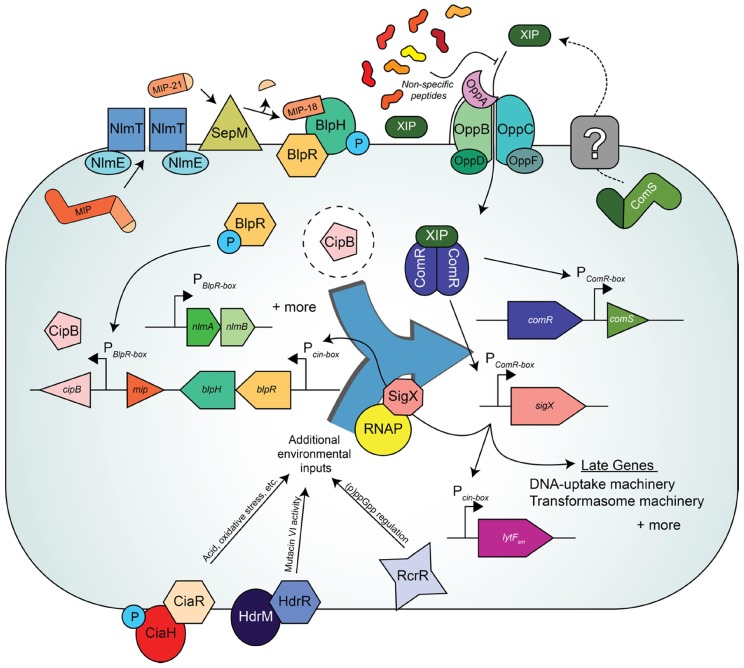
The ComRS quorum sensing (QS) pathway controls competence, and the BlpRH QS system regulates bacteriocin production in S. mutans strain UA159. The ComS pre-peptide is exported and processed via an unknown mechanism (denoted as a dotted line and gray box) into XIP. In a chemically defined, peptide-poor medium (CDM) XIP is re-imported via oligopeptide permease (Opp) and binds ComR. The ComR/XIP complex binds upstream of comS and sigX at PComR-box sites [31]. The alternative sigma factor, SigX, facilitates RNA polymerase (RNAP) binding at Pcin-box sites [64]. Genes regulated by SigX include the DNA-uptake and transformasome machinery as well as the murein hydrolase, LytFsm, among others [59,68]. Non-specific peptides present in high concentrations in peptide-rich media are thought to prevent intracellular transport of XIP via Opp [69]. Recently, a link between the bacteriocin and competence pathways was determined to be mediated by SigX at a Pcin-box site upstream of blpRH (formerly referred to as comDE, see Table 1). The BlpRH QS pathway pheromone, MIP, is exported and processed by the ABC transporter complex NlmTE into the 21 amino-acid long precursor peptide, MIP-21 [27]. Cleavage of MIP-21 by the protease SepM results in fully active MIP-18 [11]. MIP-18 is thought to bind to BlpH, resulting in activation and phosphorylation of BlpR similarly to CSP binding and activation of ComDE in S. pneumoniae [13]. BlpR~P binds at PBlpR-box sites upstream of bacteriocin loci such as cipB and nlmAB, among others [70]. Although the mechanism is unknown (represented by the dotted circle surrounding CipB), the activity of CipB is required for the indirect induction of SigX observed when cells are grown in peptide-rich media and treated with MIP [22,25,71]. Multiple other regulatory pathways are observed to feed into the ComRS/BlpRH QS networks, such as the CiaHR, HdrRM, and the RcrRPQ systems [72,73,74,75,76,77]. These additional inputs along with possible contribution through the BlpRH-regulated QS pathway (i.e., via cipB expression [71]) may help S. mutans to integrate environmental cues into the competence signaling cascade, allowing for fine tune control of natural transformation (depicted by the blue block arrow).

References

    1. Griffith F. The Significance of Pneumococcal Types. J. Hyg. (Lond) 1928;27:113–159. doi: 10.1017/S0022172400031879. - DOI - PMC - PubMed
    1. Papenfort K., Bassler B.L. Quorum sensing signal-response systems in Gram-negative bacteria. Nat. Rev. Microbiol. 2016;14:576–588. doi: 10.1038/nrmicro.2016.89. - DOI - PMC - PubMed
    1. Monnet V., Juillard V., Gardan R. Peptide conversations in Gram-positive bacteria. Crit. Rev. Microbiol. 2014;42:339–351. doi: 10.3109/1040841X.2014.948804. - DOI - PubMed
    1. Johnston C., Martin B., Fichant G., Polard P., Claverys J.P. Bacterial transformation: distribution, shared mechanisms and divergent control. Nat. Rev. Microbiol. 2014;12:181–196. doi: 10.1038/nrmicro3199. - DOI - PubMed
    1. Perez-Pascual D., Monnet V., Gardan R. Bacterial Cell-Cell Communication in the Host via RRNPP Peptide-Binding Regulators. Front. Microbiol. 2016;7:706. doi: 10.3389/fmicb.2016.00706. - DOI - PMC - PubMed

LinkOut - more resources