


Effect of Film-Forming Alginate/Chitosan Polyelectrolyte Complex on the Storage Quality of Pork
- PMID: 28067840
- PMCID: PMC6155891
- DOI: 10.3390/molecules22010098
Effect of Film-Forming Alginate/Chitosan Polyelectrolyte Complex on the Storage Quality of Pork
Abstract
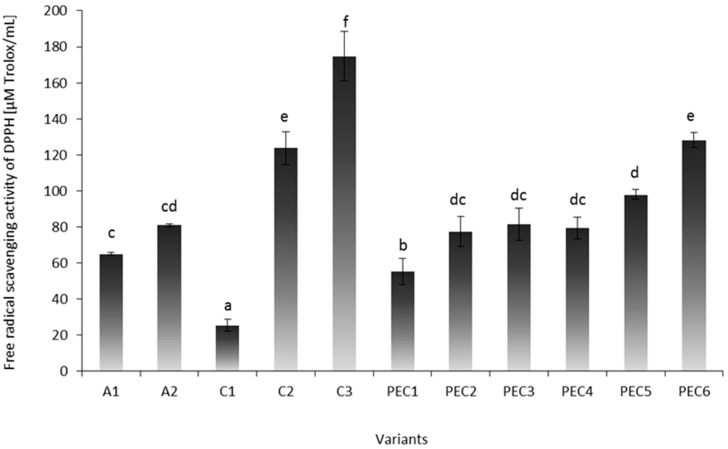
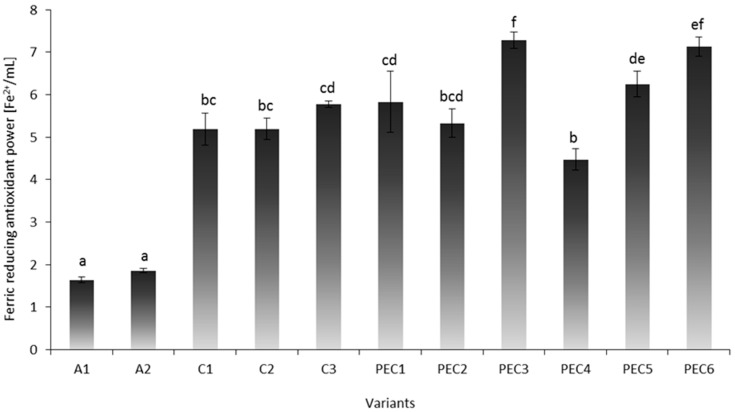
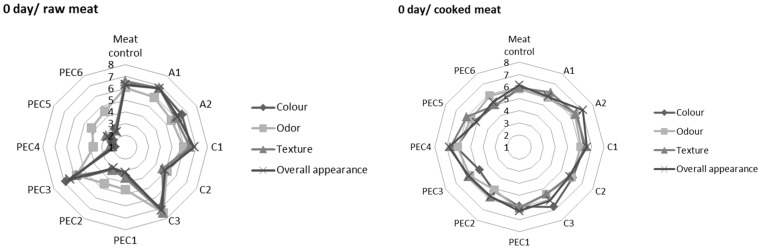
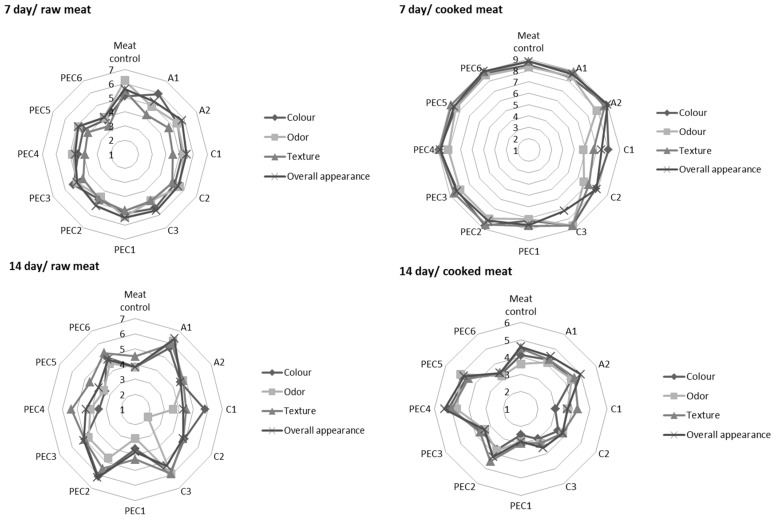
Meat is one of the most challenging food products in the context of maintaining quality and safety. The aim of this work was to improve the quality of raw/cooked meat by coating it with sodium alginate (A), chitosan (C), and sodium alginate-chitosan polyelectrolyte complex (PEC) hydrosols. Antioxidant properties of A, C, and PEC hydrosols were determined. Subsequently, total antioxidant capacity (TAC), sensory quality of raw/cooked pork coated with experimental hydrosols, and antimicrobial efficiency of those hydrosols on the surface microbiota were analysed. Application analyses of hydrosol were performed during 0, 7, and 14 days of refrigerated storage in MAP (modified atmosphere packaging). Ferric reducing antioxidant power (FRAP) and (2,2-diphenyll-picrylhydrazyl (DPPH) analysis confirmed the antioxidant properties of A, C, and PEC. Sample C (1.0%) was characterized by the highest DPPH value (174.67 μM Trolox/mL) of all variants. PEC samples consisted of A 0.3%/C 1.0% and A 0.6%/C 1.0% were characterized by the greatest FRAP value (~7.21 μM Fe2+/mL) of all variants. TAC losses caused by thermal treatment of meat were reduced by 45% by coating meat with experimental hydrosols. Application of PEC on the meat surface resulted in reducing the total number of micro-organisms, psychrotrophs, and lactic acid bacteria by about 61%, and yeast and molds by about 45% compared to control after a two-week storage.
Keywords: alginate; antimicrobial; antioxidant properties; chitosan; coating; meat quality; polyelectrolyte complex.
Conflict of interest statement
The authors declare no conflict of interest.
Figures
References
-
- Dai Y., Lu Y., Wu W., Lu X., Han Z., Liu Y., Li X., Dai R. Changes in oxidation, color and texture deteriorations during refrigerated storage of ohmically and water bath-cooked pork meat. Innov. Food Sci. Emerg. Technol. 2014;26:341–346. doi: 10.1016/j.ifset.2014.06.009. - DOI
-
- Sabow A.B., Sazili A.Q., Zulkifli I., Goh Y.M., Ab Kadir M.Z., Abdulla N.R., Nakyinsige K., Kaka U., Adeyemi K.D. A comparison of bleeding efficiency, microbiological quality and lipid oxidation in goats subjected to conscious halal slaughter and slaughter following minimal anesthesia. Meat Sci. 2015;104:78–84. - PubMed
-
- Fung D.Y. Microbial hazards in food: Food-borne infections and intoxications. In: Toldra F., editor. Handbook of Meat Processing. Blackwell Publishing; Hoboken, NJ, USA: 2010. pp. 481–500.
MeSH terms
Substances
LinkOut - more resources
Full Text Sources
Other Literature Sources
Medical
Miscellaneous
