. 2017 Jan 9:8:13671.
doi: 10.1038/ncomms13671.

Germline BRCA2 mutations drive prostate cancers with distinct evolutionary trajectories

Affiliations

Germline BRCA2 mutations drive prostate cancers with distinct evolutionary trajectories

Renea A Taylor et al. Nat Commun. .

Abstract

Germline mutations in the BRCA2 tumour suppressor are associated with both an increased lifetime risk of developing prostate cancer (PCa) and increased risk of aggressive disease. To understand this aggression, here we profile the genomes and methylomes of localized PCa from 14 carriers of deleterious germline BRCA2 mutations (BRCA2-mutant PCa). We show that BRCA2-mutant PCa harbour increased genomic instability and a mutational profile that more closely resembles metastastic than localized disease. BRCA2-mutant PCa shows genomic and epigenomic dysregulation of the MED12L/MED12 axis, which is frequently dysregulated in metastatic castration-resistant prostate cancer (mCRPC). This dysregulation is enriched in BRCA2-mutant PCa harbouring intraductal carcinoma (IDC). Microdissection and sequencing of IDC and juxtaposed adjacent non-IDC invasive carcinoma in 10 patients demonstrates a common ancestor to both histopathologies. Overall we show that localized castration-sensitive BRCA2-mutant tumours are uniquely aggressive, due to de novo aberration in genes usually associated with metastatic disease, justifying aggressive initial treatment.


Conflict of interest statement

D.C. is an employee of TissuPath. The remaining authors declare no competing financial interests.

Figures
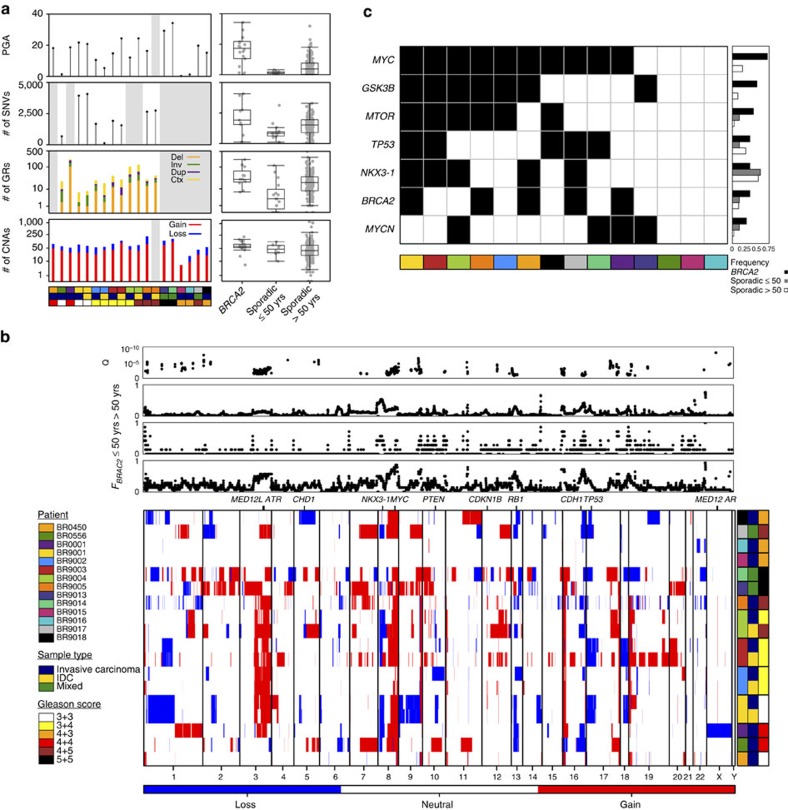
Figure 1
Figure 1. The genomics of BRCA2-mutant prostate cancer.
(a) Percent genome altered (PGA) and number of SNVs, GRs and CNAs per tumour sample is shown. GRs are stratified by type: orange—deletions (del), green—inversions (inv), purple—duplications (dup), yellow—translocations (ctx). Y axis values for CNAs and GRs are in log10-scale. Box plots compare the number of events observed in BRCA2-mutant specimens versus sporadic PCa samples split into two groups by age. Y axis values are the same as in the adjacent bar plot. Whiskers indicate the maximum and minimum values, the box outline indicates the third and first quartile and the bar indicates the mean. Multiple foci from the same patient are indicated in the same patient covariate colour, where sample type colour indicates IC in blue, IDC in yellow and a mix of IDC and IC in green. Unavailable data is indicated by grey background. (b) Per gene copy-number profiles of 18 prostate tumour specimens from 14 germline BRCA2-mutation carriers, including 4 patients with multifocal disease. Red indicates gain; blue indicates loss. Rows represent specimens and columns represent genes. Top plots show frequency of each gene per group (BRCA2, n=14; sporadic PCa arising in individuals 50 years of age or younger, n=7; sporadic PCa arising in individuals older than 50 years of age, n=276) and the q-value shown is from a two-sided proportion test comparing BRCA2-mutant and all sporadic PCa samples. Genes are ordered by genomic co-ordinates per chromosome. Multiple foci from the same patient are indicated in the same patient covariate colour, where sample type colour indicates IC in blue, IDC in yellow and a mix of IDC and IC in green. (c) Key prostate cancer driver genes that are mutated at elevated proportions in BRCA2-mutant PCa relative to sporadic PCa. Columns are patients, rows are genes, a black square indicates a CNA. Bar plots to the right show the frequency of each gene in the three groups (BRCA2, n=14; sporadic PCa arising in individuals 50 years of age or younger, n=7; sporadic PCa arising in individuals older than 50 years of age, n=276).
Figure 2
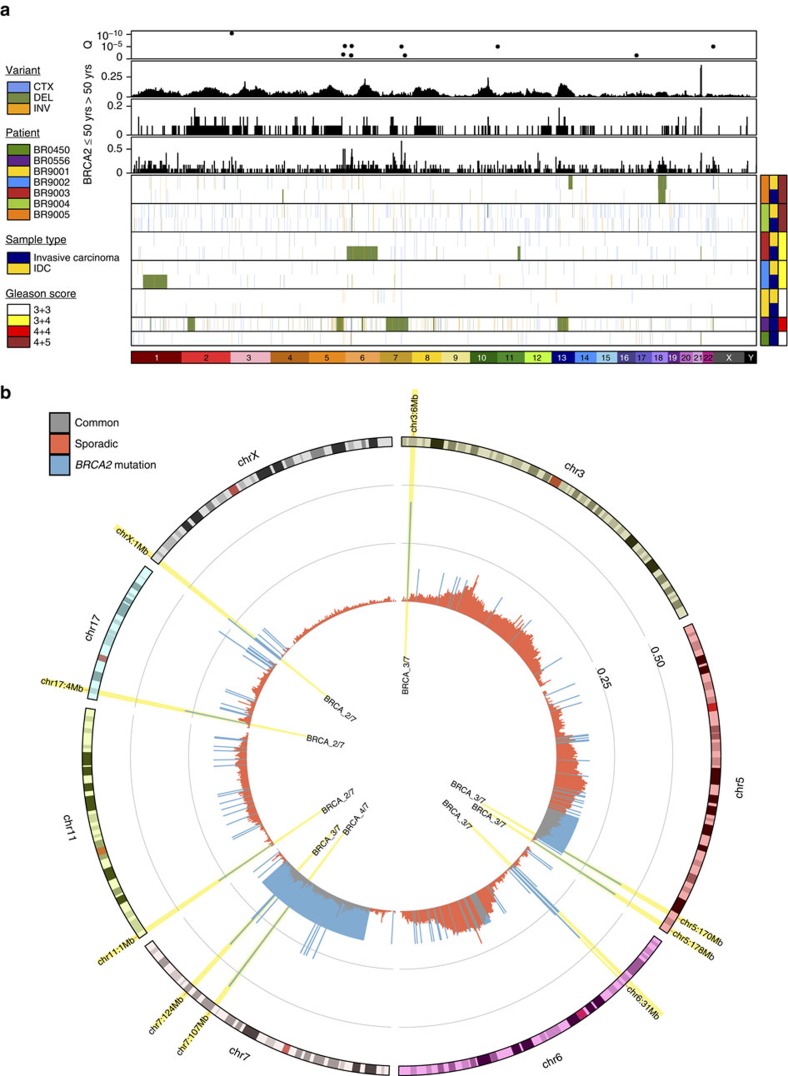
Figure 2. Genomic rearrangements in BRCA2-mutant prostate cancer.
(a) Survey of genome-wide somatic genomic rearrangements (GRs) in BRCA2-mutant tumour PCa from seven patients. CTX—inter-chromosomal translocation; DEL—deletion; INV—inversion. Multiple foci from the same patient are indicated in the same patient covariate colour, where sample type colour indicates microdissected invasive carcinoma (IC) in blue and intraductal carcinoma of the prostate (IDC) in yellow. Top bar plots show the frequency of specimens in BRCA2-mutant PCa (bottom) and sporadic PCa from men 50 years of age or younger (middle) or sporadic PCa from men older than 50 years of age (top). Scatterplot at top indicates FDR-corrected P values of a two-sided proportion test comparing frequency of GRs observed in BRCA2-mutant versus sporadic PCa. (b) A circos plot showing the proportions of BRCA2-mutant (blue) and sporadic PCa (red) with breakpoints in each mega-basepair bin. Bins with significantly different proportions between BRCA2-mutant and sporadic PCa (FDR-correct proportions test) are highlighted in yellow, and have the number of BRCA2-mutant samples indicated. Only chromosomes with at least one differentially recurrent GR are shown.
Figure 3
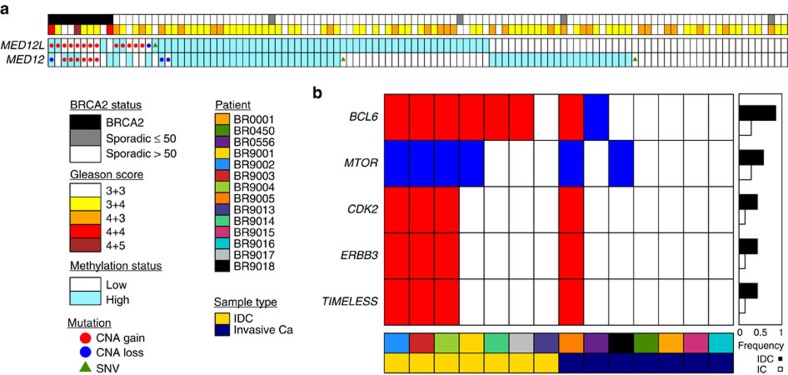
Figure 3. BRCA2-mutant PCa harbours multiple hallmarks of aggressive disease.
(a) CNA, SNV and methylation profiles for MED12L and MED12. Patients are sorted based on MED12L CNA, methylation and SNV status. β-values are median dichotomized, as reflected by the background shading of each cell. The covariate bar at the top of the graph indicates BRCA2 status and Gleason score. (b) Multiple genes show differential rates of CNAs in tumours harbouring IDC and those not. Rows are genes, columns are samples. Red indicates copy-number gain; blue indicates copy-number loss; white indicates neutral copy-number status. The barplot to the right shows the differential frequency of mutation between IDC and IC components in BRCA2-mutant PCa.
Figure 4
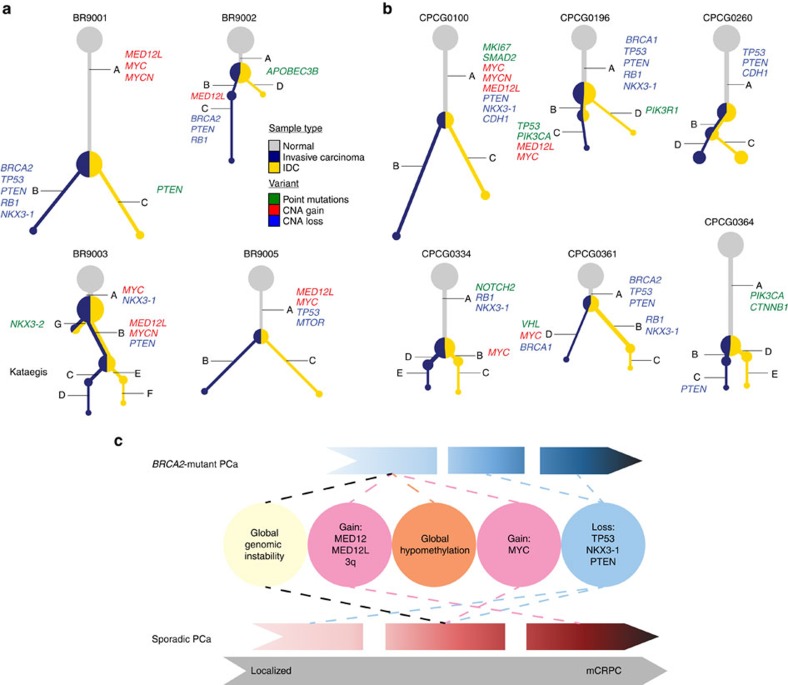
Figure 4. Evolutionary trajectory of BRCA2-mutant and sporadic PCa harbouring IDC.
(a) Subclonal reconstruction of four BRCA2-mutant PCa from microdissected IDC and IC components using CNA and SNV data. (b) Reconstructions of six sporadic PCa with microdissected IDC and IC components using CNA and SNV data. Each tree gives the inferred phylogeny for a single patient. The gray node is the germline. Blue nodes are present in the IC specimen, gold nodes in the IDC specimen, and the relative proportions of each reflect their relative cellular prevalence. Node size reflects the sum of the cellular prevalence of the IDC and IC components. A set of key mutations that occur on each branch are annotated, and the length of the branch is proportional to the number of SNVs that accumulated on it. (c) Early in the development of BRCA2-Mutant PCa, the disease is characterized by amplifications in 3q, MED12, MED12L and MYC, global genomic instability, a global hypomethylation profile and presents as a more aggressive disease. Tumour suppressors appear to be lost early in sporadic PCa, leading to subsequent development of global genome instability, and increased amplifications as the disease advances.

Comment in

References

    1. Castro E. et al. Effect of BRCA mutations on metastatic relapse and cause-specific survival after radical treatment for localised prostate cancer. Eur. Urol. 68, 186–193 (2015). - PubMed
    1. Willems A. J. et al. Loss of heterozygosity at the BRCA2 locus detected by multiplex ligation-dependent probe amplification is common in prostate cancers from men with a germline BRCA2 mutation. Clin. Cancer Res. 14, 2953–2961 (2008). - PubMed
    1. Akbari M. R. et al. The impact of a BRCA2 mutation on mortality from screen-detected prostate cancer. Br. J. Cancer 111, 1238–1240 (2014). - PMC - PubMed
    1. Castro E. et al. Germline BRCA mutations are associated with higher risk of nodal involvement, distant metastasis, and poor survival outcomes in prostate cancer. J. Clin. Oncol. 31, 1748–1757 (2013). - PMC - PubMed
    1. Risbridger G. P. et al. Patient-derived xenografts reveal that intraductal carcinoma of the prostate is a prominent pathology in BRCA2 mutation carriers with prostate cancer and correlates with poor prognosis. Eur. Urol. 67, 496–503 (2015). - PubMed

Publication types

MeSH terms