


Effectiveness of a serological tool to predict malaria transmission intensity in an elimination setting
- PMID: 28068925
- PMCID: PMC5223541
- DOI: 10.1186/s12879-016-2164-0
Effectiveness of a serological tool to predict malaria transmission intensity in an elimination setting
Abstract
Background: Sri Lanka achieved the WHO certificate as a malaria free country in September 2016, thus monitoring of malaria transmission using sensitive and effective tools is an important need. Use of age-specific antibody prevalence as a serological tool to predict transmission intensity is proven to be a cost effective and reliable method under elimination settings. This paper discusses the correlation of four anti-malarial antibodies against vivax and falciparum malaria with the declining transmission intensities in two previously high malaria endemic districts i.e. Kurunegala and Moneragala of Sri Lanka.
Methods: Sera was collected from 1,186 individuals from the two districts and were subjected to standard ELISA together with control sera from non-immune individuals to obtain Optical Density (OD) values for four anti-malarial antibodies i.e. anti-MSP1 and anti-AMA1 for both Plasmodium vivax and Plasmodium falciparum. The sero-positive samples were determined as mean OD + 3SD of the negative controls. The sero-prevalence was analyzed against the demographic characteristics of the population. A simple reversible catalytic model was fitted into sero-prevalence data to predict the sero-conversion and sero-reversion rates.
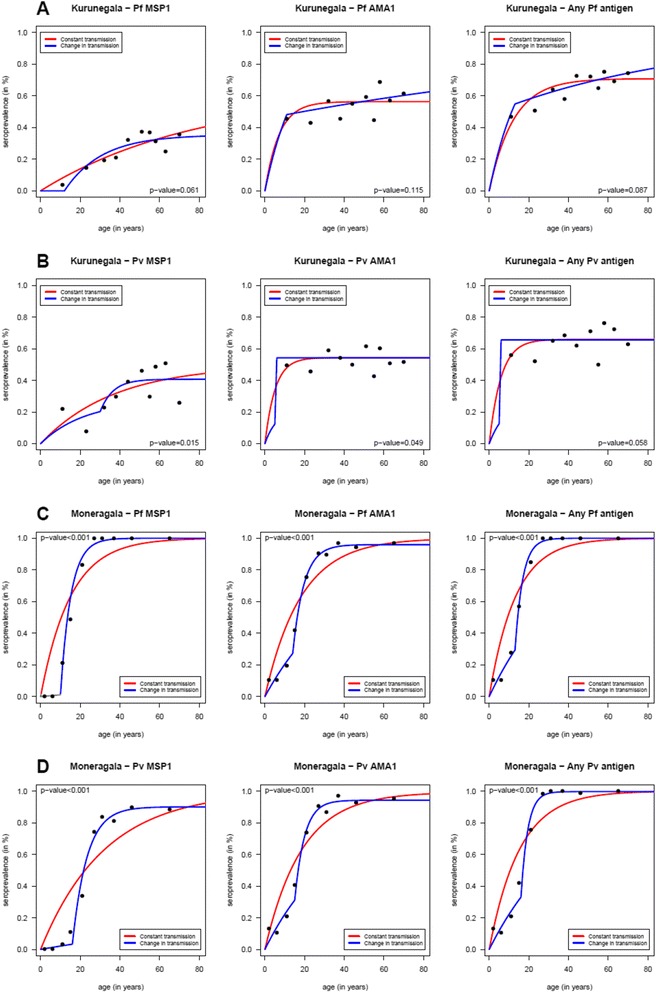
Results: Over 60% of the population was sero-positive for one or more antibodies except young children (<10 years). The sero-prevalence was zero in young children and very low in young adults when compared to the older age groups. The model developed for falciparum malaria that assumed the presence of a change in transmission was not significant in the Kurunegala district although significant reduction in transmission was observed when the model was used for P. vivax antibody data in that district. In Moneragala district however, all the serological markers indicated a change in transmission that has occurred approximately 15 years ago.
Conclusions: Assessment of MSP1 and AMA1 anti-malarial antibodies of P. vivax and P. falciparum proved to be useful indicators in predicting transmission under elimination settings as prevailed in Sri Lanka. The sero-conversion rates for the two districts studied are shown to be very low or zero indicating the absence of active and/or hidden transmission confirming a "true" state of elimination at least, in the two study districts in Sri Lanka.
Keywords: Anti-malarial antibodies; ELISA; Reversible catalytic model; Sero-positivity; Sri Lanka.
Figures
References
-
- World Health Organization. World Malaria Report. Geneva, Switzerland. 2013. http://www.who.int/malaria/publications/world_malaria_report_2013/wmr201.... Accessed Dec 2015.
MeSH terms
Substances
LinkOut - more resources
Full Text Sources
Other Literature Sources
