


Long-lasting insecticidal net (LLIN) ownership, use and cost of implementation after a mass distribution campaign in Kasaï Occidental Province, Democratic Republic of Congo
- PMID: 28068989
- PMCID: PMC5223346
- DOI: 10.1186/s12936-016-1671-1
Long-lasting insecticidal net (LLIN) ownership, use and cost of implementation after a mass distribution campaign in Kasaï Occidental Province, Democratic Republic of Congo
Abstract
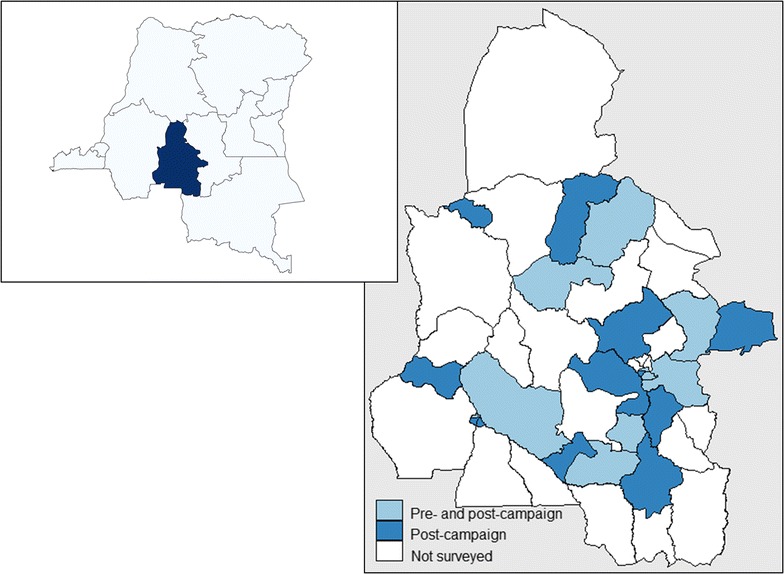
Background: Long-lasting insecticidal nets (LLIN) are a highly effective means for preventing malaria infection and reducing associated morbidity and mortality. Mass free distribution campaigns have been shown to rapidly increase LLIN ownership and use. Around 3.5 million LLINs were distributed free of charge in the Kasaï Occidental Province in the Democratic Republic of Congo (DRC) in September-October 2014, using two different approaches, a fixed delivery strategy and a door-to-door strategy including hang-up activities.
Methods: Repeated community-based cross-sectional surveys were conducted 2 months before and six months after the mass distribution. Descriptive statistics were used to measure changes in key malaria household indicators. LLIN ownership and use were compared between delivery strategies. Univariate and multivariate logistic regression analyses were used to identify factors associated with LLIN use before and after the mass distribution. A comparative financial cost analysis between the fixed delivery and door-to-door distribution strategies was carried out from the provider's perspective.
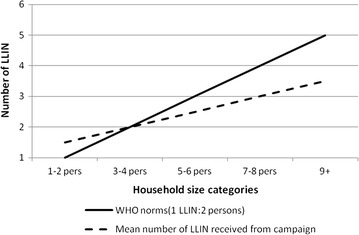
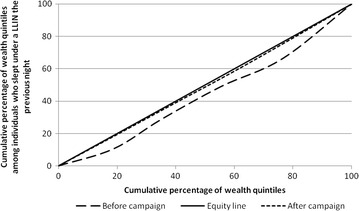
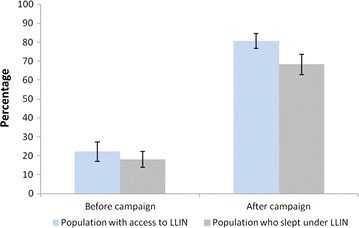
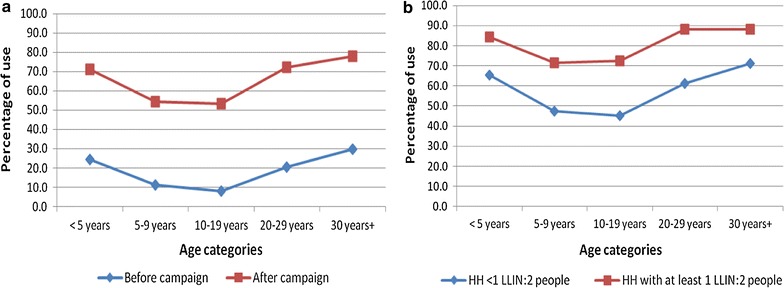
Results: Household ownership of at least one LLIN increased from 39.4% pre-campaign to 91.4% post-campaign and LLIN universal coverage, measured as the proportion of households with at least one LLIN for every two people increased from 4.1 to 41.1%. Population access to LLIN within the household increased from 22.2 to 80.7%, while overall LLIN use increased from 18.0 to 68.3%. Higher LLIN ownership was achieved with the fixed delivery strategy compared with the door-to-door (92.5% [95% CI 90.2-94.4%] versus 85.2% [95% CI 78.5-90.0%]), while distribution strategy did not have a significant impact on LLIN use (69.6% [95% CI 63.1-75.5%] versus 65.7% [95% CI 52.7-76.7%]). Malaria prevalence among children aged 6-59 months was 44.8% post-campaign. Living in a household with sufficient numbers of LLIN to cover all members was the strongest determinant of LLIN use. The total financial cost per LLIN distributed was 6.58 USD for the fixed distribution strategy and 6.61 USD for the door-to-door strategy.
Conclusions: The mass distribution campaign was effective for rapidly increasing LLIN ownership and use. These gains need to be sustained for long-term reduction in malaria burden. The fixed delivery strategy achieved a higher LLIN coverage at lower delivery cost compared with the door-to-door strategy and seems to be a better distribution strategy in the context of the present study setting.
Keywords: Delivery strategy; Democratic Republic of Congo; LLIN cost; LLIN ownership; LLIN use; Malaria; Malaria prevalence; Mass distribution campaign.
Figures
References
-
- Lengeler C. Insecticide-treated bed nets and curtains for preventing malaria. Cochrane Database Syst Rev. 2004;2:CD000363. - PubMed
-
- WHO. Global technical strategy for malaria 2016–2030. Geneva: World Health Organization; 2015.
-
- RBM. Action and investment to defeat malaria 2016–2030. Geneva: Roll Back Malaria; 2015.
MeSH terms
LinkOut - more resources
Full Text Sources
Other Literature Sources
