


STICKS study - Short-sTretch Inelastic Compression bandage in Knee Swelling following total knee arthroplasty - a feasibility study
- PMID: 28069060
- PMCID: PMC5223465
- DOI: 10.1186/s13063-016-1767-5
STICKS study - Short-sTretch Inelastic Compression bandage in Knee Swelling following total knee arthroplasty - a feasibility study
Abstract
Background: Postoperative knee swelling is common and impairs early postoperative function following total knee arthroplasty. It was hypothesised that the use of a short-stretch, inelastic compression bandage would reduce knee swelling and improve pain and early function. The aim of this study was to provide preliminary data and test feasibility with a view to informing a larger, future trial.
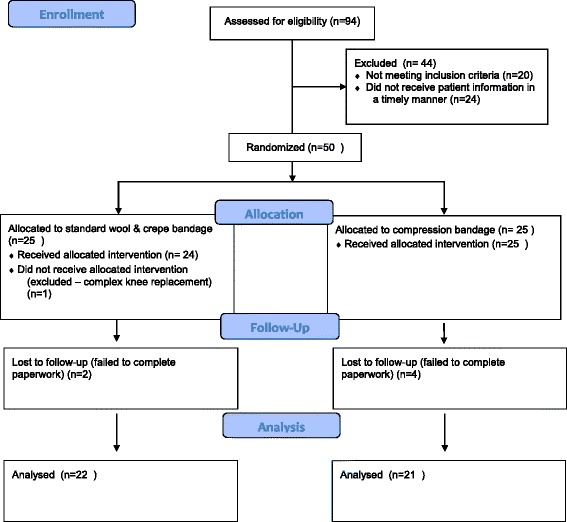
Methods: Fifty consecutive patients selected for primary total knee arthroplasty underwent distance randomisation to receive a short-stretch, inelastic compression bandage or a standard wool and crepe bandage for the first 24 h postoperatively. Study feasibility including recruitment rates, retention rates and complications were analysed. The Oxford Knee Score, the EQ-5D-3L index score, knee swelling, knee range of motion, visual analogue pain score and length of stay were compared between groups. Analysis of covariance (ANCOVA) was performed adjusting for the preoperative measurement.
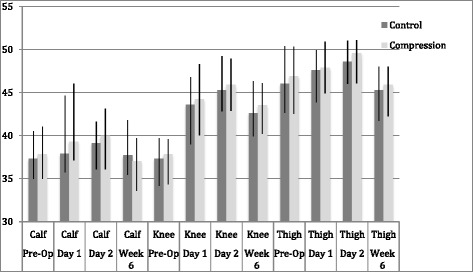
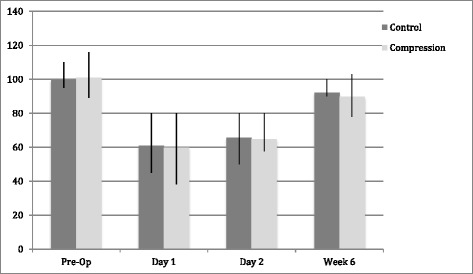
Results: Sixty-eight percent of eligible patients were recruited into the trial. The retention rate was 88%. There were no complications regarding compression bandage use. There was a greater mean but non-significant improvement in Oxford Knee Score (p = 0.580; point estimate = 2.1; 95% CI -3.288 to 7.449) and EQ-5D-3L index score (p = 0.057; point estimate = 0.147; 95% CI -0.328 to 0.005) in the compression bandage group at 6 months. There was no significant difference between groups regarding knee swelling, knee range of motion, visual analogue pain score, complications and length of stay.
Conclusion: Preliminary data suggests that the use of an inelastic, short-stretch compression bandage following total knee arthroplasty is a safe technique that is acceptable to patients. A larger, multicentre trial is required to determine its effect postoperatively.
Trial registration: The study was registered with Current Controlled Trials, identifier: ISRCTN86903140 . Registered on 30 May 2013.
Keywords: Arthroplasty; Compression bandage; Enhanced recovery; Fast track; Feasibility; Knee replacement.
Figures
References
Publication types
MeSH terms
Associated data
LinkOut - more resources
Full Text Sources
Other Literature Sources
Medical
