


Antagonizing cytokine-mediated JAK-STAT signaling by porcine reproductive and respiratory syndrome virus
- PMID: 28069291
- PMCID: PMC7117332
- DOI: 10.1016/j.vetmic.2016.12.036
Antagonizing cytokine-mediated JAK-STAT signaling by porcine reproductive and respiratory syndrome virus
Abstract
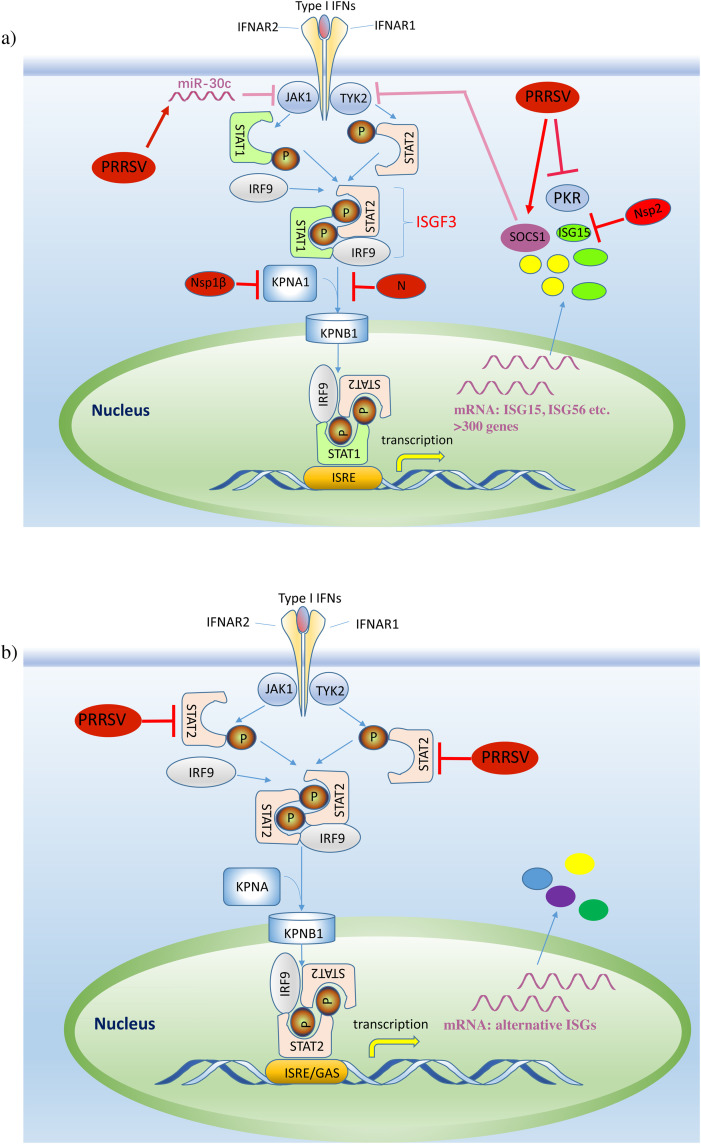
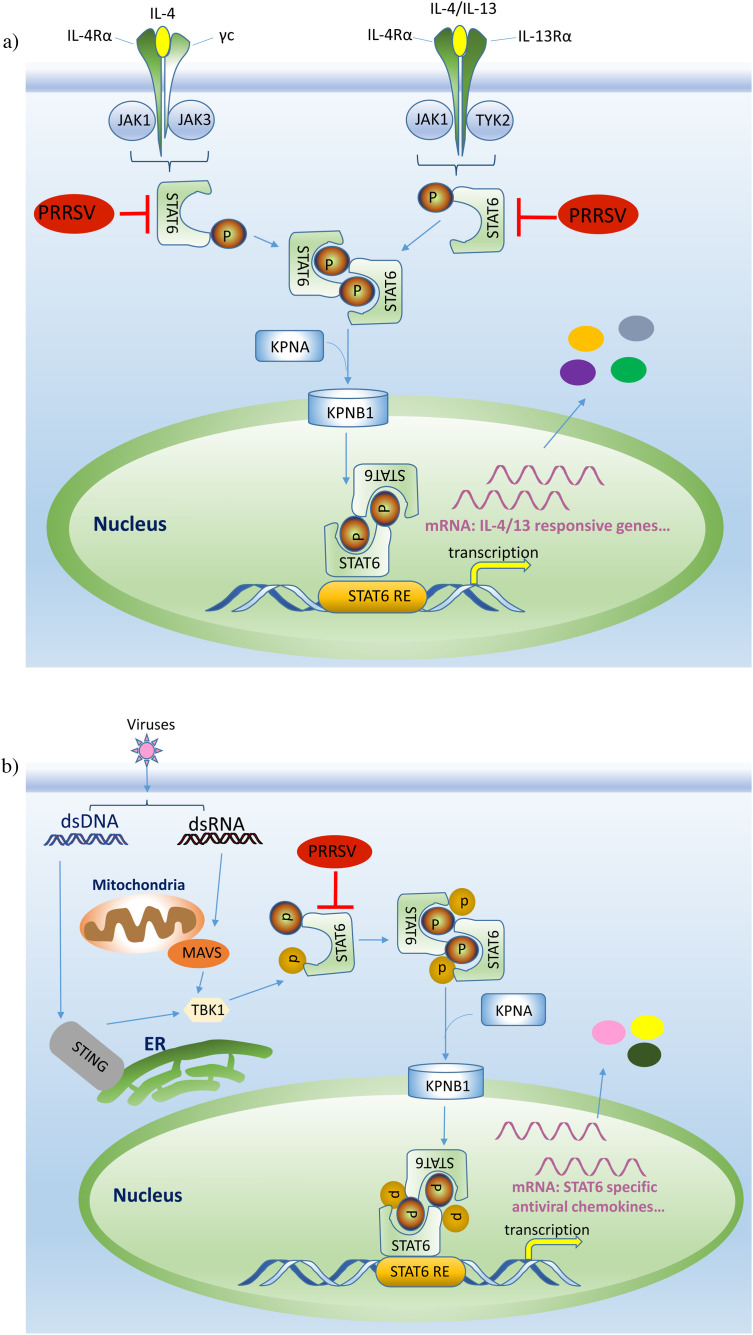
Janus kinase (JAK)-signal transducer and activator of transcription (STAT) signaling pathway is activated by myriad cytokines, which are involved in regulation of cell growth, proliferation, differentiation, apoptosis, angiogenesis, immunity and inflammatory response. Because of its significance in immune response, JAK-STAT pathway is often targeted by pathogens, including porcine reproductive and respiratory syndrome virus (PRRSV). PRRSV causes reproductive failure in sows and respiratory disease in pigs of all ages. A typical feature of the immune response to PRRSV infection in pigs is delayed production and low titer of virus neutralizing antibodies, and weak cell-mediated immune response. One of the possible reasons for the weak protective immune response is that PRRSV interferes with cytokine-mediated JAK-STAT signaling. PRRSV inhibits interferon-activated JAK-STAT signaling by blocking nuclear translocation of STAT1 and STAT2. The mechanism is that PRRSV non-structural protein 1β (nsp1β) induces degradation of karyopherin α1 (KPNA1), a critical adaptor in nucleo-cytoplasmic transport. PRRSV also antagonizes IL6-activated JAK-STAT3 signaling via inducing degradation of STAT3. In this review, we briefly introduce JAK-STAT signaling, summarize the PRRSV interference with it, and provide perspective on the perturbation in the context of PRRSV-elicited immune response.
Keywords: Innate immunity; JAK-STAT signaling; JAKs; PRRSV; STATs.
Copyright © 2016 Elsevier B.V. All rights reserved.
Figures

References
-
- Ait-Ali T., Wilson A.W., Finlayson H., Carre W., Ramaiahgari S.C., Westcott D.G., Waterfall M., Frossard J.P., Baek K.H., Drew T.W., Bishop S.C., Archibald A.L. Functional analysis of the porcine USP18 and its role during porcine arterivirus replication. Gene. 2009;439:35–42. - PubMed
-
- Albina E., Carrat C., Charley B. Interferon-alpha response to swine arterivirus (PoAV), the porcine reproductive and respiratory syndrome virus. J. Interferon Cytokine Res. 1998;18:485–490. - PubMed
-
- Avery D.T., Deenick E.K., Ma C.S., Suryani S., Simpson N., Chew G.Y., Chan T.D., Palendira U., Bustamante J., Boisson-Dupuis S., Choo S., Bleasel K.E., Peake J., King C., French M.A., Engelhard D., Al-Hajjar S., Al-Muhsen S., Magdorf K., Roesler J., Arkwright P.D., Hissaria P., Riminton D.S., Wong M., Brink R., Fulcher D.A., Casanova J.L., Cook M.C., Tangye S.G. B cell-intrinsic signaling through IL-21 receptor and STAT3 is required for establishing long-lived antibody responses in humans. J. Exp. Med. 2010;207:155–171. - PMC - PubMed
-
- Belkaid Y. Regulatory T cells and infection: a dangerous necessity. Nat. Rev. Immunol. 2007;7:875–888. - PubMed
Publication types
MeSH terms
Substances
LinkOut - more resources
Full Text Sources
Other Literature Sources
Research Materials
Miscellaneous
