


Less Intense Postacute Care, Better Outcomes For Enrollees In Medicare Advantage Than Those In Fee-For-Service
- PMID: 28069851
- PMCID: PMC5521268
- DOI: 10.1377/hlthaff.2016.1027
Less Intense Postacute Care, Better Outcomes For Enrollees In Medicare Advantage Than Those In Fee-For-Service
Abstract
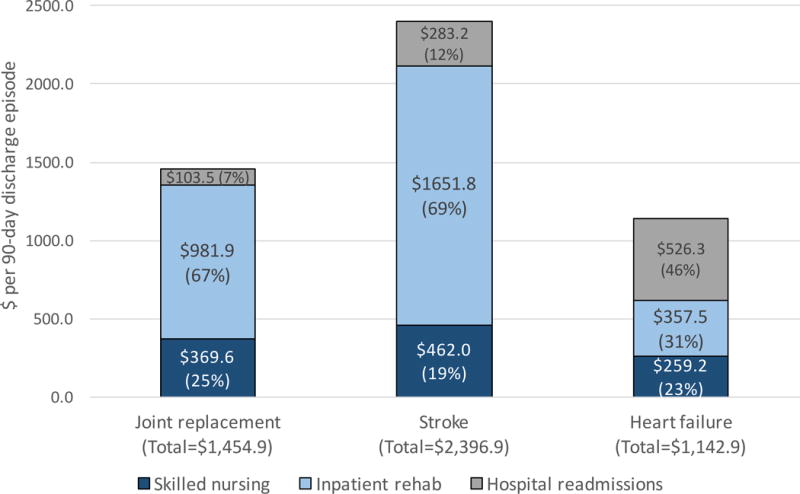
Traditional fee-for-service (FFS) Medicare's prospective payment systems for postacute care provide little incentive to coordinate care or control costs. In contrast, Medicare Advantage plans pay for postacute care out of monthly capitated payments and thus have stronger incentives to use it efficiently. We compared the use of postacute care in skilled nursing and inpatient rehabilitation facilities by enrollees in Medicare Advantage and FFS Medicare after hospital discharge for three high-volume conditions: lower extremity joint replacement, stroke, and heart failure. After accounting for differences in patient characteristics at discharge, we found lower intensity of postacute care for Medicare Advantage patients compared to FFS Medicare patients discharged from the same hospital, across all three conditions. Medicare Advantage patients also exhibited better outcomes than their FFS Medicare counterparts, including lower rates of hospital readmission and higher rates of return to the community. These findings suggest that payment reforms such as bundling in FFS Medicare may reduce the intensity of postacute care without adversely affecting patient health.
Keywords: Cost of Health Care; Managed Care - Medicare < Managed Care; Medicare.
Project HOPE—The People-to-People Health Foundation, Inc.
Figures
References
-
- Medicare Payment Advisory Commission. A data book: health care spending and the Medicare program [Internet] Washington (DC): MedPAC; 2016. Jun, http://www.medpac.gov/docs/default-source/data-book/june-2016-data-book-.... [cited 2016 Nov 17]. Available from:
-
- Mechanic RE. Post-acute care—the next frontier for controlling Medicare spending. N Engl J Med. 2014;370(8):692–4. - PubMed
-
- Newhouse JP, Garber AM. Geographic variation in Medicare services. N Engl J Med. 2013;368(16):1465–8. - PubMed
-
- Medicare Payment Advisory Commission. Report to the Congress: Medicare and the health care delivery system [Internet] Washington (DC): MedPAC; 2014. Jun, [cited 2016 Nov 17]. Chapter 6: site-neutral payments for select conditions treated in inpatient rehabilitation facilties and skilled nursing facilities. Available from: http://www.medpac.gov/docs/default-source/reports/chapter-6-site-neutral....
MeSH terms
Grants and funding
LinkOut - more resources
Full Text Sources
Other Literature Sources
