Curcumin supplementation improves vascular endothelial function in healthy middle-aged and older adults by increasing nitric oxide bioavailability and reducing oxidative stress
- PMID: 28070018
- PMCID: PMC5310664
- DOI: 10.18632/aging.101149
Curcumin supplementation improves vascular endothelial function in healthy middle-aged and older adults by increasing nitric oxide bioavailability and reducing oxidative stress
Abstract
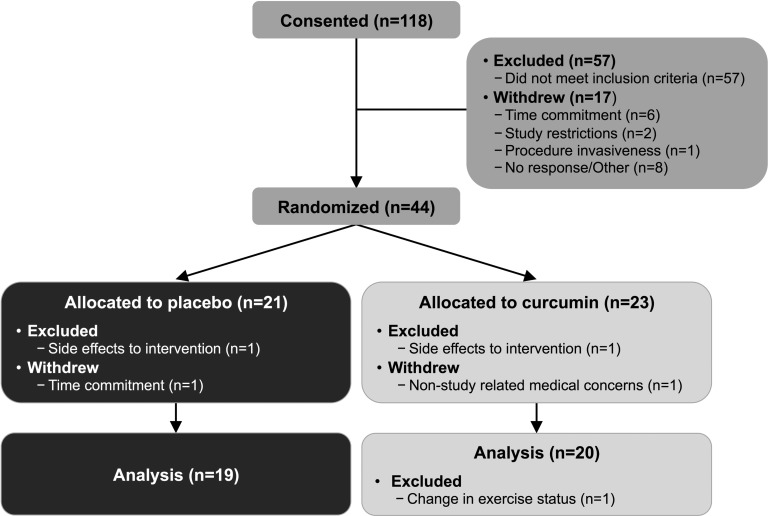
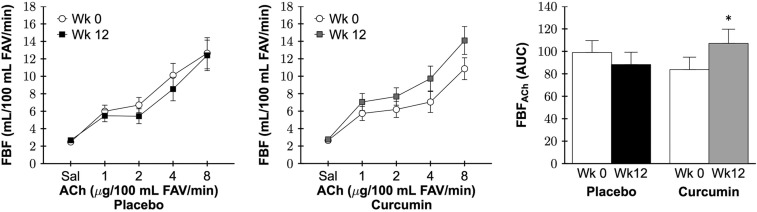
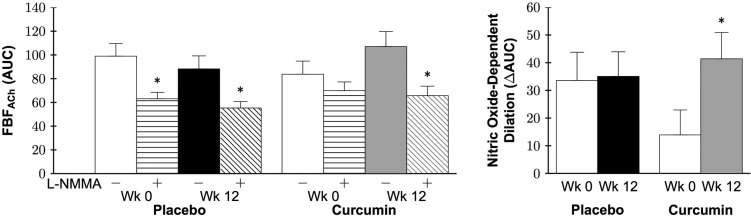
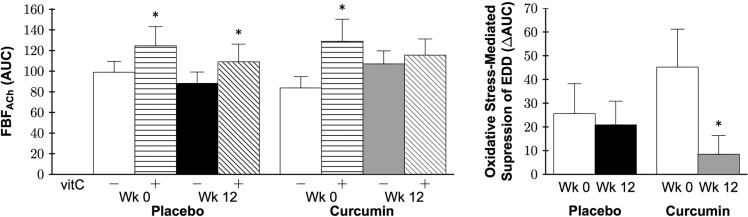
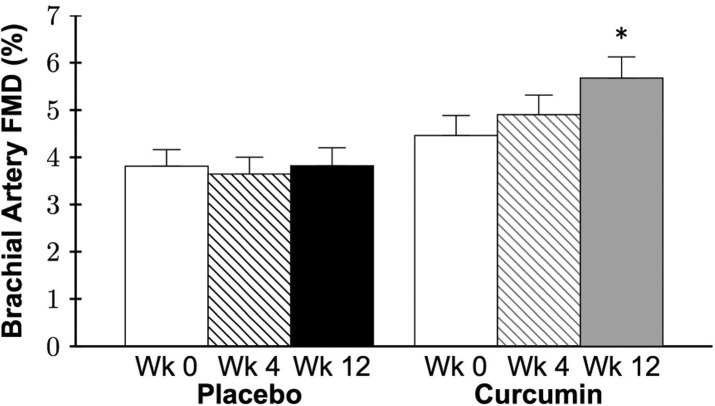
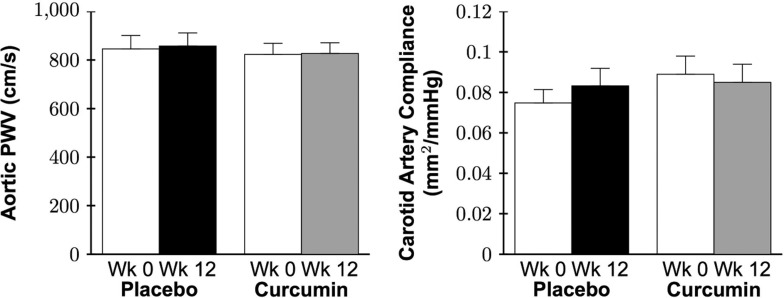
We hypothesized that curcumin would improve resistance and conduit artery endothelial function and large elastic artery stiffness in healthy middle-aged and older adults. Thirty-nine healthy men and postmenopausal women (45-74 yrs) were randomized to 12 weeks of curcumin (2000 mg/day Longvida®; n=20) or placebo (n=19) supplementation. Forearm blood flow response to acetylcholine infusions (FBFACh; resistance artery endothelial function) increased 37% following curcumin supplementation (107±13 vs. 84±11 AUC at baseline, P=0.03), but not placebo (P=0.2). Curcumin treatment augmented the acute reduction in FBFACh induced by the nitric oxide synthase inhibitor NG monomethyl-L-arginine (L-NMMA; P=0.03), and reduced the acute increase in FBFACh to the antioxidant vitamin C (P=0.02), whereas placebo had no effect (both P>0.6). Similarly, brachial artery flow-mediated dilation (conduit artery endothelial function) increased 36% in the curcumin group (5.7±0.4 vs. 4.4±0.4% at baseline, P=0.001), with no change in placebo (P=0.1). Neither curcumin nor placebo influenced large elastic artery stiffness (aortic pulse wave velocity or carotid artery compliance) or circulating biomarkers of oxidative stress and inflammation (all P>0.1). In healthy middle-aged and older adults, 12 weeks of curcumin supplementation improves resistance artery endothelial function by increasing vascular nitric oxide bioavailability and reducing oxidative stress, while also improving conduit artery endothelial function.
Keywords: aging; arterial stiffness; curcumin; endothelium-dependent dilation; inflammation; oxidative stress.
Conflict of interest statement
The authors have no declarations of interest to disclose.
Figures
References
-
- Weintraub WS, Daniels SR, Burke LE, Franklin BA, Goff DC, Jr, Hayman LL, Lloyd-Jones D, Pandey DK, Sanchez EJ, Schram AP, Whitsel LP, American Heart Association Advocacy Coordinating Committee, and Council on Cardiovascular Disease in the Young, and Council on the Kidney in Cardiovascular Disease, and Council on Epidemiology and Prevention, and Council on Cardiovascular Nursing, and Council on Arteriosclerosis, and Thrombosis and Vascular Biology, and Council on Clinical Cardiology, and Stroke Council Value of primordial and primary prevention for cardiovascular disease: a policy statement from the American Heart Association. Circulation. 2011;124:967–90. doi: 10.1161/CIR.0b013e3182285a81. - DOI - PubMed
-
- Mozaffarian D, Benjamin EJ, Go AS, Arnett DK, Blaha MJ, Cushman M, Das SR, de Ferranti S, Després JP, Fullerton HJ, Howard VJ, Huffman MD, Isasi CR, et al. Writing Group Members, and American Heart Association Statistics Committee, and Stroke Statistics Subcommittee Heart disease and stroke statistics-2016 update: a report from the American Heart Association. Circulation. 2016;133:e38–360. doi: 10.1161/CIR.0000000000000350. - DOI - PubMed
Publication types
MeSH terms
Substances
Grants and funding
LinkOut - more resources
Full Text Sources
Other Literature Sources