


Using species distribution models to define nesting habitat of the eastern metapopulation of double-crested cormorants
- PMID: 28070303
- PMCID: PMC5215296
- DOI: 10.1002/ece3.2620
Using species distribution models to define nesting habitat of the eastern metapopulation of double-crested cormorants
Abstract
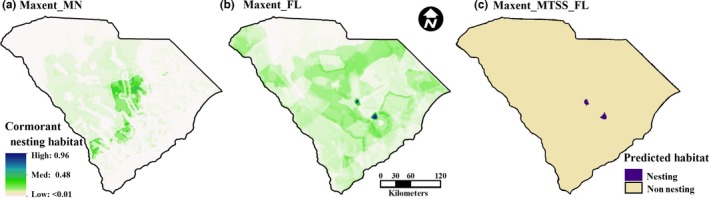
When organisms with similar phenotypes have conflicting management and conservation initiatives, approaches are needed to differentiate among subpopulations or discrete groups. For example, the eastern metapopulation of the double-crested cormorant (Phalacrocorax auritus) has a migratory phenotype that is culled because they are viewed as a threat to commercial and natural resources, whereas resident birds are targeted for conservation. Understanding the distinct breeding habitats of resident versus migratory cormorants would aid in identification and management decisions. Here, we use species distribution models (SDM: Maxent) of cormorant nesting habitat to examine the eastern P. auritus metapopulation and the predicted breeding sites of its phenotypes. We then estimate the phenotypic identity of breeding colonies of cormorants where management plans are being developed. We transferred SDMs trained on data from resident bird colonies in Florida and migratory bird colonies in Minnesota to South Carolina in an effort to identify the phenotype of breeding cormorants there based on the local landscape characteristics. Nesting habitat characteristics of cormorant colonies in South Carolina more closely resembled those of the Florida phenotype than those of birds of the Minnesota phenotype. The presence of the resident phenotype in summer suggests that migratory and resident cormorants will co-occur in South Carolina in winter. Thus, there is an opportunity for separate management strategies for the two phenotypes in that state. We found differences in nesting habitat characteristics that could be used to refine management strategies and reduce human conflicts with abundant winter migrants and, at the same time, conserve less common colonies of resident cormorants. The models we use here show potential for advancing the study of geographically overlapping phenotypes with differing conservation and management priorities.
Keywords: conservation; cormorant; metapopulation; nesting habitat; species distribution model; wildlife management.
Figures



References
-
- Aarts, G. , Fieberg, J. , & Matthiopoulos, J. (2012). Comparative interpretation of count, presence–absence and point methods for species distribution models. Methods in Ecology and Evolution, 3, 177–187.
-
- Audubon, J. J. (1840. ‐1844). The birds of America, Vol. 6 New York: Dover Publications. (Facsimile reprint, 1967).
-
- Becker, M. E. , & Weisberg, P. J. (2015). Synergistic effects of spring temperatures and land cover on nest survival of urban birds. The Condor, 117, 18–30.
-
- Beston, J. A. , Williams, C. K. , Nichols, T. C. , & Castelli, P. M. (2015). Survival and harvest of Atlantic Flyway resident population Canada Geese. Wildlife Society Bulletin, 39, 583–592.
-
- Blair, M. E. , Gutierrez‐Espeleta, G. A. , & Melnick, D. J. (2013). Subspecies of the central American Squirrel Monkey (Saimiri oerstedii) as units for conservation. International Journal of Primatology, 34, 86–98.
LinkOut - more resources
Full Text Sources
Other Literature Sources
