


doi: 10.1016/j.nmni.2016.12.013.
eCollection 2017 Jan.
Noncontiguous finished genome sequence and description of Prevotella phocaeensis sp. nov., a new anaerobic species isolated from human gut infected by Clostridium difficile
Affiliations
- PMID: 28070336
- PMCID: PMC5219628
- DOI: 10.1016/j.nmni.2016.12.013
Item in Clipboard
Noncontiguous finished genome sequence and description of Prevotella phocaeensis sp. nov., a new anaerobic species isolated from human gut infected by Clostridium difficile
New Microbes New Infect.
.
Abstract
Prevotella phocaeensis sp. nov. strain SN19T (= DSM 103364) is a new species isolated from the gut microbiota of patient with colitis due to Clostridium difficile. Strain SN19T is Gram-negative rod-shaped bacteria, strictly anaerobic, nonmotile and non-endospore forming. The predominance fatty acid is hexadecanoic acid. Its 16S rRNA showed a 97.70% sequence identity with its phylogenetically closest species, Prevotella oralis. The genome is 2 922 117 bp long and contains 2486 predicted genes including 56 RNA genes.
Keywords: Clostridium difficile; Prevotella phocaeensis; culturomics; gut microbiota; taxonogenomics.
Figures

Spectrum of Prevotella phocaeensis strain SN19T obtained by MALDI-TOF MS. Spectra from 16 individual colonies were compared and reference spectrum generated. MALDI-TOF MS, matrix-assisted desorption ionization–time of flight mass spectrometry.
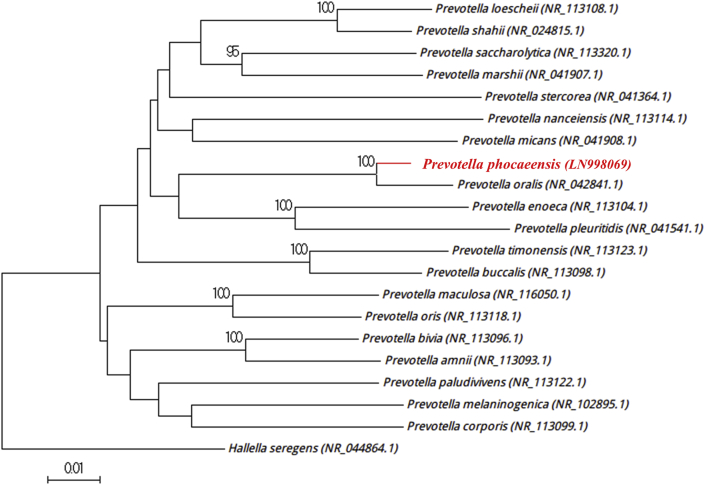
Phylogenetic tree highlighting position of Prevotella phocaeensis strain SN19T relative to others of Prevotellaceae family. Sequences were aligned using Muscle 3.8.31 with default parameters, and phylogenetic inferences were obtained using neighbour-joining method with 500 bootstrap replicates within MEGA6 software. Only bootstraps >95% are shown. Scale bar represents 1% nucleotide sequence divergence.

Gel view of Prevotella phocaeensis strain SN19T relative to other Prevotella species. Gel view displays raw spectra of loaded spectrum files arranged in pseudo-gel-like look. X-axis records m/z value. Left y-axis displays running spectrum number originating from subsequent spectra loading. Peak intensity is expressed by greyscale scheme code. Colour bar and right y-axis indicating relation between colour peak is displayed; peak intensity uses arbitrary units.

Microscopic aspects of Prevotella phocaeensis strain SN19T. (A) Gram staining of Prevotella phocaeensis strain SN19T. Scale bar = 10 μm. (B) Transmission electron microscopy of Prevotella phocaeensis strain SN19T using Tecnai G20 Cryo (FEI Company) transmission electron microscope operated at 200 keV. Scale bar = 500 nm.

Graphical circular map of Prevotella phocaeensis strain SN19T genome. From outside to centre: contigs (red/grey), genes on forward strand coloured by COGs categories (only genes assigned to COGs), genes on reverse strand coloured by COGs categories (only gene assigned to COGs), RNA genes (tRNAs green, rRNAs red), GC content and GC skew. COGs, Clusters of Orthologous Groups database.

Distribution of functional classes of predicted genes of strain SN19T and related species of Prevotella genus according to COGs of proteins. COGs, Clusters of Orthologous Groups database.
References
-
- Landman C., Quévrain E. Le microbiote intestinal: description, rôle et implications physiopathologiques. Rev Med Interne. 2016;37:418–423. - PubMed
-
- Hooper L.V. Bacterial contributions to mammalian gut development. Trends Microbiol. 2004;12:129–134. - PubMed
-
- Christl S.U., Murgatroyd P.R., Gibson G.R., Cummings J.H. Production, metabolism, and excretion of hydrogen in the large intestine. Gastroenterology. 1992;102:1269–1277. - PubMed
-
- Turnbaugh P.J., Ley R.E., Mahowald M.A., Magrini V., Mardis E.R., Gordon J.I. An obesity-associated gut microbiome with increased capacity for energy harvest. Nature. 2006;444:1027–1031. - PubMed
LinkOut - more resources
Full Text Sources
Other Literature Sources
Molecular Biology Databases