


Emotional distress impacts quality of life evaluation: a report from the Childhood Cancer Survivor Study
- PMID: 28070769
- PMCID: PMC5419851
- DOI: 10.1007/s11764-016-0589-5
Emotional distress impacts quality of life evaluation: a report from the Childhood Cancer Survivor Study
Abstract
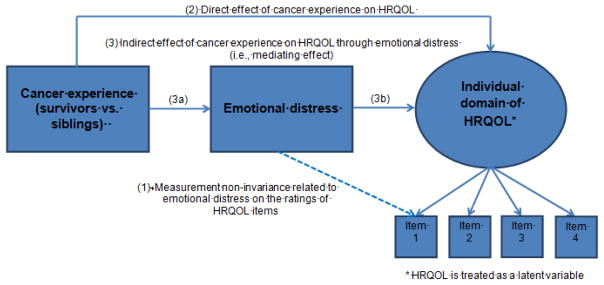
Purpose: We compared health-related quality of life (HRQOL) between adult survivors of childhood cancer and siblings by investigating the mediating role of emotional distress on HRQOL assessment, and examining the extent to which emotional distress affected the item responses of HRQOL measures given the same underlying HRQOL (i.e., measurement non-invariance).
Methods: Cancer survivors (7103) and siblings (390) enrolled in Childhood Cancer Survivor Study who completed the SF-36 measuring HRQOL and the Brief Symptom Inventory-18 measuring anxiety, depression, and somatization were analyzed. Multiple Indicators & Multiple Causes modeling was performed to identify measurement non-invariance related to emotional distress on the responses to HRQOL items. Mediation analysis was performed to test the effects of cancer experience on HRQOL accounting for the mediating role of emotional distress.
Results: Twenty-nine percent, 40%, and 34% of the SF-36 items were identified with measurement non-invariance related to anxiety, depression, and somatization, respectively. Survivors reported poorer HRQOL than siblings in all domains (ps < 0.05), except for pain. Other than physical functioning and general health perceptions, poorer HRQOL was explained by the mediating role of emotional distress (ps < 0.05).
Conclusions: Differences in HRQOL between survivors and siblings appear due, in part, to the mediating effect of emotional distress through which cancer experience influences the responses to HRQOL measures.
Implications of cancer survivors: Interventions to treat emotional distress may improve cancer survivors' HRQOL.
Keywords: Cancer survivors; Emotional distress; Health-related quality of life; Measurement non-invariance; Mediation analysis.
Conflict of interest statement
Conflict of Interest:
All co-authors have declares that they have no conflict of interest.
Ethical Approval:
All procedures performed in studies involving human participants were in accordance with the ethical standards of the institutional and/or national research committee and with the 1964 Helsinki declaration and its later amendments or comparable ethical standards. Specifically, the study protocol was approved by Institutional Review Boards at the 26 participating institutions with participants providing informed consent.
Informed Consent:
Informed consent was obtained from all individual participants included in the study.
Figures
References
-
- American Cancer Society. Cancer Facts & Figures 2015. Atlanta, GA: American Cancer Society; 2015.
-
- Aaronson NK, Ahmedzai S, Bergman B, Bullinger M, Cull A, Duez NJ, et al. The European Organization for Research and Treatment of Cancer QLQ-C30: A quality-of-life instrument for use in international clinical trials in oncology. Journal of the National Cancer Institute. 1993;85(5):365–76. - PubMed
MeSH terms
Grants and funding
LinkOut - more resources
Full Text Sources
Other Literature Sources
Medical
Research Materials
