Molecular signal networks and regulating mechanisms of the unfolded protein response
- PMID: 28070992
- PMCID: PMC5260473
- DOI: 10.1631/jzus.B1600043
Molecular signal networks and regulating mechanisms of the unfolded protein response
Abstract
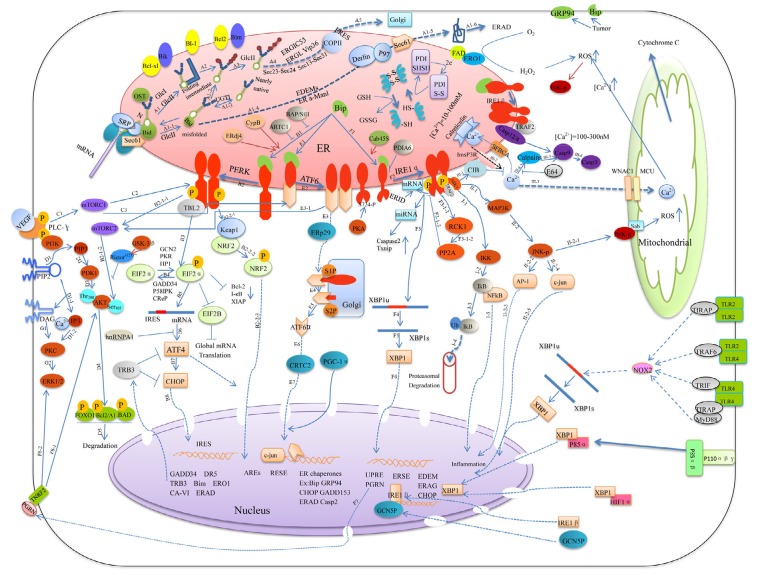
Within the cell, several mechanisms exist to maintain homeostasis of the endoplasmic reticulum (ER). One of the primary mechanisms is the unfolded protein response (UPR). In this review, we primarily focus on the latest signal webs and regulation mechanisms of the UPR. The relationships among ER stress, apoptosis, and cancer are also discussed. Under the normal state, binding immunoglobulin protein (BiP) interacts with the three sensors (protein kinase RNA-like ER kinase (PERK), activating transcription factor 6 (ATF6), and inositol-requiring enzyme 1α (IRE1α)). Under ER stress, misfolded proteins interact with BiP, resulting in the release of BiP from the sensors. Subsequently, the three sensors dimerize and autophosphorylate to promote the signal cascades of ER stress. ER stress includes a series of positive and negative feedback signals, such as those regulating the stabilization of the sensors/BiP complex, activating and inactivating the sensors by autophosphorylation and dephosphorylation, activating specific transcription factors to enable selective transcription, and augmenting the ability to refold and export. Apart from the three basic pathways, vascular endothelial growth factor (VEGF)-VEGF receptor (VEGFR)-phospholipase C-γ (PLCγ)-mammalian target of rapamycin complex 1 (mTORC1) pathway, induced only in solid tumors, can also activate ATF6 and PERK signal cascades, and IRE1α also can be activated by activated RAC-alpha serine/threonine-protein kinase (AKT). A moderate UPR functions as a pro-survival signal to return the cell to its state of homeostasis. However, persistent ER stress will induce cells to undergo apoptosis in response to increasing reactive oxygen species (ROS), Ca2+ in the cytoplasmic matrix, and other apoptosis signal cascades, such as c-Jun N-terminal kinase (JNK), signal transducer and activator of transcription 3 (STAT3), and P38, when cellular damage exceeds the capacity of this adaptive response.
Keywords: Unfolded protein response; Endoplasmic reticulum (ER) stress; Mechanism; Signal networks; Homeostasis.
Conflict of interest statement
Compliance with ethics guidelines: Jing GONG, Xing-zhi WANG, Tao WANG, Jiao-jiao CHEN, Xiao-yuan XIE, Hui HU, Fang YU, Hui-lin LIU, Xing-yan JIANG, and Han-dong FAN declare that they have no conflict of interest. This article does not contain any studies with human or animal subjects performed by any of the authors.
Figures
References
-
- Awad W, Estrada I, Shen Y, et al. BiP mutants that are unable to interact with endoplasmic reticulum Dnaj proteins provide insights into interdomain interactions in BiP. PNAS. 2008;105(4):1164–1169. (Available from: http://dx.doi.org/10.1073/pnas.0702132105) - DOI - PMC - PubMed
-
- Bevilacqua E, Wang X, Majumder M, et al. eIF2α phosphorylation tips the balance to apoptosis during osmotic stress. J Biol Chem. 2010;285(22):17098–17111. (Available from: http://dx.doi.org/10.1074/jbc.M110.109439) - DOI - PMC - PubMed
-
- Binet F, Mawambo G, Sitaras N, et al. Neuronal ER stress impedes myeloid-cell-induced vascular regeneration through IRE1α degradation of netrin-1. Cell Metab. 2013;17(3):353–371. (Available from: http://dx.doi.org/10.1016/j.cmet.2013.02.003) - DOI - PubMed
-
- Bommiasamy H, Back SH, Fagone P, et al. ATF6α induces XBP1-independent expansion of the endoplasmic reticulum. J Cell Sci. 2009;122(10):1626–1636. (Available from: http://dx.doi.org/10.1242/jcs.045625) - DOI - PMC - PubMed
-
- Braakman I, Bulleid NJ. Protein folding and modification in the mammalian endoplasmic reticulum. Annu Rev Biochem. 2011;80(1):71–99. (Available from: http://dx.doi.org/10.1146/annurev-biochem-062209-093836) - DOI - PubMed
Publication types
MeSH terms
Substances
LinkOut - more resources
Full Text Sources
Other Literature Sources
Research Materials
Miscellaneous