. 2017 Jan 10:8:13954.
doi: 10.1038/ncomms13954.

Marine origin of retroviruses in the early Palaeozoic Era

Affiliations

Marine origin of retroviruses in the early Palaeozoic Era

Pakorn Aiewsakun et al. Nat Commun. .

Abstract

Very little is known about the ancient origin of retroviruses, but owing to the discovery of their ancient endogenous viral counterparts, their early history is beginning to unfold. Here we report 36 lineages of basal amphibian and fish foamy-like endogenous retroviruses (FLERVs). Phylogenetic analyses reveal that ray-finned fish FLERVs exhibit an overall co-speciation pattern with their hosts, while amphibian FLERVs might not. We also observe several possible ancient viral cross-class transmissions, involving lobe-finned fish, shark and frog FLERVs. Sequence examination and analyses reveal two major lineages of ray-finned fish FLERVs, one of which had gained two novel accessory genes within their extraordinarily large genomes. Our phylogenetic analyses suggest that this major retroviral lineage, and therefore retroviruses as a whole, have an ancient marine origin and originated together with, if not before, their jawed vertebrate hosts >450 million years ago in the Ordovician period, early Palaeozoic Era.


Conflict of interest statement

The authors declare no competing financial interests.

Figures
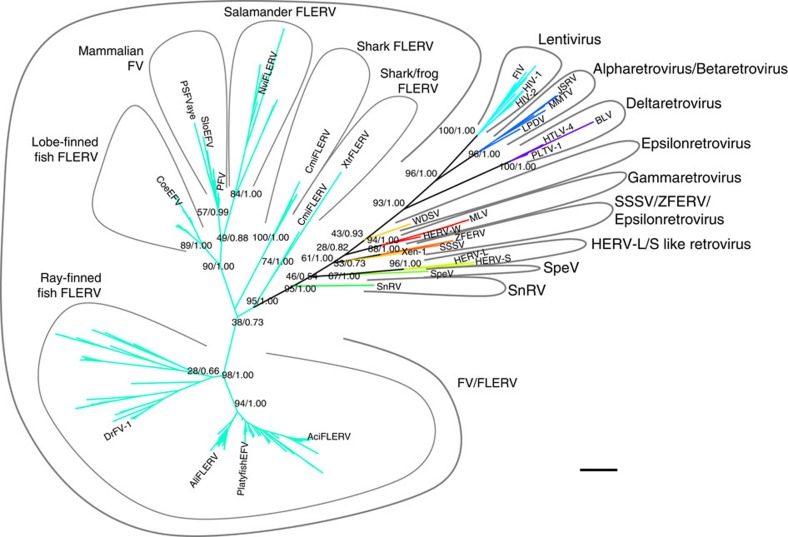
Figure 1
Figure 1. Retroviral phylogeny illustrating how FVs and FLERVs relate to other retroviruses.
The un-rooted phylogenies were estimated from a reverse transcriptase protein alignment. Since both Bayesian maximum clade credibility and maximum-likelihood trees have very similar topologies, only the Bayesian tree is shown. The scale bar (black solid line; bottom right corner) represents genetic divergence of length 0.2 in units of amino acid substitutions per site. The numbers on the nodes are bootstrap (first) and Bayesian posterior probability (second) clade support values.
Figure 2
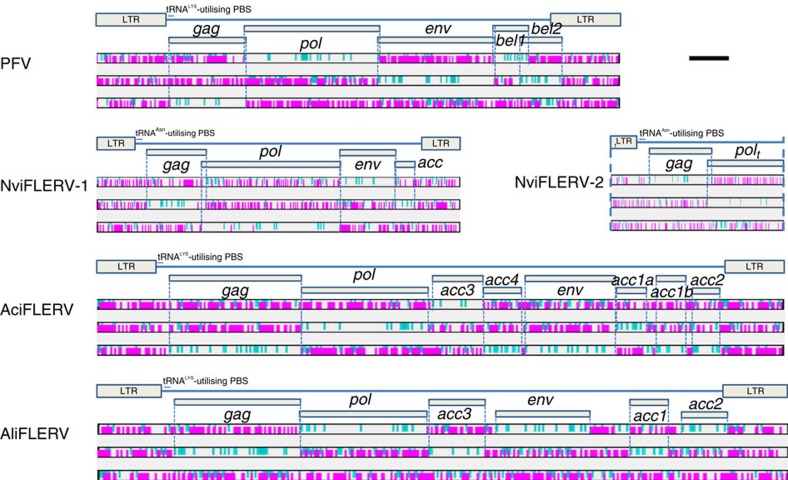
Figure 2. Genomic organizations of FVs and FLERVs.
NviFLERV-1 and NviFLERV-2 are endogenous viral elements present within the genome of N. viridescens. This is in contrast to AciFLERV and AliFLERV, which were annotated by using their maximum-likelihood ancestral sequences, reconstructed from 9 and 23 elements, respectively. Under each element are the distributions of stop codons (TAA, TAG and TGA; pink) and start codon (ATG; blue) in frame +1 (top), +2 (middle) and +3 (bottom), used to determine potential protein coding regions (blue thin vertical dashed lines). ‘t’-subscription indicates that the domain is truncated (5′-truncated: preceding the domain name; 3′-truncated: following the domain name; blue thick vertical dashed lines indicate where domains are truncated). Prototype foamy virus (PFV) was included as a reference. The scale bar (black solid line; top right corner) represents a nucleotide length of 1 kilobase.
Figure 3
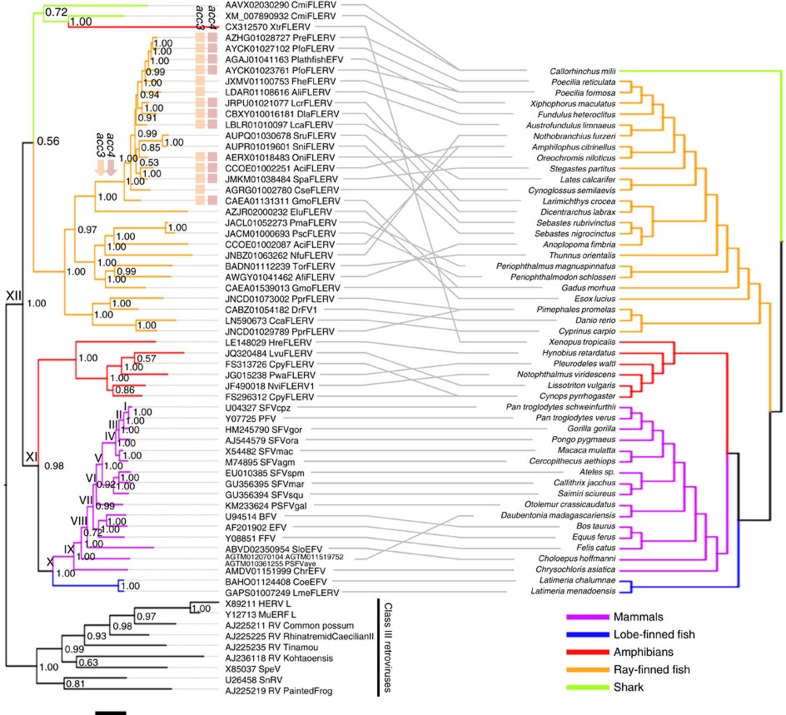
Figure 3. Coevolution of FVs and FLERVs and their vertebrate hosts.
A Bayesian phylogeny of FVs and FLERVs (left) is compared with the published vertebrate host cladogram (right). Preceding viral names are the contig accession numbers containing viral sequences. Class III retroviruses were used to root the viral tree. Solid grey lines between the two trees indicate viral–host associations. The scale bar (black solid line; underneath the virus phylogeny) represents genetic divergence of length 0.3 in units of amino acid substitutions per site, and Arabic numerals on nodes are Bayesian posterior probability node support values. Roman numerals indicate the nodes of which the total per-lineage substitutions to the chimpanzee simian FV (U14327 SFVcpz) were used to construct the time-dependent rate phenomenon model (Fig. 4). The presence of acc3 (orange squares) and acc4 (red squares) is mapped onto the viral phylogeny. The most parsimonious timing of acc3 and acc4 acquisition is indicated (orange and pink arrows, respectively).
Figure 4
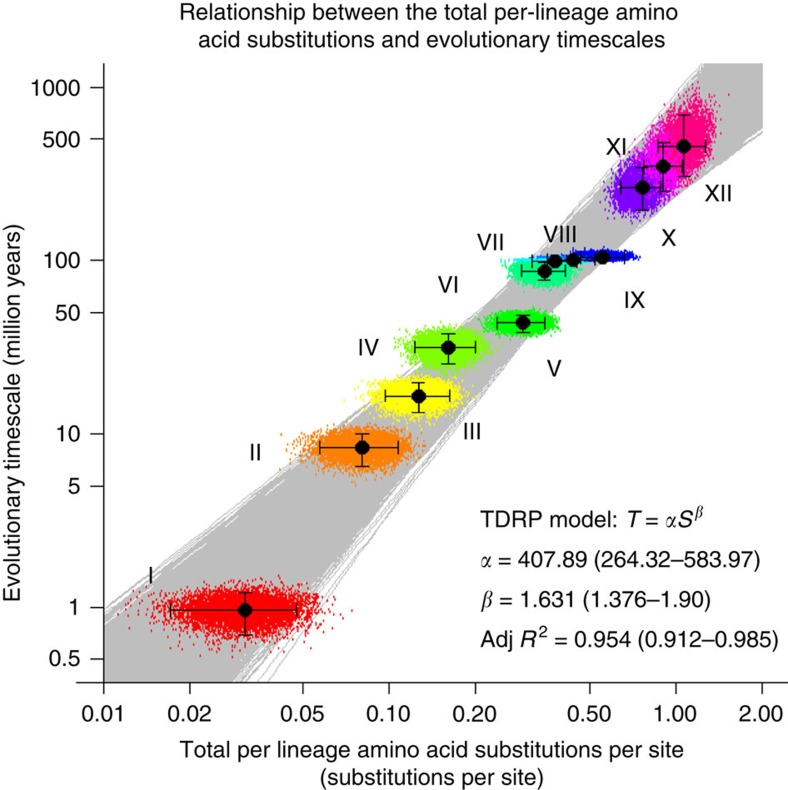
Figure 4. Evolutionary timescale of FLERVs estimated by using the power-law rate-decay model.
The total per-lineage amino acid substitutions (S) from various nodes to the chimpanzee simian FV (U14327 SFVcpz) are plotted against corresponding evolutionary timescales (T). The S and T estimates are labelled with Roman numerals (I–XI), referring to nodes in Fig. 3. Solid black dots are median estimates, and the associated 95% HPDs intervals are indicated by error bars. The T estimates of node I–IX were directly inferred from those of their hosts. 7,500 power-law TDRP models were fitted to the posterior distributions of the S and T estimates of the nodes I–IX (grey lines). The median model parameter values, adjusted R2 scores, and corresponding 95% HPDs (in the parentheses) are shown in the bottom right. The model was extrapolated to infer the branching date of lobe-finned fish FLERV lineage (node X), the separation date of salamander FLERV lineage (node XI) and the age of the entire FV/FLERV clade (node XII). See Table 2 for the values.

References

    1. Hayward A., Cornwallis C. K. & Jern P. Pan-vertebrate comparative genomics unmasks retrovirus macroevolution. Proc. Natl. Acad. Sci. USA 112, 464–469 (2015). - PMC - PubMed
    1. Herniou E. et al.. Retroviral diversity and distribution in vertebrates. J. Virol. 72, 5955–5966 (1998). - PMC - PubMed
    1. Aiewsakun P. & Katzourakis A. Endogenous viruses: connecting recent and ancient viral evolution. Virology 479–480, 26–37 (2015). - PubMed
    1. Lee A., Nolan A., Watson J. & Tristem M. Identification of an ancient endogenous retrovirus, predating the divergence of the placental mammals. Philos. Trans. R. Soc. Lond. B. Biol. Sci. 368, 20120503 (2013). - PMC - PubMed
    1. Katzourakis A., Gifford R. J., Tristem M., Gilbert M. T. P. & Pybus O. G. Macroevolution of complex retroviruses. Science 325, 1512 (2009). - PubMed

Publication types