. 2017 Jan 10:8:13877.
doi: 10.1038/ncomms13877.

Dopaminergic dynamics underlying sex-specific cocaine reward

Affiliations

Dopaminergic dynamics underlying sex-specific cocaine reward

Erin S Calipari et al. Nat Commun. .

Abstract

Although both males and females become addicted to cocaine, females transition to addiction faster and experience greater difficulties remaining abstinent. We demonstrate an oestrous cycle-dependent mechanism controlling increased cocaine reward in females. During oestrus, ventral tegmental area (VTA) dopamine neuron activity is enhanced and drives post translational modifications at the dopamine transporter (DAT) to increase the ability of cocaine to inhibit its function, an effect mediated by estradiol. Female mice conditioned to associate cocaine with contextual cues during oestrus have enhanced mesolimbic responses to these cues in the absence of drug. Using chemogenetic approaches, we increase VTA activity to mechanistically link oestrous cycle-dependent enhancement of VTA firing to enhanced cocaine affinity at DAT and subsequent reward processing. These data have implications for sexual dimorphism in addiction vulnerability and define a mechanism by which cellular activity results in protein alterations that contribute to dysfunctional learning and reward processing.


Figures
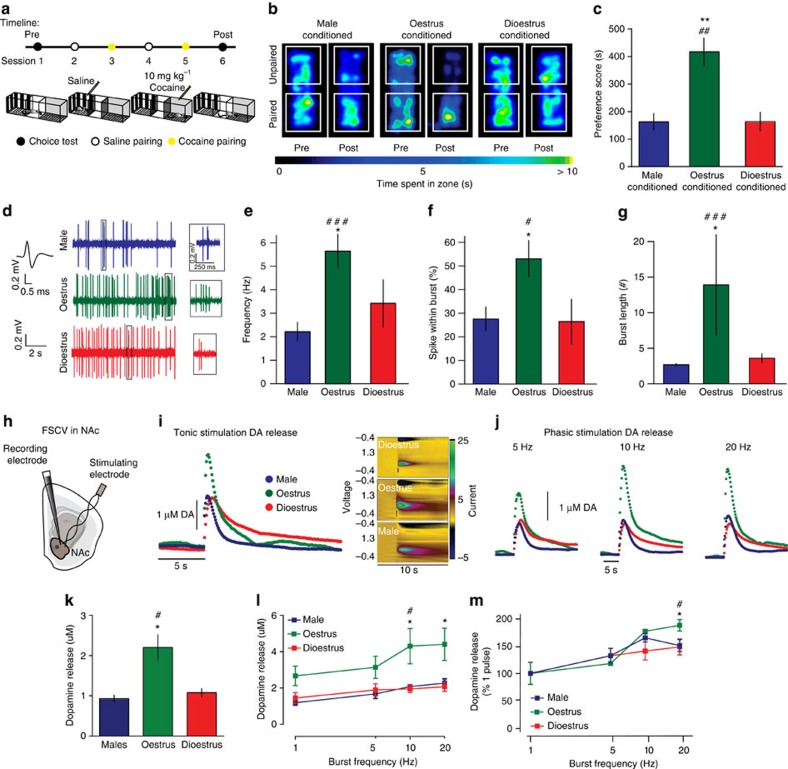
Figure 1
Figure 1. Oestrus-conditioned female mice exhibit elevated CPP for cocaine and enhanced basal reward circuit function.
(a) Timeline of cocaine CPP experiments. (b) Representative heat maps of time spent in each area of the CPP chamber for male (left), oestrus-conditioned females (centre) and dioestrus-conditioned females (right). (c) Increased CPP in females was only observed in mice paired with cocaine conditioning during oestrus (one-way analysis of variance (ANOVA); F(2, 12)=13.13, P<0.001; **P<0.01 oestrus versus dioestrus, ##P<0.01 oestrus versus male). (d) Electrophysiological traces showing increased phasic activity of VTA dopamine neurons in oestrus females. In vivo single-unit electrophysiology of basal activity of putative VTA dopamine neurons identified increased: (e) firing rate (Kruskal–Wallis (KW) (χ2(2)=11.76, P<0.005; *P<0.05, ###P<0.001), (f) percentage of spikes within burst (one-way ANOVA F(2, 36)=7.858, P<0.005; */#P<0.05) and (g) burst length (KW (χ2(2)=10.17, P<0.01; *P<0.05, ###P<0.001) in only oestrus females when compared with males (#) or dioestrus females (*). (h) FSCV recordings of subsecond dopamine release in the NAc. (i) Current versus time plots (left) and colour plots showing the presence of dopamine after one pulse tonic stimulation, as indicated by its oxidation at +0.6 V and reduction at −0.2 V. (j) Current versus time plots showing increased dopamine release to increasing frequency of five pulse stimulations. (k) Group data showing enhanced NAc dopamine per one pulse tonic stimulation in oestrus females (one-way ANOVA; F(2, 6)=11.57; *P<0.05, #P<0.05). (l) Phasic responsivity was increased in oestrus females (two-way ANOVA; F(6, 18)=3.279, P<0.05; *P<0.05, #P<0.05). (m) Phasic responses represented as a percent of one pulse (tonic) release. Oestrus females exhibit increased dopamine release during phasic stimulations (two-way ANOVA; F(3, 14)=9.079, P<0.05; *P<0.05, #P<0.05). *P<0.05, **P<0.01, ***P<0.001 oestrus versus dioestrus (unless otherwise noted); #P<0.05, ##P<0.01 oestrus versus male. Data represented as mean±s.e.m.
Figure 2
Figure 2. Oestrus females exhibit enhanced cocaine actions on the VTA-NAc reward pathway.
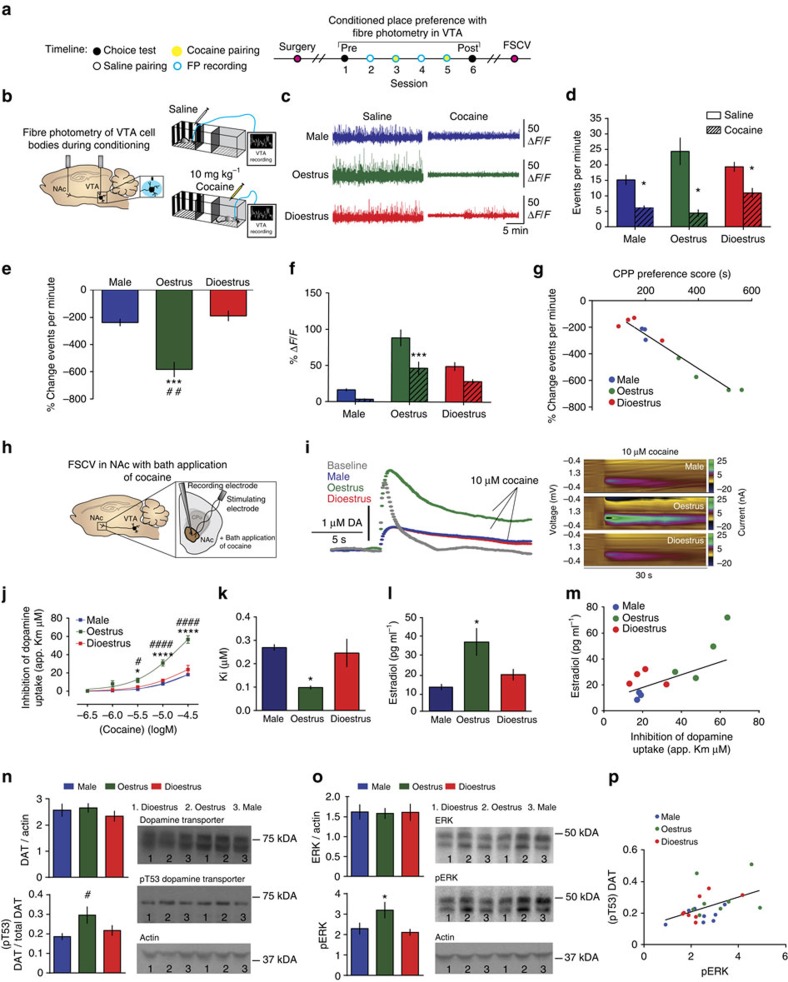
(a) Timeline of CPP and paired fibre photometry recordings. (b) Schematic of fibre photometry recording experiments for VTA recordings during conditioning sessions. (c) Representative Ca2+ imaging traces from male, oestrus female and dioestrus female mice during saline (left) and cocaine (right) conditioning. (d) Cocaine reduces frequency of VTA Ca2+ events (two-way analysis of variance (ANOVA); F(2, 8)=5.792, P<0.05; *P<0.05 as compared with saline). (e) Cocaine-induced frequency reductions in activity were greater during oestrus (one-way ANOVA; F(2, 8)=23.76, P<0.001; ***, P<0.001, ##P<0.01) when compared with males (#) or dioestrus females (*). (f) Cocaine-induced changes in the amplitude of Ca2+ events (two-way ANOVA; F(1, 10)=25.53, P<0.001; ***P<0.001 versus saline). (g) Correlation between percent change in frequency activity of VTA neurons and CPP (r=0.9445; P<0.0001). (h) Schematic of FSCV recordings with bath application of cocaine performed in NAc slices (right) and representative current versus time plots showing cocaine (10 μM) effects on one pulse evoked dopamine release (left). (i) Current versus time plot (left) and colour plots (right) showing the presence of dopamine, as indicated by its oxidation at +0.6 V and reduction at −0.2 V, and the effects of bath application of 10 μM cocaine. (j) Concentration–response curves show that cocaine potency is increased selectively in females during oestrus with no difference in baseline activity (two-way ANOVA; F(4, 16)=15.73, P<0.0001; *P<0.05, ****P<0.0001, #P<0.05, ####P<0.0001). (k) Ki values show that the affinity of cocaine for DAT is increased during oestrus (one-way ANOVA; F(2, 6)=6.564, P<0.05; *P<0.05). (l) Serum estradiol levels were increased during oestrus (one-way ANOVA; F(2, 13)=4.83, P<0.05; *P<0.05). (m) Serum estradiol levels taken immediately before FSCV recordings was positively correlated with cocaine potency (r=0.731; P<0.01). (n) Western blot analysis showing that dopamine transporter levels are not changed over the oestrous cycle (one-way ANOVA F(2, 21)=0.68, P=0.52) (top), yet levels of the phosphorylated Thr53 site on the dopamine transporter were increased during oestrus (one-way ANOVA F(2, 21)=0.37, P<0.05; #P<0.05) (bottom). (o) Total ERK levels were not changed between groups (one-way ANOVA F(2, 21)=0.01, P=0.99) (top), whereas phosphorylated ERK levels were increased significantly during oestrus (one-way ANOVA F(2, 21)=3.97, P<0.05; *P<0.05) (bottom). (p) These increased phospho ERK levels were correlated with DAT Thr53 phosphorylation (r=0.47, P<0.05). *P<0.05, **P<0.01, ***P<0.001, ****P<0.0001 oestrus versus dioestrus (unless otherwise noted); #P<0.05, ##P<0.01, ###P<0.001, ####P<0.0001 oestrus versus male. Data represented as mean±s.e.m.
Figure 3
Figure 3. Cocaine-conditioned oestrus females exhibit enhanced VTA and NAc responses to cocaine-associated cues.
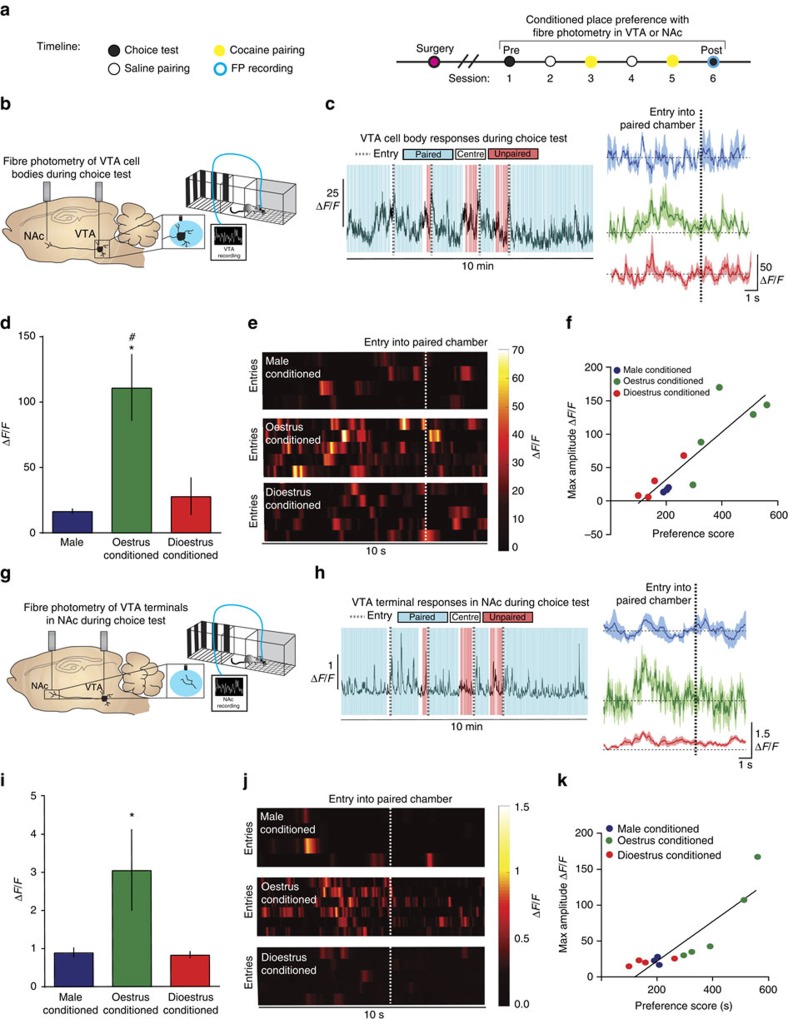
(a) Timeline of CPP experiments and paired fibre photometry recordings during choice test 24 h after the last conditioning session. (b) Schematic of recording experiments for VTA cell body recordings, which were taken during the choice test, 24 h after the last conditioning session. (c) Representative VTA Ca2+ activity trace during choice test demonstrating increases in activity preceding entry (dashed line) into the drug-paired (blue) chamber (left); averaged Ca2+ activity in a 10 s window around paired chamber entry (right). (d) The amplitude (ΔF/F) of the spike in Ca2+ activity preceding cocaine-paired chamber entry was increased in oestrus-conditioned female mice (one-way analysis of variance (ANOVA); F(2, 9)=6.603, P<0.05; *P<0.05; #P<0.05) when compared with males (#) or dioestrus females (*). (e) Heat maps of Ca2+ activity over time during successive entries (rows) into the cocaine-paired chamber across groups. (f) Correlation between the amplitude of VTA response to the cocaine-paired context and preference score for cocaine (r=0.881; P<0.0001). (g) Schematic of recording experiments for NAc recordings taken at the same time as VTA recordings during the choice test 24 h after the last conditioning session. (h) Representative Ca2+ activity trace, from the same animal as depicted in c, showing VTA terminal activity in the NAc around cocaine-paired (blue) and unpaired (red) entry where dashed lines denote entry into the cocaine-paired chamber (left); averaged Ca2+ activity in a 10 s window around paired chamber entry (right). (i) The amplitude of the spike in VTA terminal Ca2+ activity in NAc preceding cocaine-paired chamber entry was increased in oestrus-conditioned female mice (Kruskal–Wallis (KW); χ2 (2)=8.122, P<0.01; *P<0.05). (j) Heat maps of Ca2+ activity over time during successive entries (rows) into the cocaine-paired chamber across groups. (k) Correlation between the amplitude of VTA terminal Ca2+ activity in NAc to the cocaine-paired context and CPP for cocaine (r=0.883; P<0.0001). *P<0.05 versus dioestrus; #P<0.05 versus male. Data represented as mean±s.e.m.
Figure 4
Figure 4. Oestrous cycle-dependent fluctuations in VTA and NAc are mediated by dopaminergic signalling.
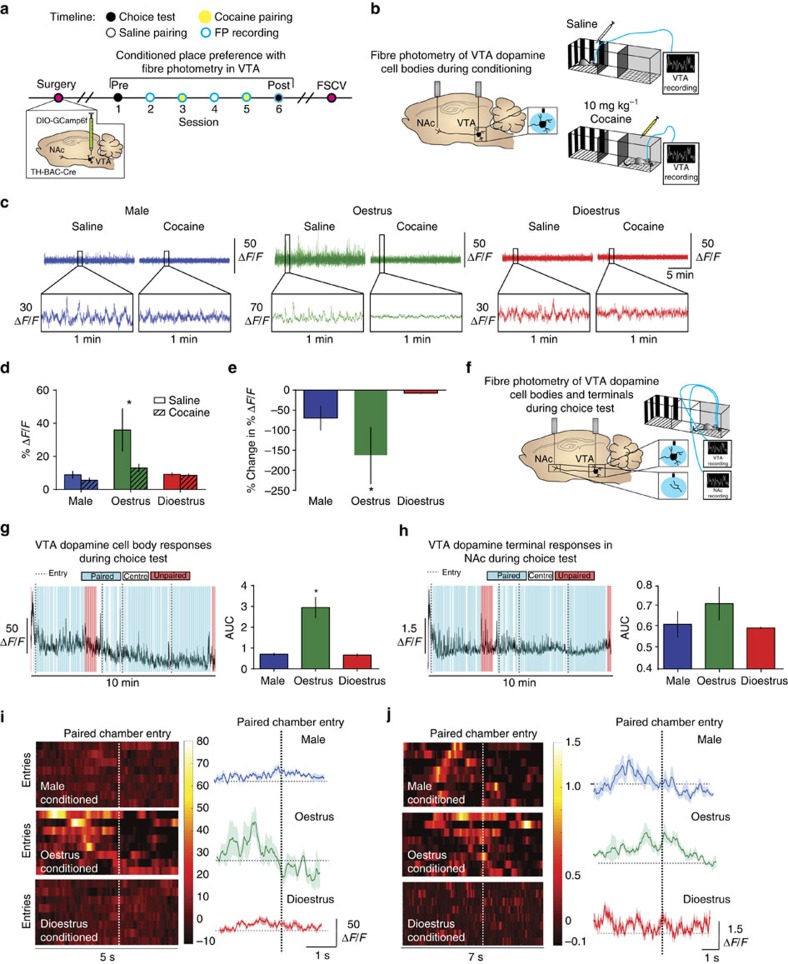
(a) Timeline of CPP experiments and paired fibre photometry recordings during choice test 24 h after the last conditioning session. (b) Schematic of recording experiments for VTA cell body recordings in TH-BAC-Cre mice, which were taken during the saline or cocaine pairing. (c) Representative Ca2+ imaging traces from male (left), oestrus female (middle) and dioestrus female (right) mice during saline and cocaine conditioning. (d) Cocaine reduces the amplitude of VTA Ca2+ events (two-way analysis of variance (ANOVA); F(1, 8)=8.63, P<0.01; *P<0.05 as compared with saline). (e) Cocaine-induced amplitude reductions in activity were greater during oestrus (one-way ANOVA; F(2, 8)=23.76; *P<0.05) when compared with males or dioestrus females. (f) Schematic of recording experiments for VTA cell body and terminal recordings in TH-BAC-Cre mice, which were taken during the choice test, 24 h after the last conditioning session. (g) Left: representative VTA Ca2+ activity trace during choice test demonstrating increases in activity preceding entry (dashed line) into the drug-paired (blue). (g) Right: the area under the curve (ΔF/F) of the spike in Ca2+ activity preceding cocaine-paired chamber entry was increased in oestrus-conditioned female mice (one-way ANOVA; F(2, 8)=5.80, P<0.05; *P<0.05). (h) Left: representative NAc Ca2+ activity trace. (h) Right: the area under the curve (ΔF/F) of the spike in Ca2+ activity in NAc terminals preceding cocaine-paired chamber entry (one-way ANOVA; F(2, 8)=4.50, P<0.05). (i) Left: heat maps of VTA-dopamine Ca2+ activity over time during successive entries (rows) into the cocaine-paired chamber across groups. (i) Right: averaged VTA-dopamine Ca2+ activity in a window around paired chamber entry. (j) Left: heat maps of NAc terminal-dopamine Ca2+ activity over time during successive entries. (j) Right: averaged NAc terminal-dopamine Ca2+ activity in a window around paired chamber entry. Data represented as mean±s.e.m.
Figure 5
Figure 5. Enhancing VTA dopamine activity in dioestrus females increases cocaine reward processing.
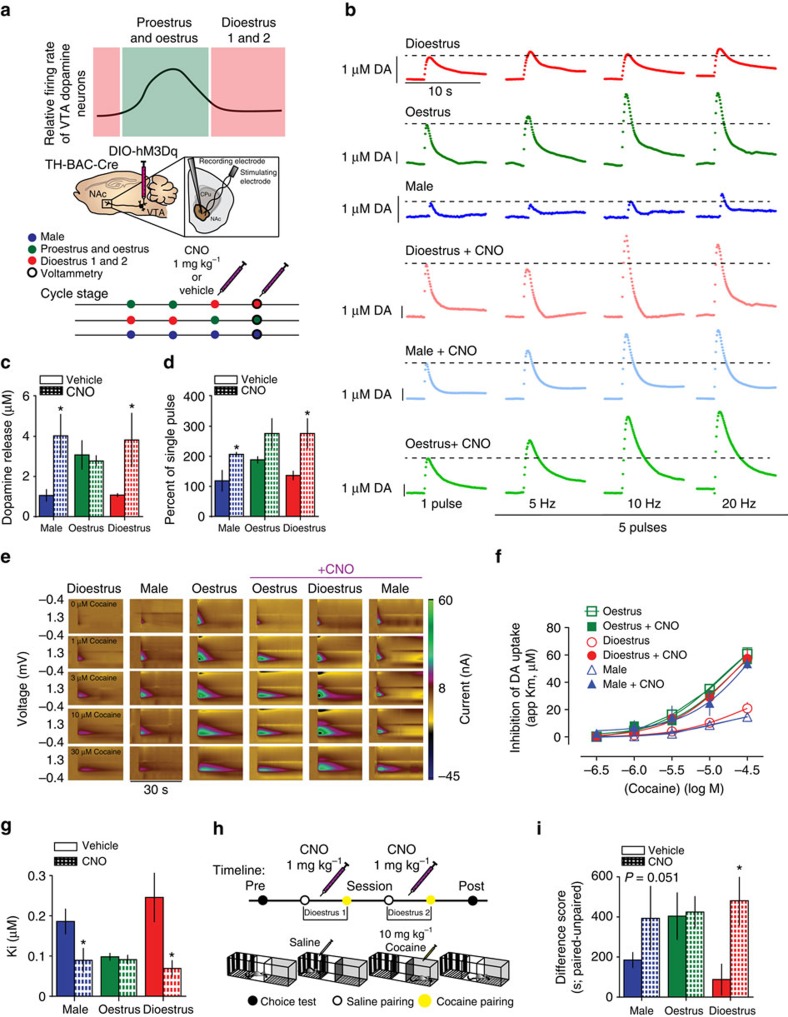
(a) Schematic of VTA firing through the oestrous cycle (top); experimental design using excitatory DREADDS (hM3Dq) expressed exclusively in dopamine neurons using TH-BAC-Cre mice to increase VTA dopamine activity (bottom). (b) Representative FSCV current versus time plots showing dopamine release to increasing frequency stimulations during oestrus, dioestrus or in males on the second day of vehicle or CNO injections. (c) Group data demonstrate enhanced dopamine per stimulation in dioestrus females and males that were given CNO to enhance VTA firing rates (one-way analysis of variance (ANOVA); F(5, 12)=3.78, P<0.05; *P<0.05). (d) Phasic responsivity was increased in dioestrus females and males given CNO (two-way ANOVA; F(5, 8)=3.93, P<0.05; *P<0.05. (e) Colour plots showing the presence of dopamine, as indicated by its oxidation at +0.6 V and reduction at −0.2 V, and the effects of bath application of 1, 3, 10 and 30 μM cocaine in each group. (f) Concentration–response curves showing that cocaine potency is increased in oestrus females and dioestrus females that were given CNO as compared with dioestrus controls. (g) Ki values showing that the affinity of cocaine for DAT is increased in dioestrus females and males given CNO (one-way ANOVA; F(5, 12)=3.89, P<0.05; *P<0.05). (h) Schematic of CPP experiments with CNO injections. (i) Increased CPP in male and dioestrus females with CNO+DREADDs to increase VTA firing (one-way ANOVA; F(5, 12)=3.78, P<0.05; *P<0.05 versus dioestrus). Data represented as mean±s.e.m.
Figure 6
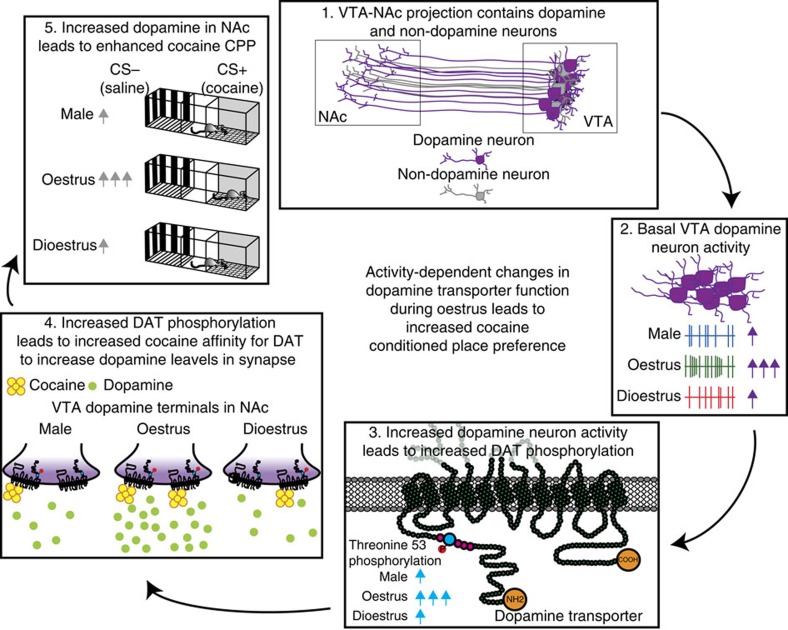
Figure 6. Proposed schematic highlighting a potential mechanism for the activity-dependent changes in reward processing that occur during oestrus.
(1) The VTA to NAc pathway comprises dopaminergic neurons (purple) and other neuronal subpopulations (grey). (2) Dopamine neuron firing is enhanced during oestrus. (3) The increased activity of this pathway leads to downstream ERK activation and concomitant phosphorylation of Thr53 (blue) on DAT. (4) These changes in DAT lead to alterations in cocaine affinity, whereby cocaine is more able to bind to DAT and increase extracellular dopamine levels. This increased cocaine binding leads to increased dopamine levels in the NAc. (5) In vivo this drives increased associations between cocaine and contextual cues, which leads to enhanced cocaine CPP due to differences in the perceived rewarding value of cocaine.

References

    1. Reid A. G., Lingford-Hughes A. R., Cancela L. M. & Kalivas P. W. Substance abuse disorders. Handb. Clin. Neurol. 106, 419–431 (2012). - PubMed
    1. Becker J. B. & Koob G. F. Sex differences in animal models: focus on addiction. Pharmacol. Rev. 68, 242–263 (2016). - PMC - PubMed
    1. Van Etten M. L., Neumark Y. D. & Anthony J. C. Male-female differences in the earliest stages of drug involvement. Addiction 94, 1413–1419 (1999). - PubMed
    1. Kasperski S. J. et al. College students' use of cocaine: results from a longitudinal study. Addict. Behav. 36, 408–411 (2011). - PMC - PubMed
    1. Randall C. L. et al. Telescoping of landmark events associated with drinking: a gender comparison. J. Stud. Alcohol 60, 252–260 (1999). - PubMed

Publication types