


Evaluation of the Association of Early Elevated Lactate With Outcomes in Children With Severe Sepsis or Septic Shock
- PMID: 28072671
- PMCID: PMC5502202
- DOI: 10.1097/PEC.0000000000001021
Evaluation of the Association of Early Elevated Lactate With Outcomes in Children With Severe Sepsis or Septic Shock
Abstract
Objective: The aim of the study was to assess the association of initial lactate (L0) with mortality in children with severe sepsis.
Methods: This prospective cohort study included 74 patients younger than 18 years with severe sepsis admitted to the pediatric intensive care unit (PICU) of a tertiary, academic children's hospital with lactate measured within 3 hours of meeting severe sepsis or septic shock. The primary outcome was in-hospital mortality. The secondary outcomes included PICU and hospital length of stay.
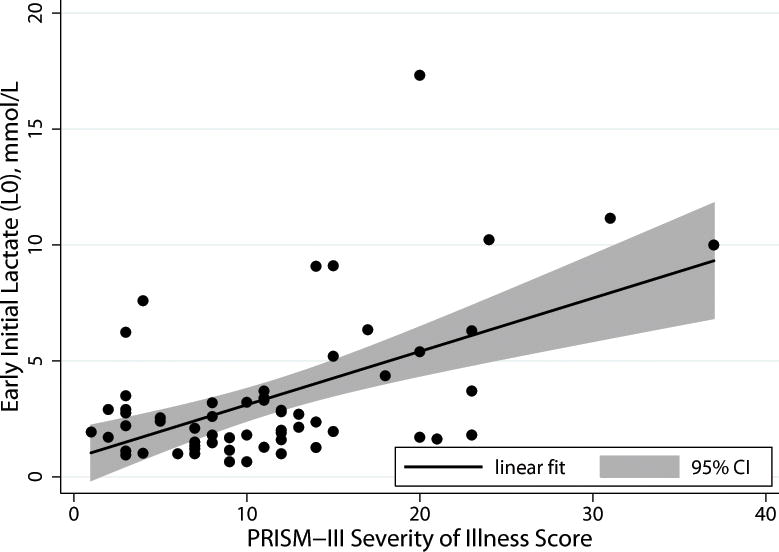
Results: Although overall mortality was 10.5% (n = 18), patients with L0 measured (n = 72) had a higher mortality (16% vs 6%, P = 0.03) and higher median PRISM-III risk of mortality scores (P = 0.02) than those who did not. Median L0 was no different between nonsurvivors and survivors (3.6 mmol/L [interquartile range, 2.0-9.0] in nonsurvivors vs 2.3 mmol/L [interquartile range, 1.4-3.5] in survivors, P = 0.11). However, L0 was independently associated with PRISM-III score (coefficient, 1.12; 95% confidence interval, 0.4-1.8; P = 0.003) with an increase in mean PRISM-III score of 1.12 U for every 1 mmol/L increase in L0, with L0 accounting for 12% of the variability in PRISM-III scores between patients. There was no association between L0 and PICU or hospital length of stay.
Conclusions: Although our single center study did not demonstrate that an elevated early lactate is associated with mortality in pediatric severe sepsis, L0 did correlate strongly with PRISM-III, the most robust measure of mortality risk in pediatrics. Therefore, early lactate measurement may be important as an early biomarker of disease severity. These data should be validated in a larger, multicenter, prospective study.
Conflict of interest statement
Conflicts of Interest:
There are no conflicts of interest to disclose.
Figures
References
-
- Ruth A, McCracken CE, Fortenberry JD, et al. Pediatric severe sepsis: current trends and outcomes from the Pediatric Health Information Systems database. Pediatr Crit Care Med. 2014 Nov;15(9):828–38. - PubMed
-
- Hartman ME, Linde-Zwirble WT, Angus DC, Watson RS. Trends in the epidemiology of pediatric severe sepsis. Pediatr Crit Care Med. 2013 Sep;14(7):686–93. - PubMed
-
- Tiru B, DiNino EK, Orenstein A, et al. The Economic and Humanistic Burden of Severe Sepsis. Pharmacoeconomics. 2015 May 3;33(9):925–37. - PubMed
-
- Burchardi H, Schneider H. Economic aspects of severe sepsis: a review of intensive care unit costs, cost of illness and cost effectiveness of therapy. Pharmacoeconomics. 2004 Jan;22(12):793–813. - PubMed
Publication types
MeSH terms
Substances
Grants and funding
LinkOut - more resources
Full Text Sources
Other Literature Sources
Medical
