


Screening the key microRNAs and transcription factors in prostate cancer based on microRNA functional synergistic relationships
- PMID: 28072703
- PMCID: PMC5228663
- DOI: 10.1097/MD.0000000000005679
Screening the key microRNAs and transcription factors in prostate cancer based on microRNA functional synergistic relationships
Abstract
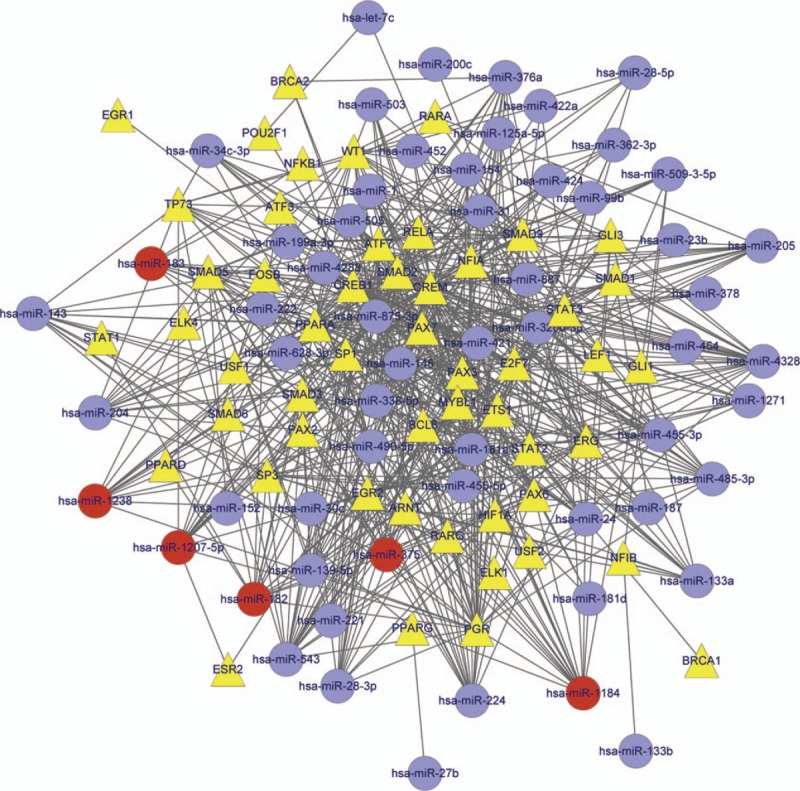
Prostate cancer (PC) is a common neoplasm, and metastatic PC remains incurable. The study aims to screen key microRNAs (miRNAs) and transcription factors (TFs) involved in PC.The miRNA expression profile dataset (GSE45604) was downloaded from Gene Expression Omnibus database, including 50 PC and 10 normal specimens. Differentially expressed miRNAs (DEmiRNAs) were identified through limma package in R, and DEmiRNA-DEmiRNA co-regulation network was constructed based on the number of co-regulated target genes. Functional enrichment analysis of co-regulated target genes was performed using clusterProfiler package in R, and miRNA interactions sharing at least 1 functional term were used to construct a DEmiRNA-DEmiRNA functional synergistic network (MFSN). Based on Transcriptional Regulatory Element Database, cancer-related TFs which were co-regulated by DEmiRNAs were utilized to construct a DEmiRNA-TF regulation network.A total of 66 DEmiRNAs were identified, including 7 up-regulated miRNAs with 18,642 target genes and 59 down-regulated miRNAs with 130,694 target genes. Then, the DEmiRNA-DEmiRNA co-regulation network was constructed, including 66 DEmiRNAs and 2024 co-regulation relationships. In MFSN, hsa-miR-1184, hsa-miR-1207-5p, and hsa-miR-24 had significant functional synergistic relationships. The DEmiRNA-TF network contained 6 up-regulated DEmiRNAs and 4 of them were highlighted, as hsa-miR-1184, hsa-miR-1207-5p, hsa-miR-182, and hsa-miR-183. In subnetwork of the 4 miRNAs, peroxisome proliferative activated receptor, alpha (PPARA) and cyclic AMP-responsive element modulator (CREM) were the critical regulated TFs.Four up-regulated miRNAs (hsa-miR-1207-5p, hsa-miR-1184, hsa-miR-182, and hsa-miR-183) and 2 TFs (PPARA and CREM) were identified as key regulators in PC progression. The above 4 miRNAs might participate in PC progression by targeting PPARA and CREM.
Conflict of interest statement
The authors have no conflicts of interest to disclose.
Figures



References
-
- Varambally S, Dhanasekaran SM, Zhou M, et al. The polycomb group protein EZH2 is involved in progression of prostate cancer. Nature 2002;419:624–9. - PubMed
-
- Barbieri CE, Demichelis F, Rubin MA. Molecular genetics of prostate cancer: emerging appreciation of genetic complexity. Histopathology 2012;60:187–98. - PubMed
-
- Cavalieri EL, Devanesan P, Bosland MC, et al. Catechol estrogen metabolites and conjugates in different regions of the prostate of Noble rats treated with 4-hydroxyestradiol: implications for estrogen-induced initiation of prostate cancer. Carcinogenesis 2002;23:329–33. - PubMed
MeSH terms
Substances
LinkOut - more resources
Full Text Sources
Other Literature Sources
Medical
Miscellaneous
