


Life-threatening motor vehicle crashes in bright sunlight
- PMID: 28072708
- PMCID: PMC5228668
- DOI: 10.1097/MD.0000000000005710
Life-threatening motor vehicle crashes in bright sunlight
Abstract
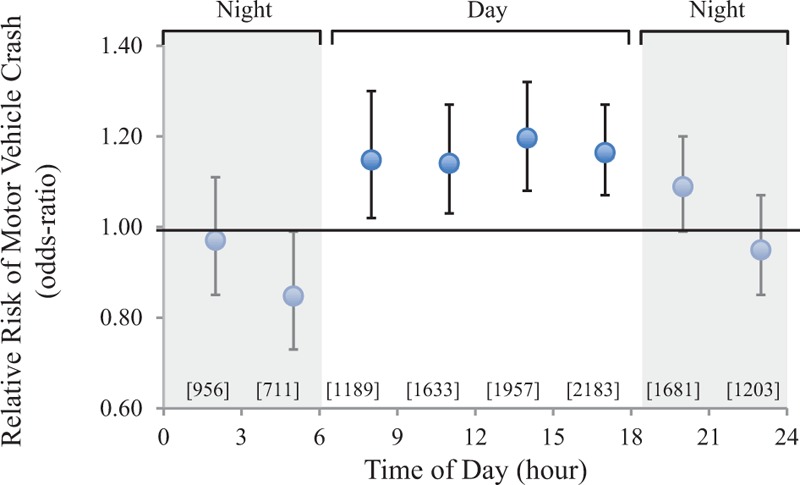
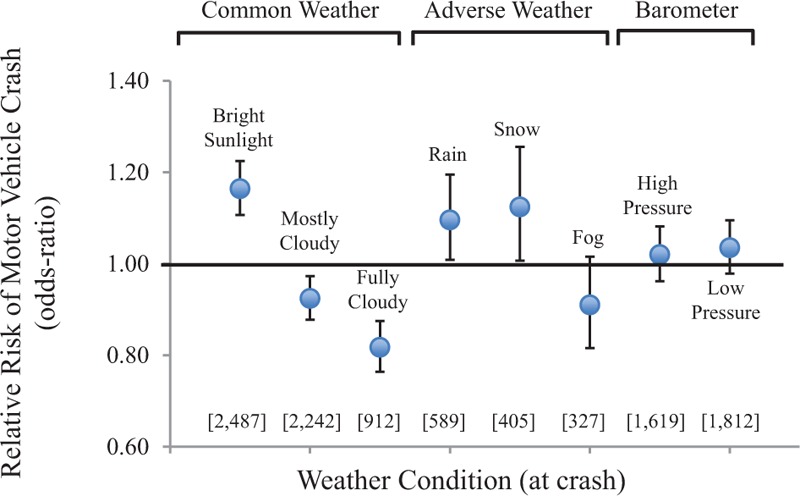
Bright sunlight may create visual illusions that lead to driver error, including fallible distance judgment from aerial perspective. We tested whether the risk of a life-threatening motor vehicle crash was increased when driving in bright sunlight.This longitudinal, case-only, paired-comparison analysis evaluated patients hospitalized because of a motor vehicle crash between January 1, 1995 and December 31, 2014. The relative risk of a crash associated with bright sunlight was estimated by evaluating the prevailing weather at the time and place of the crash compared with the weather at the same hour and location on control days a week earlier and a week later.The majority of patients (n = 6962) were injured during daylight hours and bright sunlight was the most common weather condition at the time and place of the crash. The risk of a life-threatening crash was 16% higher during bright sunlight than normal weather (95% confidence interval: 9-24, P < 0.001). The increased risk was accentuated in the early afternoon, disappeared at night, extended to patients with different characteristics, involved crashes with diverse features, not apparent with cloudy weather, and contributed to about 5000 additional patient-days in hospital. The increased risk extended to patients with high crash severity as indicated by ambulance involvement, surgical procedures, length of hospital stay, intensive care unit admission, and patient mortality. The increased risk was not easily attributed to differences in alcohol consumption, driving distances, or anomalies of adverse weather.Bright sunlight is associated with an increased risk of a life-threatening motor vehicle crash. An awareness of this risk might inform driver education, trauma staffing, and safety warnings to prevent a life-threatening motor vehicle crash.
Level of evidence: Epidemiologic Study, level III.
Conflict of interest statement
The authors disclose no conflicts of interest.
Figures
References
-
- WHO. The Top 10 Causes of Death Worldwide. Geneva, Switzerland: World Health Organization; October 2008 [cited June 9, 2015]. Available at: http://www.who.int/mediacentre/factsheets/fs310/en/index.html.
-
- Redelmeier DA, Bayoumi AM. Time lost by driving fast in the United States. Med Decis Making 2010;30:E12–9. - PubMed
-
- Blincoe L, Seay A, Zaloshnja E, et al. The Economic Impact of Motor Vehicle Crashes, 2000. Washington, DC:Dept of Transportation (US), National Highway Traffic Safety Administration (NHTSA); 2002.
-
- Shackford SR, Mackersie RC, Holbrook TL, et al. The epidemiology of traumatic death: a population-based analysis. Arch Surg 1993;128:571–5. - PubMed
MeSH terms
LinkOut - more resources
Full Text Sources
Other Literature Sources
Medical
Research Materials
