Case Reports
. 2017 Jan 10;15(1):18.
doi: 10.1186/s12957-016-1090-3.

Successful multimodal treatment of intraoral salivary duct carcinoma in a patient with multiple lymph node metastases: a case report

Affiliations
Case Reports

Successful multimodal treatment of intraoral salivary duct carcinoma in a patient with multiple lymph node metastases: a case report

Shuichi Imaue et al. World J Surg Oncol. .

Abstract

Background: Salivary duct carcinoma (SDC) is a high-grade salivary gland malignancy that is associated with an aggressive clinical behavior and poor prognosis. Herein, we report on a long surviving case of SDC of the minor salivary gland with multiple lymph node metastases (LNMs).

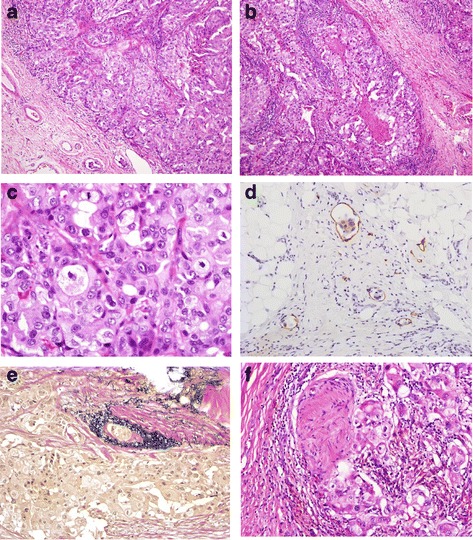
Case presentation: An 83-year-old woman presented with a history of lymphadenopathy in the right side of the neck and recent onset and rapid growth of a mass in the right buccal region. Clinical examinations and biopsy findings were suggestive of a salivary gland malignant tumor with regional LNMs. The patient was treated with neoadjuvant chemotherapy. Tumor excision and ipsilateral radical neck dissection were performed, followed by adjuvant chemoradiotherapy. Postoperative histological examination revealed a tumor with irregular nests of atypical ductal epithelial cells, a cribriform growth pattern, and comedo-like central necrosis that lead to a final diagnosis of SDC. LNMs were observed in six lymph nodes of the right side of the neck. The patient underwent postoperative chemotherapy using single-agent cisplatin that was administered concurrently with radiotherapy (total, 65 Gy). There was no evidence of local recurrence or distant metastasis for >6 years.

Conclusions: Although available data on treatment modalities for SDC remain limited, multimodal therapy may contribute to improved clinical outcomes in patients with advanced intraoral SDC.

Keywords: Lymph node metastasis; Multimodal therapy; Salivary duct carcinoma.


Figures
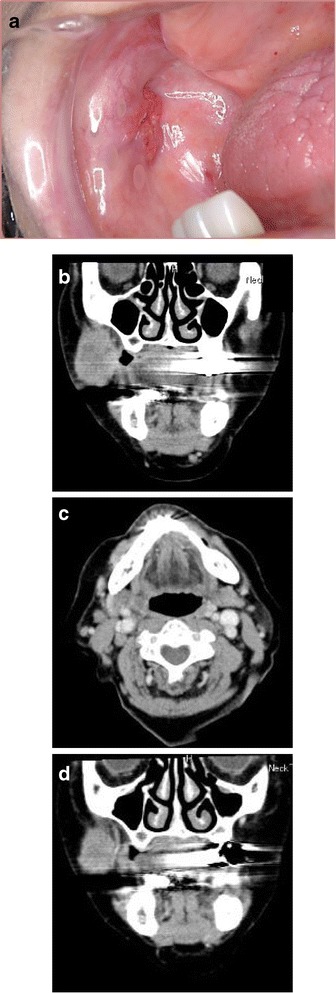
Fig. 1
Fig. 1
a An intraoral photograph revealing an ulcerated lesion in the right buccal region. b, c Computed tomography demonstrating a homogeneously enhanced lesion in the right buccal region and multiple, enlarged lymph nodes in the right side of the neck. The largest diameter of the tumor on initial assessment (b) and after induction chemotherapy (d) was 34.2 to 26.0 cm, respectively. The tumor exhibited a reduction in size (d) in response to induction chemotherapy using an intra-arterial infusion of high-dose cisplatin and concurrent peroral TS-1
Fig. 2
Fig. 2
Microscopic features of salivary duct carcinoma on hematoxylin and eosin staining. a, b The tumor was composed of a neoplastic component characterized by atypical ductal epithelial cells, a cribriform growth pattern, and comedo-like central necrosis. c The epithelium was primarily composed of polygonal shaped cells with an abundant eosinophilic cytoplasm (numerous mitotic figures) and large nuclei (nuclear atypia). d Lymphatic invasion, e vascular invasion, and f perineural invasion were observed on podoplanin, elastic Van Gieson, and hematoxylin and eosin staining, respectively
Fig. 3
Fig. 3
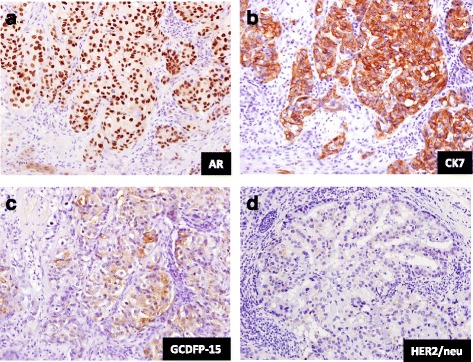
Immunohistochemical staining for androgen receptor, cytokeratin 7, gross cystic disease fluid protein-15 (GCDFP-15), and human epithelial growth factor receptor 2 (HER2)/neu. The tumor cells were immunoreactive for a androgen receptor and b cytokeratin 7 and focally immunoreactive for c GCDFP-15 but were not immunoreactive for (d) HER2/neu

References

    1. Kleinsasser O, Klein HJ, Hübner G. Salivary duct carcinoma. A group of salivary gland tumors analogous to mammary duct carcinoma. Arch Klin Exp Ohren Nasen Kehlkopfheilkd. 1968;192:100–105. doi: 10.1007/BF00301495. - DOI - PubMed
    1. Seifert G, Sobin LH. Histological typing of salivary gland tumours, 2nd ed. Berlin, Germany: Springer-Verlag; 1991.
    1. Jaehne M, Roeser K, Jaekel T, Schepers JD, Albert N, Löning T. Clinical and immunohistologic typing of salivary duct carcinoma: a report of 50 cases. Cancer. 2005;103:2526–2533. doi: 10.1002/cncr.21116. - DOI - PubMed
    1. Jayaprakash V, Merzianu M, Warren GW, et al. Survival rates and prognostic factors for infiltrating salivary duct carcinoma: analysis of 228 cases from the Surveillance, Epidemiology, and End results database. Head Neck. 2014;36:694–701. doi: 10.1002/hed.23350. - DOI - PMC - PubMed
    1. Otsuka K, Imanishi Y, Tada Y, et al. Clinical outcomes and prognostic factors for salivary duct carcinoma: a multi-institutional analysis of 141 patients. Ann Surg Oncol. 2016;23:2038–2045. doi: 10.1245/s10434-015-5082-2. - DOI - PMC - PubMed

Publication types