Migraine and risk of perioperative ischemic stroke and hospital readmission: hospital based registry study
- PMID: 28073753
- PMCID: PMC5225233
- DOI: 10.1136/bmj.i6635
Migraine and risk of perioperative ischemic stroke and hospital readmission: hospital based registry study
Abstract
Objective: To evaluate whether patients with migraine are at increased risk of perioperative ischemic stroke and whether this may lead to an increased hospital readmission rate.
Design: Prospective hospital registry study.
Setting: Massachusetts General Hospital and two satellite campuses between January 2007 and August 2014.
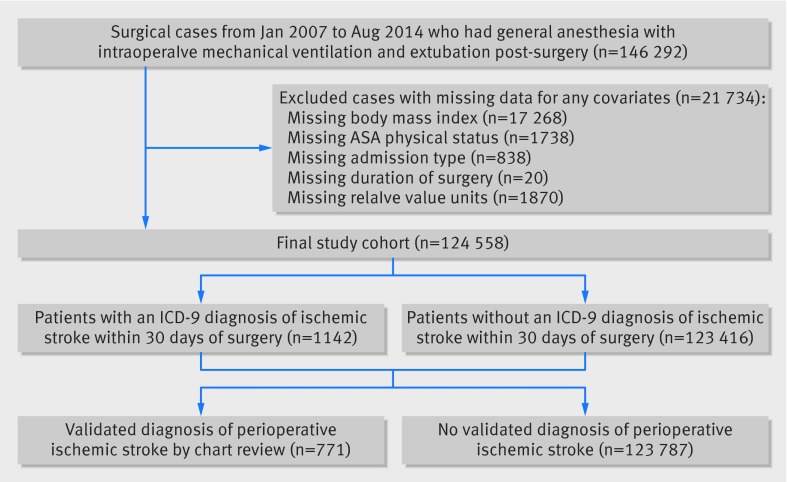
Participants: 124 558 surgical patients (mean age 52.6 years; 54.5% women).
Main outcome measures: The primary outcome was perioperative ischemic stroke occurring within 30 days after surgery in patients with and without migraine and migraine aura. The secondary outcome was hospital readmission within 30 days of surgery. Exploratory outcomes included post-discharge stroke and strata of neuroanatomical stroke location.
Results: 10 179 (8.2%) patients had any migraine diagnosis, of whom 1278 (12.6%) had migraine with aura and 8901 (87.4%) had migraine without aura. 771 (0.6%) perioperative ischemic strokes occurred within 30 days of surgery. Patients with migraine were at increased risk of perioperative ischemic stroke (adjusted odds ratio 1.75, 95% confidence interval 1.39 to 2.21) compared with patients without migraine. The risk was higher in patients with migraine with aura (adjusted odds ratio 2.61, 1.59 to 4.29) than in those with migraine without aura (1.62, 1.26 to 2.09). The predicted absolute risk is 2.4 (2.1 to 2.8) perioperative ischemic strokes for every 1000 surgical patients. This increases to 4.3 (3.2 to 5.3) for every 1000 patients with any migraine diagnosis, 3.9 (2.9 to 5.0) for migraine without aura, and 6.3 (3.2 to 9.5) for migraine with aura. : Patients with migraine had a higher rate of readmission to hospital within 30 days of discharge (adjusted odds ratio 1.31, 1.22 to 1.41).
Conclusions: Surgical patients with a history of migraine are at increased risk of perioperative ischemic stroke and have an increased 30 day hospital readmission rate. Migraine should be considered in the risk assessment for perioperative ischemic stroke.
Published by the BMJ Publishing Group Limited. For permission to use (where not already granted under a licence) please go to http://group.bmj.com/group/rights-licensing/permissions.
Conflict of interest statement
Competing interests: All authors have completed the ICMJE uniform disclosure form at www.icmje.org/coi_disclosure.pdf (available on request from the corresponding author) and declare: TTH has received a research grant from Merck Inc, has served as a statistical consultant for Depomed Inc, receives payment for statistical reviewing from Anesthesiology, Annals of Surgery, and Headache, and has received research grants from National Institutes of Health (NINDS, NIGMS); TK has received grants from the Else-Kröner-Fresenius-Stiftung/German Scholars Organization, the US National Institutes of Health, and the French National Research Agency, is a consultant for Amgen on a scientific project, for which the Charité - Universitätsmedizin Berlin receives research funds, has received honorariums for editorial services from The BMJ and Cephalalgia, and, as a board of trustees member of the International Headache Society, has received compensation for travel and accommodation expenses; ME has received funding for research projects from Merck, has an equity stake at Calabash Bioscience Inc, and received funding from a research grant from the Buzen Fund, established by Jeffrey Buzen and Judith Buzen of Boston, Massachusetts; no other relationships or activities that could appear to have influenced the submitted work.
Figures
Comment in
-
[Does migraine lead perioperatively to stroke?].Anaesthesist. 2017 Apr;66(4):291-292. doi: 10.1007/s00101-017-0287-3. Anaesthesist. 2017. PMID: 28246752 German. No abstract available.
References
-
- Smitherman TA, Burch R, Sheikh H, Loder E. The prevalence, impact, and treatment of migraine and severe headaches in the United States: a review of statistics from national surveillance studies. Headache 2013;53:427-36. 10.1111/head.12074 pmid:23470015. - DOI - PubMed
-
- Goadsby PJ, Lipton RB, Ferrari MD. Migraine--current understanding and treatment. N Engl J Med 2002;346:257-70. 10.1056/NEJMra010917 pmid:11807151. - DOI - PubMed
-
- Henrich JB, Horwitz RI. A controlled study of ischemic stroke risk in migraine patients. J Clin Epidemiol 1989;42:773-80. 10.1016/0895-4356(89)90075-9 pmid:2760669. - DOI - PubMed
-
- Kurth T, Slomke MA, Kase CS, et al. Migraine, headache, and the risk of stroke in women: a prospective study. Neurology 2005;64:1020-6. 10.1212/01.WNL.0000154528.21485.3A pmid:15781820. - DOI - PubMed
-
- MacClellan LR, Giles W, Cole J, et al. Probable migraine with visual aura and risk of ischemic stroke: the stroke prevention in young women study. Stroke 2007;38:2438-45. 10.1161/STROKEAHA.107.488395 pmid:17690308. - DOI - PubMed
MeSH terms
LinkOut - more resources
Full Text Sources
Other Literature Sources
Medical
Miscellaneous