Predictive modeling of respiratory tumor motion for real-time prediction of baseline shifts
- PMID: 28075331
- PMCID: PMC5702258
- DOI: 10.1088/1361-6560/aa58c3
Predictive modeling of respiratory tumor motion for real-time prediction of baseline shifts
Abstract
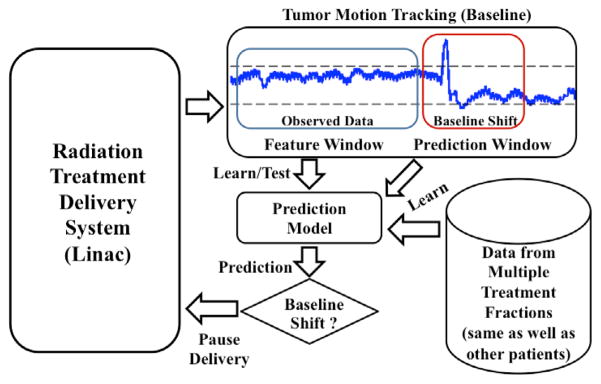
Baseline shifts in respiratory patterns can result in significant spatiotemporal changes in patient anatomy (compared to that captured during simulation), in turn, causing geometric and dosimetric errors in the administration of thoracic and abdominal radiotherapy. We propose predictive modeling of the tumor motion trajectories for predicting a baseline shift ahead of its occurrence. The key idea is to use the features of the tumor motion trajectory over a 1 min window, and predict the occurrence of a baseline shift in the 5 s that immediately follow (lookahead window). In this study, we explored a preliminary trend-based analysis with multi-class annotations as well as a more focused binary classification analysis. In both analyses, a number of different inter-fraction and intra-fraction training strategies were studied, both offline as well as online, along with data sufficiency and skew compensation for class imbalances. The performance of different training strategies were compared across multiple machine learning classification algorithms, including nearest neighbor, Naïve Bayes, linear discriminant and ensemble Adaboost. The prediction performance is evaluated using metrics such as accuracy, precision, recall and the area under the curve (AUC) for repeater operating characteristics curve. The key results of the trend-based analysis indicate that (i) intra-fraction training strategies achieve highest prediction accuracies (90.5-91.4%); (ii) the predictive modeling yields lowest accuracies (50-60%) when the training data does not include any information from the test patient; (iii) the prediction latencies are as low as a few hundred milliseconds, and thus conducive for real-time prediction. The binary classification performance is promising, indicated by high AUCs (0.96-0.98). It also confirms the utility of prior data from previous patients, and also the necessity of training the classifier on some initial data from the new patient for reasonable prediction performance. The ability to predict a baseline shift with a sufficient look-ahead window will enable clinical systems or even human users to hold the treatment beam in such situations, thereby reducing the probability of serious geometric and dosimetric errors.
Figures




References
-
- Adler J, Chang S, Murphy M, Doty J, Geis P, Hancock S. The cyberknife: a frameless robotic system for radiosurgery. Stereotactic Funct Neurosurg. 1997;69:124–8. - PubMed
-
- Arlot S, Celisse A. A survey of cross-validation procedures for model selection. Stat Surv. 2010;4:40–79.
-
- Brown C, Davis H. Receiver operating characteristics curves and related decision measures: a tutorial. Chemometr Intell Lab Syst. 2006;80:24–38.
-
- Cover TM, Hart PE. Nearest neighbor pattern classification. IEEE Trans Inf Theory. 1967;13:21–7.
MeSH terms
Grants and funding
LinkOut - more resources
Full Text Sources
Other Literature Sources