


Atmospheric fine particulate matter and breast cancer mortality: a population-based cohort study
- PMID: 28076275
- PMCID: PMC5129133
- DOI: 10.1136/bmjopen-2016-012580
Atmospheric fine particulate matter and breast cancer mortality: a population-based cohort study
Abstract
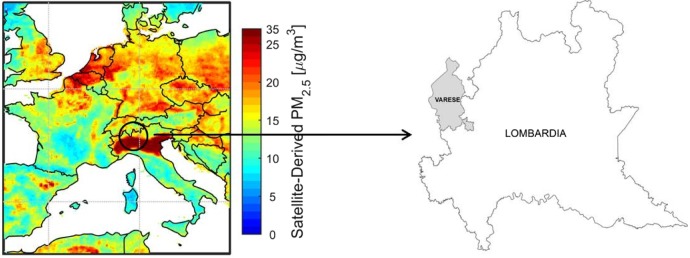
Objectives: Atmospheric fine particulate matter (PM2.5) has multiple adverse effects on human health. Global atmospheric levels of PM2.5 increased by 0.55 μg/m3/year (2.1%/year) from 1998 through 2012. There is evidence of a causal relationship between atmospheric PM2.5 and breast cancer (BC) incidence, but few studies have investigated BC mortality and atmospheric PM2.5. We investigated BC mortality in relation to atmospheric PM2.5 levels among patients living in Varese Province, northern Italy.
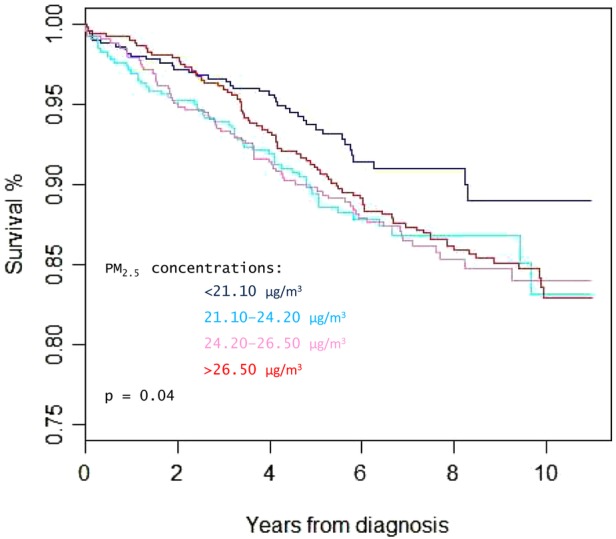
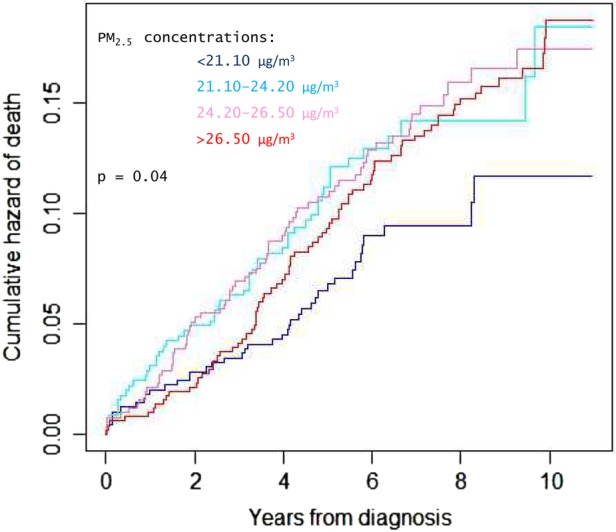
Methods: We selected female BC cases, archived in the local population-based cancer registry, diagnosed at age 50-69 years, between 2003 and 2009. The geographic coordinates of each woman's place of residence were identified, and individual PM2.5 exposures were assessed from satellite data. Grade, stage, age at diagnosis, period of diagnosis and participation in BC screening were potential confounders. Kaplan-Meir and Nelson-Aalen methods were used to test for mortality differences in relation to PM2.5 quartiles. Multivariable Cox proportional hazards modelling estimated HRs and 95% CIs of BC death in relation to PM2.5 exposure.
Results: Of 2021 BC cases, 325 died during follow-up to 31 December 2013, 246 for BC. Risk of BC death was significantly higher for all three upper quartiles of PM2.5 exposure compared to the lowest, with HRs of death: 1.82 (95% CI 1.15 to 2.89), 1.73 (95% CI 1.12 to 2.67) and 1.72 (95% CI 1.08 to 2.75).
Conclusions: Our study indicates that the risk of BC mortality increases with PM2.5 exposure. Although additional research is required to confirm these findings, they are further evidence that PM2.5 exposure is harmful and indicate an urgent need to improve global air quality.
Keywords: cancer registry; environment; particulate matter; prognosis; survival.
Published by the BMJ Publishing Group Limited. For permission to use (where not already granted under a licence) please go to http://www.bmj.com/company/products-services/rights-and-licensing/.
Conflict of interest statement
Conflicts of Interest: None declared.
Figures
References
-
- IARC Scientific Publication no. 161: Air pollution and cancer. http://www.iarc.fr/en/publications/books/sp161/AirPollutionandCancer161.pdf. - PubMed
-
- Barman SC, Kumar N, Singh R et al. Assessment of urban air pollution and it's probable health impact. J Environ Biol 2010;31:913–20. - PubMed
-
- Fantke P, Jolliet O, Evans JS et al. Health effects of fine particulate matter in life cycle impact assessment: findings from the Basel Guidance Workshop. Int J Life Cycle Assess 2015;20:276–88. 10.1007/s11367-014-0822-2 - DOI
-
- IARC monographs: volume 109: outdoor air pollution. http://monographs.iarc.fr/ENG/Monographs/vol109/mono109.pdf. - PMC - PubMed
MeSH terms
Substances
LinkOut - more resources
Full Text Sources
Other Literature Sources
Medical
