


The correlation of age with chemotherapy-induced ovarian function failure in breast cancer patients
- PMID: 28076330
- PMCID: PMC5355271
- DOI: 10.18632/oncotarget.14532
The correlation of age with chemotherapy-induced ovarian function failure in breast cancer patients
Abstract
Purpose: To assess the incidence of chemotherapy-induced ovarian function failure (COFF) based on estradiol and follicle stimulating hormone (FSH) monitoring in premenopausal women with hormone-receptor positive breast cancer treated with second and third generation (neo-)adjuvant chemotherapy.
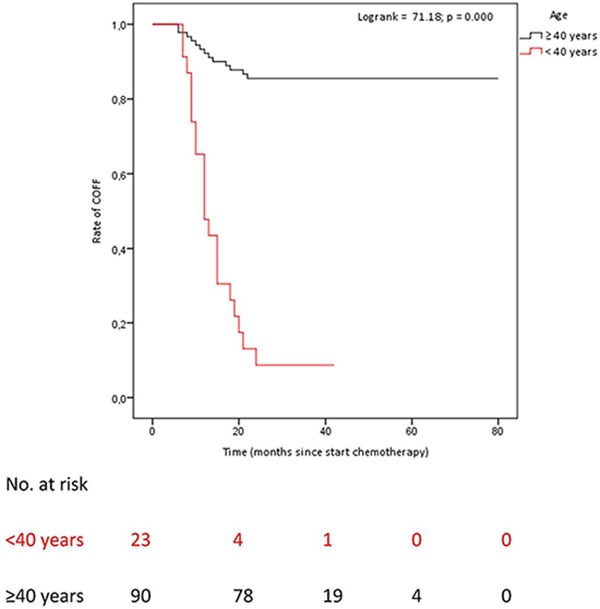
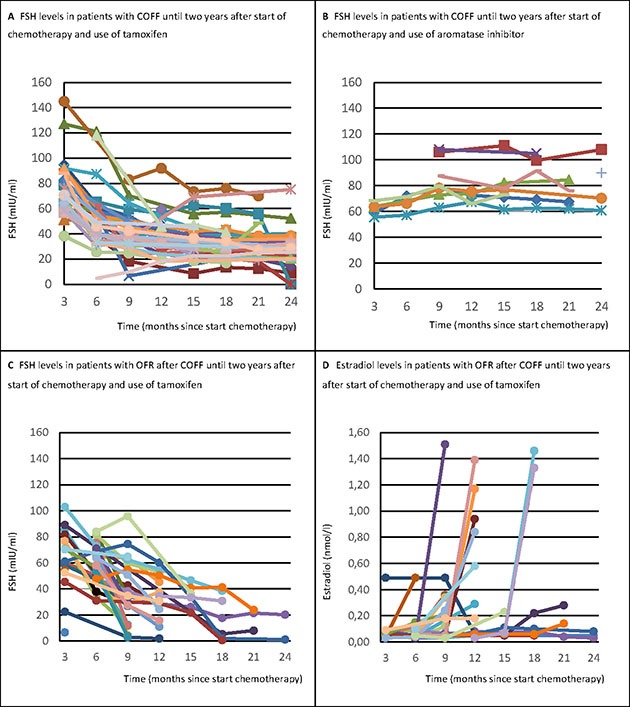
Results: We identified 115 eligible women. Two years after start of chemotherapy, COFF was significantly more often present in women ≥ 40 years (85.6%) as compared to women < 40 years (8.7%). Only age was significantly associated with COFF two years after start of chemotherapy (HR 12.26; 95% CI 5.21-28.86). In 50% of the patients, premenopausal hormone levels were the first or only evidence of ovarian function recovery (OFR).
Materials and methods: We included all premenopausal women with hormone-receptor positive breast cancer treated with anthracycline-based chemotherapy, with or without taxanes, in our university hospital in the Netherlands in the years 2005-2013. Patients were 3-monthly monitored for ovarian function. Cox proportional hazards model was used to determine the predictive impact of various parameters on the occurrence of COFF.
Conclusions: After second- or third generation (neo-)adjuvant chemotherapy, COFF was still present in 8.7% of patients < 40 years after two years. FSH and estradiol monitoring may be relevant for those in whom ovarian function suppression is considered an additional effective endocrine treatment.
Keywords: breast cancer; chemotherapy; chemotherapy induced ovarian function failure; ovarian insufficiency; premenopausal patients.
Conflict of interest statement
None declared.
Figures
References
-
- Torino F, Barnabei A, De Vecchis L, Sini V, Schittulli F, Marchetti P, Corsello SM. Chemotherapy-induced ovarian toxicity in patients affected bij endocrine-responsive early breast cancer. Critical Reviews in Oncology/Hematology. 2014;89:27–42. - PubMed
-
- Walshe JM, Denduluri N, Swain SM. Amenorrhea in premenopausal women after adjuvant chemotherapy for breast cancer. J Clin Oncol. 2006;24:5769–5779. - PubMed
-
- Tham YL, Sexton K, Weiss H, Elledge R, Friedman LC, Kramer R. The rates of chemotherapy-induced amenorrhea in patients treated with adjuvant doxorubicin and Cyclophosphamide followed by a taxane. Am J Clin Oncol. 2007;30:126–132. - PubMed
-
- Yung M, Shin HJ, Rha SY, Jeung HC, Hong S, Moon YW, Kim HS, Oh KJ, Yang WI, Roh JK, Chung HC. The clinical outcome of chemotherapy-induced amenorrhea in premenopausal young patients with breast cancer with long-term follow-up. Ann Surg Oncol. 2010;17:3259–3268. - PubMed
-
- Okanami Y, Ito Y, Watanabe C, Iijima K, Iwase T, Tokudome N, Takahashi S, Hatake K. Incidence of chemotherapy-induced amenorrhea in premenopausal patients with breast cancer following adjuvant anthracycline and taxane. Breast Cancer. 2011;18:182–188. - PubMed
MeSH terms
Substances
LinkOut - more resources
Full Text Sources
Other Literature Sources
Medical
