. 2017 Jan 11;12(1):e0169938.
doi: 10.1371/journal.pone.0169938. eCollection 2017.

Distinct Subtypes of Apathy Revealed by the Apathy Motivation Index

Affiliations

Distinct Subtypes of Apathy Revealed by the Apathy Motivation Index

Yuen-Siang Ang et al. PLoS One. .

Abstract

Apathy is a debilitating but poorly understood disorder characterized by a reduction in motivation. As well as being associated with several brain disorders, apathy is also prevalent in varying degrees in healthy people. Whilst many tools have been developed to assess levels of apathy in clinical disorders, surprisingly there are no measures of apathy suitable for healthy people. Moreover, although apathy is commonly comorbid with symptoms of depression, anhedonia and fatigue, how and why these symptoms are associated is unclear. Here we developed the Apathy-Motivation Index (AMI), a brief self-report index of apathy and motivation. Using exploratory factor analysis (in a sample of 505 people), and then confirmatory analysis (in a different set of 479 individuals), we identified subtypes of apathy in behavioural, social and emotional domains. Latent profile analyses showed four different profiles of apathy that were associated with varying levels of depression, anhedonia and fatigue. The AMI is a novel and reliable measure of individual differences in apathy and might provide a useful means of probing different mechanisms underlying sub-clinical lack of motivation in otherwise healthy individuals. Moreover, associations between apathy and comorbid states may be reflective of problems in different emotional, social and behavioural domains.


Conflict of interest statement

The authors have declared that no competing interests exist.

Figures

Fig 1
Fig 1. Apathy Motivation Index (AMI) factor model.
The factor analysis identified three distinct subscales, namely behavioural activation (BA), social motivation (SM) and emotional sensitivity (ES). BA relates to an individual’s tendency to self-initiate goal-directed behaviour, SM examines a person’s engagement of social interactions and ES probes an individual’s feelings of positive and negative affection. While SM correlated with BA and ES, BA did not associate with ES. (**: p < 0.01).
Fig 2
Fig 2. Correlation coefficients between AMI subscales and established measures of depression, anhedonia and fatigue.
BA and SM correlated positively with BDI and MFIS, indicating that individuals that were more apathetic on these subscales also had higher levels of depression and fatigue. In contrast the ES scale was negatively correlated with depression and fatigue. All three AMI subscales were negatively correlated with the SHAPS (lower scores indicate higher levels of anhedonia), suggesting that higher apathy was associated with lower hedonia.
Fig 3
Fig 3. Distribution of apathy along the AMI subscales and conditional response means of the 4-class solution.
The AMI consists of three subscales: Behavioural Activation, Social Motivation and Emotional Sensitivity. Every subscale contains 6 items that is each scored from 0–4, with a higher mean score indicating greater apathy. (A) 3D scatterplot illustrating the distribution of each healthy individual’s mean rating along the three AMI subscales. The four classes were labelled generally motivated (orange), behaviourally/socially apathetic (green), emotionally apathetic (blue), and generally apathetic (red). (B) Conditional response mean value greater than overall sample means (black line) indicates apathy on that AMI subscale.
Fig 4
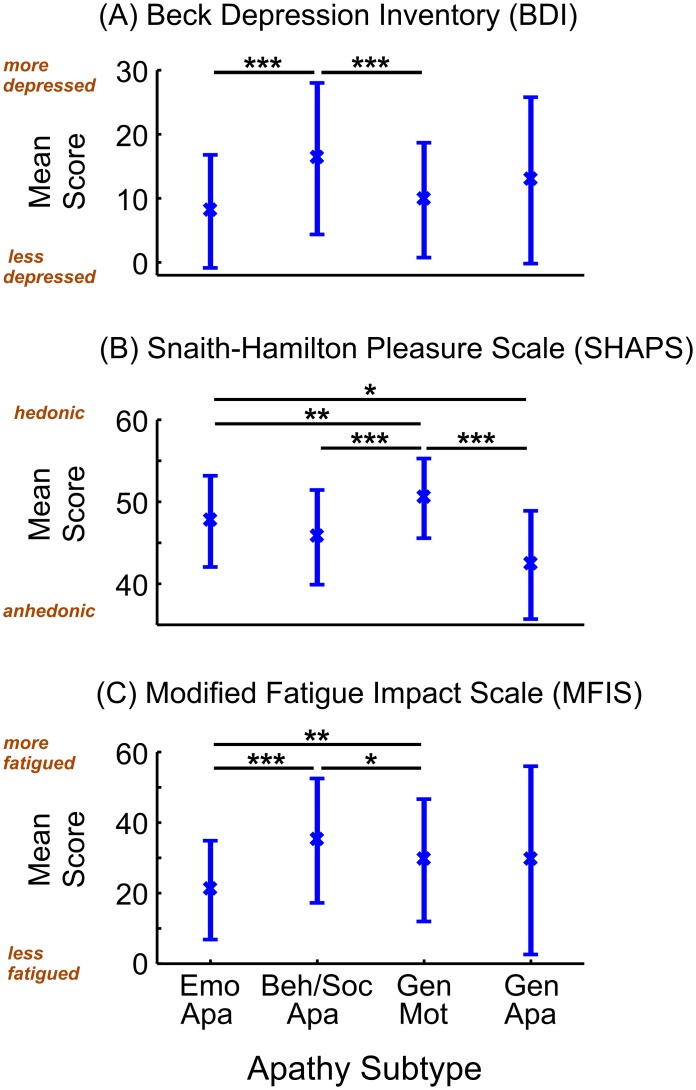
Fig 4. Relationships between apathy subtype and depression, anhedonia and fatigue.
The four apathy-motivation subtypes were predictive of different associations with depression (A), anhedonia (B) and fatigue (C). The behaviourally/socially apathetic experienced the greatest depression and fatigue while the generally motivated were most hedonic. (* p < 0.05, ** p < 0.01, *** p < 0.001).

References

    1. Marin RS. Apathy: a neuropsychiatric syndrome. J Neuropsychiatry Clin Neurosci. 1991;3(3):243–54. 10.1176/jnp.3.3.243 - DOI - PubMed
    1. Levy R, Dubois B. Apathy and the Functional Anatomy of the Prefrontal Cortex-Basal Ganglia Circuits. Cereb Cortex. 2006;16(7):916–28. 10.1093/cercor/bhj043 - DOI - PubMed
    1. Pagonabarraga J, Kulisevsky J, Strafella AP, Krack P. Apathy in Parkinson’s disease: clinical features, neural substrates, diagnosis, and treatment. Lancet Neurol. 2015. May;14(5):518–31. 10.1016/S1474-4422(15)00019-8 - DOI - PubMed
    1. Muhammed K, Husain M. Clinical significance of apathy in Parkinson’s disease. EMJ Neurol. 4(1):56–63.
    1. Bonnelle V, Manohar S, Behrens T, Husain M. Individual Differences in Premotor Brain Systems Underlie Behavioral Apathy. Cereb Cortex. 2015. November 12;bhv247. - PMC - PubMed

MeSH terms