. 2017 Jan 11;12(1):e0169321.
doi: 10.1371/journal.pone.0169321. eCollection 2017.

Evidence of a Vocalic Proto-System in the Baboon (Papio papio) Suggests Pre-Hominin Speech Precursors

Affiliations

Evidence of a Vocalic Proto-System in the Baboon (Papio papio) Suggests Pre-Hominin Speech Precursors

Louis-Jean Boë et al. PLoS One. .

Abstract

Language is a distinguishing characteristic of our species, and the course of its evolution is one of the hardest problems in science. It has long been generally considered that human speech requires a low larynx, and that the high larynx of nonhuman primates should preclude their producing the vowel systems universally found in human language. Examining the vocalizations through acoustic analyses, tongue anatomy, and modeling of acoustic potential, we found that baboons (Papio papio) produce sounds sharing the F1/F2 formant structure of the human [ɨ æ ɑ ɔ u] vowels, and that similarly with humans those vocalic qualities are organized as a system on two acoustic-anatomic axes. This confirms that hominoids can produce contrasting vowel qualities despite a high larynx. It suggests that spoken languages evolved from ancient articulatory skills already present in our last common ancestor with Cercopithecoidea, about 25 MYA.


Conflict of interest statement

The authors have declared that no competing interests exist.

Figures

Fig 1
Fig 1. Procedure for acoustic analysis and VLS labeling.
(A) Vocalizations in both human and nonhuman primates use the acoustic signal from the vocal folds vibrating at their fundamental frequency (F0). The formant frequencies depend on the configuration of the vocal tract and the lip opening. (B) LPC analysis was used to reveal the formants of each VLS (supplemental information S2 Fig) [28,29]. (C) A Monte Carlo procedure using an n-tube model normalized for the anatomical measures of the baboons’ vocal tracts then served to generate the MAS (shown by the red line). With this normalized MAS reference, any VLSs could be precisely labeled with the IPA vowel symbols [30,31]. (D) The VLSs thus labeled correspond to well-documented articulatory configurations with characteristic tongue positions and lip openings. (A-D) Red-&-black dots indicate the corresponding values for this illustrative grunt vocalization, which is classified as [u].
Fig 2
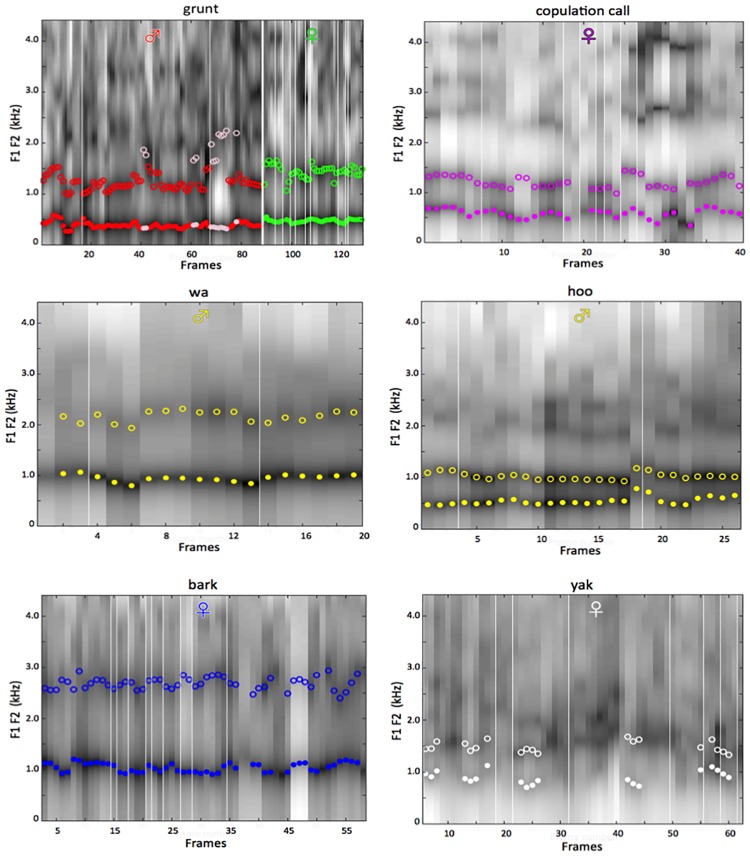
Fig 2. LPC spectrograms and formants, by VLS class.
The panels show LPC spectra for all frames. The white bars approximate the boundaries between sexes (thick bar, Grunt panel) and individual animals (although given our sliding window procedure with frames overlapping, the actual boundary is typically internal to the frames both preceding and following each bar). Frames were selected for further use when both F1 and F2 were detected by LPC (within plausible ranges) and were within ± 3 standard deviations of their class means; those frames are indicted by a dot for F1 and an open circle for F2 at their measured frequencies in those frames. The acoustic results reported were calculated from the frames thus selected. See the supplemental section for additional details on these LPC analyses.
Fig 3
Fig 3. Distribution of VLSs within the MAS.
(A) and (B) show the males’ and females’ MAS, respectively, with our data (analyzed in frames). An open circle marks the location where a neutral tube of the vocal tract’s length would produce the central schwa sound, [ə]. (A) confirms that male grunts occur in two subtypes, grunt 1 and grunt 2, based on distinct F2 ranges. (C) shows normalized data, pooling males and females. Ellipses within the MAS delineate an area covering 86.5% of the data for each VLS category. Note that the baboons produced five distinct VLSs, [ɨ æ ɑ ɔ u]. Comparison of the findings to those of American-English speaking children [, data publicly available in Praat] shown in (D) demonstrates strong similarities between the two species, suggesting a phylogenetically ancient origin of the vowel systems of humans. Arrows indicate acoustic axes.
Fig 4
Fig 4. Fundamental frequency in baboon VLSs.
(A) Baboon F0 by VLS and sex (mean and two SDs). For comparison, black bars show typical F0 for conversational speech by human men and women [37]. (B, C) For most VLSs, F0, F1, & F2 were either all high in their ranges (6 wa- ♂, 7 bark ♀) or all low (1 grunt1♂, 3 grunt ♀, 4 -hoo ♂, 5 copulation ♀), although grunt2 ♂ was characterized by a low F0 and high F2 (C).
Fig 5
Fig 5. Anatomical structure of the baboon tongue and muscle recruitment during VLS production.
(A) The baboon’s muscle fiber orientation allows tongue motion along two main axes (see also supplemental information S3 Fig). The first axis produces the front/back contrast [æ] ⇔ [u ɔ], including the [u] VLS, which requires a constriction in the back of the vocal tract. Movement along this axis uses antagonistic activation of GGam and SG tongue muscles. The second axis produces the [ɑ] ⇔ [ɨ] VLS contrasts by controlling vertical tongue displacement using the GGp and HG tongue muscles. (B) The baboons’ different VLSs can each be explained by recruitment of a unique configuration of tongue muscles. GGa, GGm, GGp: anterior, medium, posterior part of the genioglossus; HG: hyoglossus; SG: styloglossus.

References

    1. International Phonetic Association. Handbook of the International Phonetic Association: a guide to the use of the International Phonetic Alphabet. Cambridge, U.K.; New York, NY: Cambridge University Press; 1999.
    1. Maddieson I. Patterns of sounds. Cambridge, UK; New York: Cambridge University Press; 2009.
    1. Lieberman PH. The evolution of human speech: its anatomical and neural bases. Curr Anthropol. 2007;48: 39–66.
    1. Lieberman PH, Klatt DH, Wilson WH. Vocal tract limitations on the vowel repertoires of rhesus monkey and other nonhuman primates. Science. 1969;164: 1185–1187. - PubMed
    1. Bolhuis JJ, Tattersall I, Chomsky N, Berwick RC. How could language have evolved? PLoS Biol. 2014;12: e1001934 10.1371/journal.pbio.1001934 - DOI - PMC - PubMed