


Genome-Wide Association Analysis Reveals Genetic Heterogeneity of Sjögren's Syndrome According to Ancestry
- PMID: 28076899
- PMCID: PMC5449251
- DOI: 10.1002/art.40040
Genome-Wide Association Analysis Reveals Genetic Heterogeneity of Sjögren's Syndrome According to Ancestry
Abstract
Objective: The Sjögren's International Collaborative Clinical Alliance (SICCA) is an international data registry and biorepository derived from a multisite observational study of participants in whom genotyping was performed on the Omni2.5M platform and who had undergone deep phenotyping using common protocol-directed methods. The aim of this study was to examine the genetic etiology of Sjögren's syndrome (SS) across ancestry and disease subsets.
Methods: We performed genome-wide association study analyses using SICCA subjects and external controls obtained from dbGaP data sets, one using all participants (1,405 cases, 1,622 SICCA controls, and 3,125 external controls), one using European participants (585, 966, and 580, respectively), and one using Asian participants (460, 224, and 901, respectively) with ancestry adjustments via principal components analyses. We also investigated whether subphenotype distributions differ by ethnicity, and whether this contributes to the heterogeneity of genetic associations.
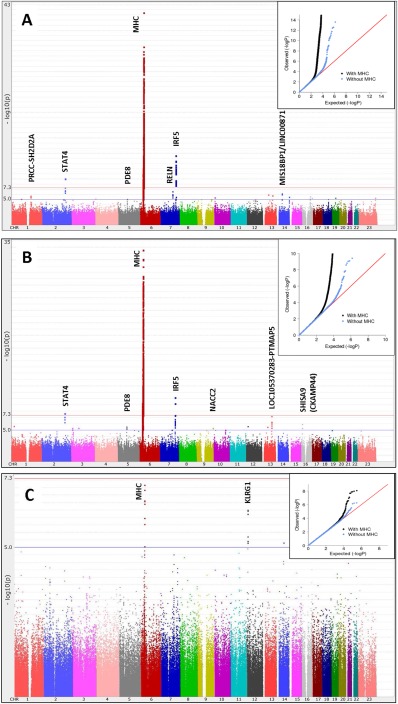
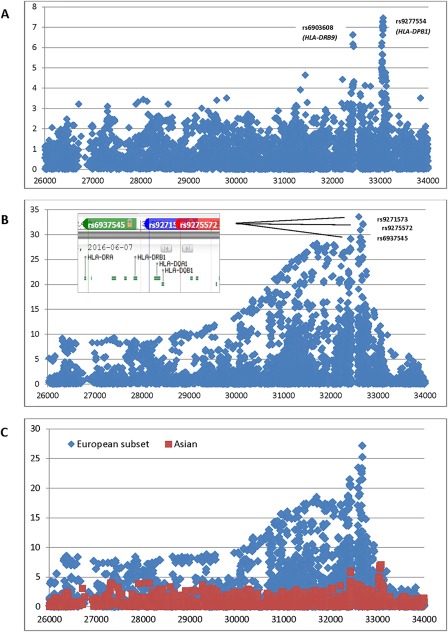
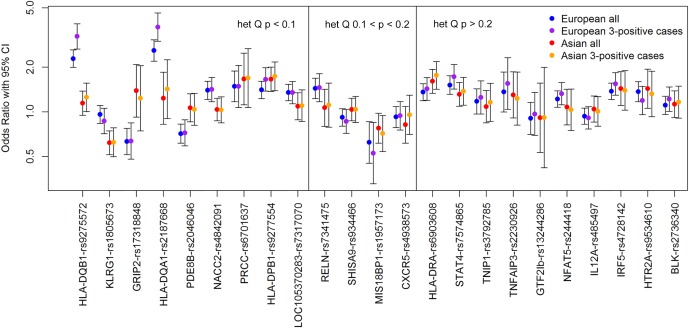
Results: We observed significant associations in established regions of the major histocompatibility complex (MHC), IRF5, and STAT4 (P = 3 × 10-42 , P = 3 × 10-14 , and P = 9 × 10⁻¹⁰ , respectively), and several novel suggestive regions (those with 2 or more associations at P < 1 × 10⁻⁵ ). Two regions have been previously implicated in autoimmune disease: KLRG1 (P = 6 × 10⁻⁷ [Asian cluster]) and SH2D2A (P = 2 × 10⁻⁶ [all participants]). We observed striking differences between the associations in Europeans and Asians, with high heterogeneity especially in the MHC; representative single-nucleotide polymorphisms from established and suggestive regions had highly significant differences in the allele frequencies in the study populations. We showed that SSA/SSB autoantibody production and the labial salivary gland focus score criteria were associated with the first worldwide principal component, indicative of higher non-European ancestry (P = 4 × 10-15 and P = 4 × 10⁻⁵ , respectively), but that subphenotype differences did not explain most of the ancestry differences in genetic associations.
Conclusion: Genetic associations with SS differ markedly according to ancestry; however, this is not explained by differences in subphenotypes.
© 2017, The Authors. Arthritis & Rheumatology published by Wiley Periodicals, Inc. on behalf of American College of Rheumatology.
Figures
References
-
- Shiboski SC, Shiboski CH, Criswell L, Baer A, Challacombe S, Lanfranchi H, et al. American College of Rheumatology classification criteria for Sjögren's syndrome: a data‐driven, expert consensus approach in the Sjögren's International Collaborative Clinical Alliance cohort. Arthritis Care Res (Hoboken) 2012;64:475–87. - PMC - PubMed
-
- Cruz‐Tapias P, Rojas‐Villarraga A, Maier‐Moore S, Anaya JM. HLA and Sjögren's syndrome susceptibility: a meta‐analysis of worldwide studies. Autoimmun Rev 2012;11:281–7. - PubMed
MeSH terms
Substances
Grants and funding
LinkOut - more resources
Full Text Sources
Other Literature Sources
Medical
Research Materials
Miscellaneous
