. 2017 Jan 11;17(1):8.
doi: 10.1186/s12870-016-0963-5.

The Arabidopsis paralogs, PUB46 and PUB48, encoding U-box E3 ubiquitin ligases, are essential for plant response to drought stress

Affiliations

The Arabidopsis paralogs, PUB46 and PUB48, encoding U-box E3 ubiquitin ligases, are essential for plant response to drought stress

Guy Adler et al. BMC Plant Biol. .

Abstract

Background: Plants respond to abiotic stress on physiological, biochemical and molecular levels. This includes a global change in their cellular proteome achieved by changes in the pattern of their protein synthesis and degradation. The ubiquitin-proteasome system (UPS) is a key player in protein degradation in eukaryotes. Proteins are marked for degradation by the proteasome by coupling short chains of ubiquitin polypeptides in a three-step pathway. The last and regulatory stage is catalyzed by a member of a large family of substrate-specific ubiquitin ligases.

Results: We have identified AtPUB46 and AtPUB48-two paralogous genes that encode ubiquitin ligases (E3s)-to have a role in the plant environmental response. The AtPUB46, -47, and -48 appear as tandem gene copies on chromosome 5, and we present a phylogenetic analysis that traces their evolution from an ancestral PUB-ARM gene. Single homozygous T-DNA insertion mutants of AtPUB46 and AtPUB48 displayed hypersensitivity to water stress; this was not observed for similar mutants of AtPUB47. Although the three genes show a similar spatial expression pattern, the steady state levels of their transcripts are differentially affected by abiotic stresses and plant hormones.

Conclusions: AtPUB46 and AtPUB48 encode plant U-Box E3s and are involved in the response to water stress. Our data suggest that despite encoding highly homologous proteins, AtPUB46 and AtPUB48 biological activity does not fully overlap.


Figures
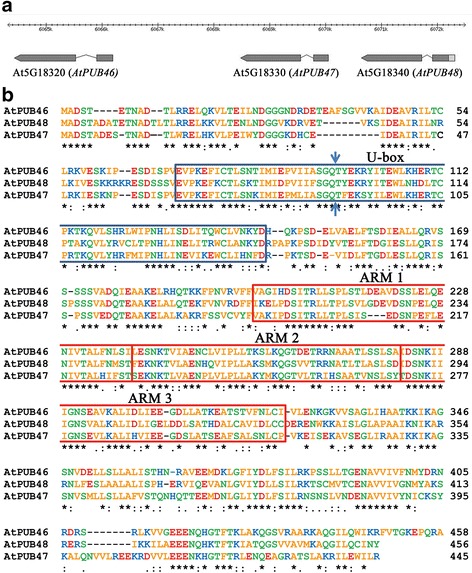
Fig. 1
Fig. 1
Genome organization of the AtPUB46, AtPUB47 and AtPub48 genes and the proteins they encode. a Genome organization of Arabidopsis chromosome 5 loci At5G18320, AtG18330, and At5G18340 that encode the AtPUB46, AtPUB47, and AtPUB48 genes, respectively. Exons are shown as wide and introns as narrow lines. Arrows mark gene orientation. b Amino acid sequence alignment and domain structure of AtPUB46, AtPUB47, and AtPUB48: blue (positivly charged), red (negatively charged), green (polar) and orange (non-polar) residues. U-box is shown in a blue frame, ARM motifs are marked by red frames. Arrows indicate the position corresponding to the exon-exon borders
Fig. 2
Fig. 2
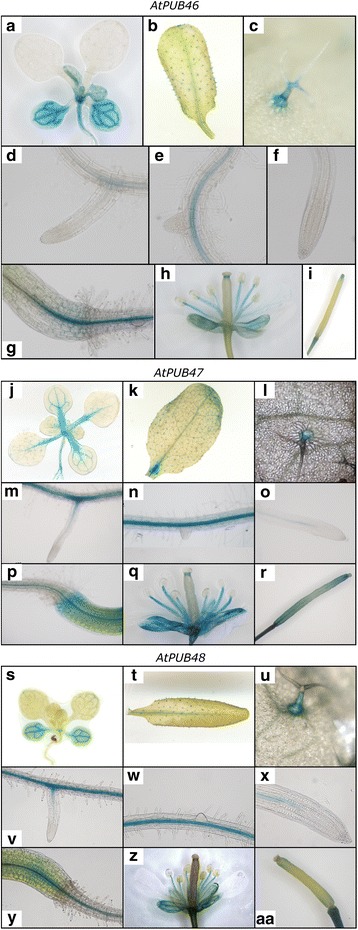
Expression pattern of the AtPUB46-48 promoters. Arabidopsis plants expressing the GUS reporter gene driven by the AtPUB46 (a-i) AtPUB47 (j-r) or AtPUB48 (s-aa) promoters were stained for GUS activity. (a, j, s), 2 week old seedlings; (b, k, t), rosette leaves of mature plants; (c, l, u), trichomes; (d, e, m, n, v, w), primary roots, root hairs and developing lateral roots; (f, o, x), root tips; (g, p, y) shoot-root transition zone; (h, q, z) flowers; (I, r, aa), siliques. At least 3 independent lines were assayed for each construct
Fig. 3
Fig. 3
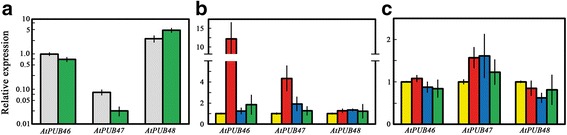
Expression levels of the AtPUB46-48 genes in roots and shoots of 10 d old seedlings untreated or treated with plant hormones. RNA was extracted from roots and shoots, cDNA was prepared and transcripts levels of the indicated genes were analyzed by RT-qPCR. a Root (gray) and shoot (green); transcript levels of all genes were normalized to that of AtPUB46 in the roots. b, c of seedlings were incubated for 6 h with 0.5 x MS without supplements (yellow), or supplemented with 10 μM each of IAA (red), zeatin (blue) or ABA (green). Transcript levels were assayed in roots (b) and shoots (c). Data shown are average ± SE. Expression levels of each gene in the respective organ of non-treated plants were defined as 1
Fig. 4
Fig. 4
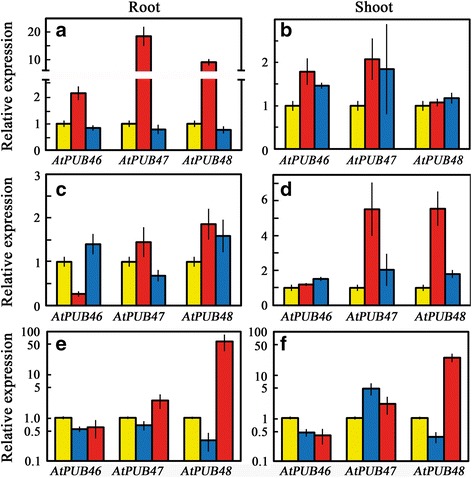
Expression levels of AtPUB46-AtPUB48 genes in response to abiotic stress analyzed by RT-qPCR. Ten day old seedlings were exposed to the following treatments: (a, b) salt- and osmotic stress: control (yellow); 0.2 M NaCl (red); 0.4 M mannitol (blue) for 6 h. c & d, oxidative stress: control (yellow); 100 mM H2O2 (red); 1 μM methyl viologen (blue) for 3 h in the light. e, f temperature stress: 25 °C (yellow); 3 h at 4 °C (blue); 15 min at 45 °C (red). Data shown are average ± SE
Fig. 5
Fig. 5
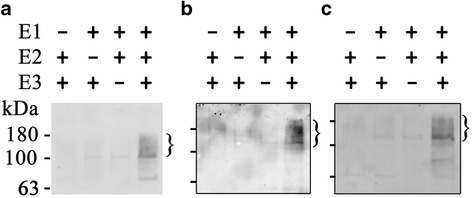
AtPUB46-48 possesses E3 activity. Self-ubiquitylation of each E3 was assayed in vitro using purified recombinant proteins. Uniquitylated protein (marked by } sign) were detected by western blot using anti-ubiquitin antiserum. a AtPUB46; b AtPUB47; c AtPUB48. a & b had the E2, AtPUBC10 (At5G53300); c had AtUBC8 (At5G41700)
Fig. 6
Fig. 6
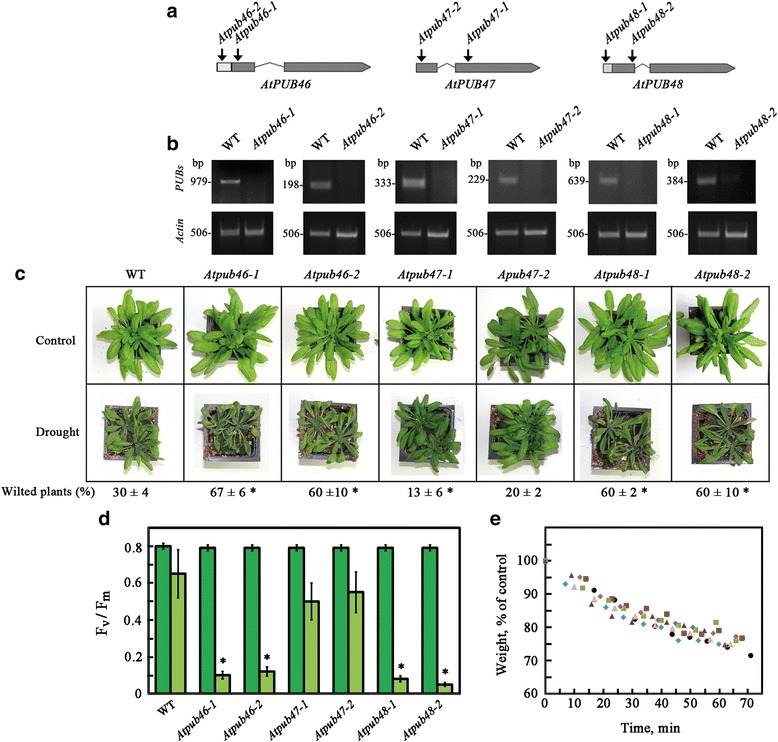
Water stress performance of pot-grown Atpub46-48 mutant plants. a Location of the T-DNA insertion in the studied mutants. Exons and introns are shown as wide and narrow lines, respectively. Arrows mark gene orientation. The location of the T-DNA insertions in the mutant lines used in this study are marked by arrows. b Upper panels: analysis of the indicated AtPUB46-48 genes in 1-week old wild type (WT) and the indicated mutants using gene-specific primers that anneal to sequences on both sides of the T-DNA insertions. Lower panels: the expression of ACTIN2 was used as an internal control. c, d Water stress performance of Atpub46-48 mutant plants. Plants were grown in pots for 3 (d) or 4 (c) weeks and then water was withheld from drought treated plants. c, Plants were photographed after 10 days. d Photosynthetic efficiency was assayed 20 days after water withheld. e Detached rosettes of 1 month old pot grown plants were assayed for water loss. Data shown are average ± SE. Statistically significant changes from WT plants (P < 0.05) are marked with asterisks
Fig. 7
Fig. 7
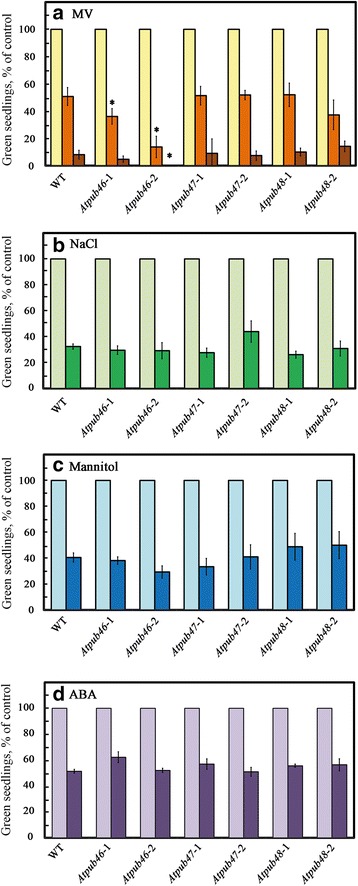
Effects of oxidative, salt and osmotic stresses on seedling germination. Surface sterilized cold treated seeds of the indicated plant lines were plated on agar media containing 0.5 x MS, 0.5% sucrose (control) supplemented with: a methyl viologen (MV) at 0 (yellow bars), 0.5 μM (orange bars) or 1 μM (brown bars); b NaCl at 0 (light green) or 150 mM (green) NaCl; c mannitol at 0 (light blue) or 300 mM (blue); d ABA at 0 (light purple) or 1 μM (purple). Green seedlings were scored 5 (a-c) or 6 (d) days later. Data shown are average ± SE. Statistically significant changes from WT plants (P < 0.05) are marked with asterisks

References

    1. Apel K, Hirt H. Reactive oxygen species: metabolism, oxidative stress, and signal transduction. Ann Rev Plant Biol. 2004;55:373–99. doi: 10.1146/annurev.arplant.55.031903.141701. - DOI - PubMed
    1. Xiong Y, Contento AL, Nguyen PQ, Bassham DC. Degradation of oxidized proteins by autophagy during oxidative stress in Arabidopsis. Plant Physiol. 2007;143:291–9. doi: 10.1104/pp.106.092106. - DOI - PMC - PubMed
    1. Van Breusegem F, Dat JF. Reactive oxygen species in plant cell death. Plant Physiol. 2006;141:384–90. doi: 10.1104/pp.106.078295. - DOI - PMC - PubMed
    1. Jacques S, Ghesquière B, Van Breusegem F, Gevaert K. Plant proteins under oxidative attack. Proteomics. 2013;13:932–40. doi: 10.1002/pmic.201200237. - DOI - PubMed
    1. Vierstra RD. The ubiquitin-26S proteasome system at the nexus of plant biology. Nat Rev Mol Cell Biol. 2009;10:385–97. doi: 10.1038/nrm2688. - DOI - PubMed

Publication types

MeSH terms

Substances