


What do we know about the effects of exposure to 'Low alcohol' and equivalent product labelling on the amounts of alcohol, food and tobacco people select and consume? A systematic review
- PMID: 28077126
- PMCID: PMC5228109
- DOI: 10.1186/s12889-016-3956-2
What do we know about the effects of exposure to 'Low alcohol' and equivalent product labelling on the amounts of alcohol, food and tobacco people select and consume? A systematic review
Abstract
Background: Explicit labelling of lower strength alcohol products could reduce alcohol consumption by attracting more people to buy and drink such products instead of higher strength ones. Alternatively, it may lead to more consumption due to a 'self-licensing' mechanism. Equivalent labelling of food or tobacco (for example "Low fat" or "Low tar") could influence consumption of those products by similar mechanisms. This systematic review examined the effects of 'Low alcohol' and equivalent labelling of alcohol, food and tobacco products on selection, consumption, and perceptions of products among adults.
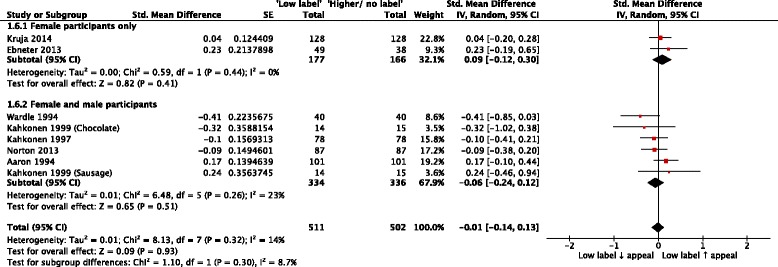
Methods: A systematic review was conducted based on Cochrane methods. Electronic and snowball searches identified 26 eligible studies. Evidence from 12 randomised controlled trials (all on food) was assessed for risk of bias, synthesised using random effects meta-analysis, and interpreted in conjunction with evidence from 14 non-randomised studies (one on alcohol, seven on food and six on tobacco). Outcomes assessed were: quantities of the product (i) selected or (ii) consumed (primary outcomes - behaviours), (iii) intentions to select or consume the product, (iv) beliefs associated with it consumption, (v) product appeal, and (vi) understanding of the label (secondary outcomes - cognitions).
Results: Evidence for impacts on the primary outcomes (i.e. amounts selected or consumed) was overall of very low quality, showing mixed effects, likely to vary by specific label descriptors, products and population characteristics. Overall very low quality evidence suggested that exposure to 'Low alcohol' and equivalent labelling on alcohol, food and tobacco products can shift consumer perceptions of products, with the potential to 'self-licence' excess consumption.
Conclusions: Considerable uncertainty remains about the effects of labels denoting low alcohol, and equivalent labels, on alcohol, food and tobacco selection and consumption. Independent, high-quality studies are urgently needed to inform policies on labelling regulations.
Keywords: Alcohol; Alcohol policy; Labelling; Meta-analysis; Public health; Systematic review.
Figures




References
-
- UK Government . Regulation 42 and schedule 8: misleading descriptions (part 1, general) In: UK Government, editor. The food labelling regulations 1996 (statutory instrument 1996 No. 1449) London: The National Archives; 1996.
-
- Merritt AC, Effron DA, Monin B. Moral self-licensing: when being good frees us to be bad. Soc Personal Psychol Compass. 2010;4(5):344–57. doi: 10.1111/j.1751-9004.2010.00263.x. - DOI
-
- Cleeren K, Geyskens K, Verhoef PC and Pennings JME. ‘Regular or low-fat? An investigation of the long-run impact of the first low-fat purchase on subsequent purchase volumes and calories’. Int J Res Marketing. 2016;33(4):896-906.
Publication types
MeSH terms
Grants and funding
LinkOut - more resources
Full Text Sources
Other Literature Sources
Medical
