


Incremental decreases in quality-adjusted life years (QALY) associated with higher levels of depressive symptoms for U.S. Adults aged 65 years and older
- PMID: 28077154
- PMCID: PMC5225616
- DOI: 10.1186/s12955-016-0582-8
Incremental decreases in quality-adjusted life years (QALY) associated with higher levels of depressive symptoms for U.S. Adults aged 65 years and older
Abstract
Background: Quality-adjusted life years (QALY) is a single value index that quantifies the overall burden of disease. It reflects all aspects of heath, including nonfatal illness and mortality outcomes by weighting life-years lived with health-related quality of life (HRQOL) scores. This study examine the burden of disease due to increasing levels of depressive symptoms by examining the association between the 9-item Patient Health Questionnaire (PHQ-9) scores and QALY for U.S. adults aged 65 years and older.
Methods: We ascertained respondents' HRQOL scores and mortality status from the 2005-2006, 2007-2008, and 2009-2010 cohorts of the National Health and Nutrition Examination Survey (NHANES) with mortality follow-up data through December 31, 2011. This analysis included respondents aged 65 years and older (n = 3,680). We estimated the mean QALY throughout the remaining lifetime according to participants' depression severity categories: none or minimal (PHQ-9 score 0-4), mild (5-9), moderate (10-14), and moderately severs and severe (15 or higher). We estimated QALY loss due to major depressive disorder (PHQ-9 score 10 or higher) and to mild depression (5-9).
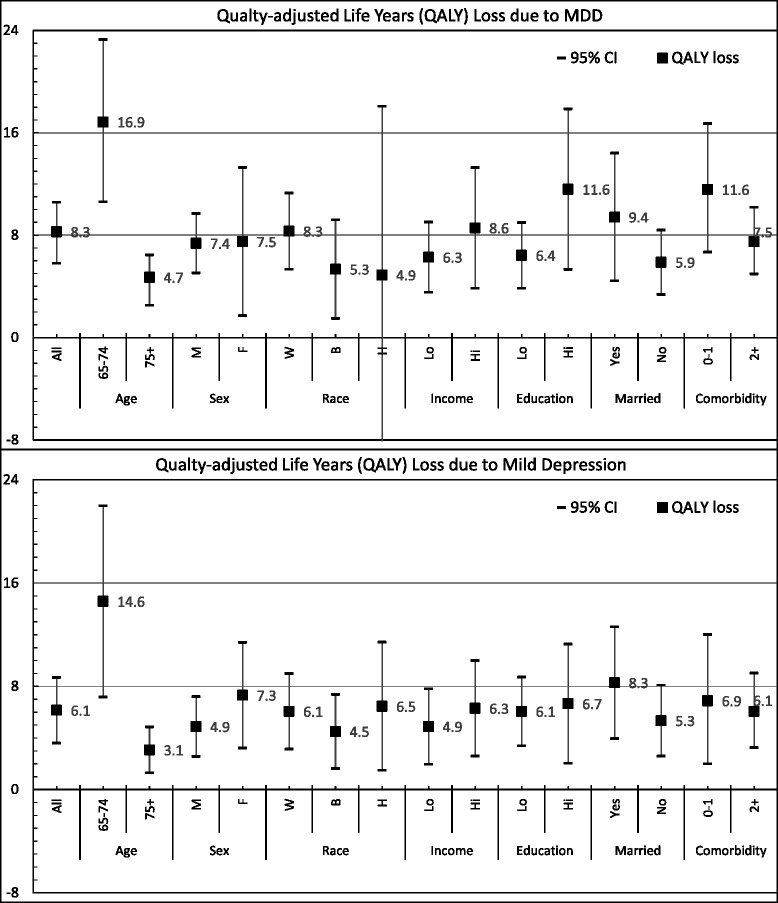
Results: The QALY for persons with none/minimal, mild, moderate, and moderately severe/severe depression were 14.0, 7.8, 4.7, and 3.3 years, respectively. Compared to persons without major depressive disorder, persons with major depressive disorder had 8.3 fewer QALY (12.7 vs. 4.4), or a 65% loss. Compared to persons who reported "none" or minimal depressive symptoms, persons who reported mild depressive symptoms had 6.2 fewer QALY (14.0 vs. 7.8), or a 44% loss. The same patterns were noted in demographic and socioeconomic subgroups and according to number of comorbidities.
Conclusions: This study not only confirmed the significant burden of disease for major depressive disorder among the U.S. elderly, but also showed an incremental decrease in QALY with an increasing severity of depressive symptoms as well as significant QALY loss due to mild depression. Specifically, individuals with higher (or more impaired) PHQ-9 scores had significantly fewer QALYs and our findings of fewer years of QALY for persons with major depressive disorder and mild depression were not only statistically significant but also clinically important.
Keywords: Burden of disease; Depression; Health-related quality of life (HRQOL); Major depressive disorder (MDD); Quality-adjusted life year (QALY).
Figures
References
-
- Goodwin FK, Jamison KR. Manic-Depressive Illness: Bipolar Disorders and Recurrent Depression. 2. New York: Oxford University Press; 2007.
MeSH terms
Grants and funding
LinkOut - more resources
Full Text Sources
Other Literature Sources
Medical
