Review
. 2017 Apr;16(4 suppl 1):S75-S91.
doi: 10.1074/mcp.R116.065649. Epub 2017 Jan 11.

Protein Interactions during the Flavivirus and Hepacivirus Life Cycle

Affiliations
Review

Protein Interactions during the Flavivirus and Hepacivirus Life Cycle

Gisa Gerold et al. Mol Cell Proteomics. 2017 Apr.

Abstract

Protein-protein interactions govern biological functions in cells, in the extracellular milieu, and at the border between cells and extracellular space. Viruses are small intracellular parasites and thus rely on protein interactions to produce progeny inside host cells and to spread from cell to cell. Usage of host proteins by viruses can have severe consequences e.g. apoptosis, metabolic disequilibria, or altered cell proliferation and mobility. Understanding protein interactions during virus infection can thus educate us on viral infection and pathogenesis mechanisms. Moreover, it has led to important clinical translations, including the development of new therapeutic and vaccination strategies. Here, we will discuss protein interactions of members of the Flaviviridae family, which are small enveloped RNA viruses. Dengue virus, Zika virus and hepatitis C virus belong to the most prominent human pathogenic Flaviviridae With a genome of roughly ten kilobases encoding only ten viral proteins, Flaviviridae display intricate mechanisms to engage the host cell machinery for their purpose. In this review, we will highlight how dengue virus, hepatitis C virus, Japanese encephalitis virus, tick-borne encephalitis virus, West Nile virus, yellow fever virus, and Zika virus proteins engage host proteins and how this knowledge helps elucidate Flaviviridae infection. We will specifically address the protein composition of the virus particle as well as the protein interactions during virus entry, replication, particle assembly, and release from the host cell. Finally, we will give a perspective on future challenges in Flaviviridae interaction proteomics and why we believe these challenges should be met.


Conflict of interest statement

Authors declare no conflict of interest

Figures
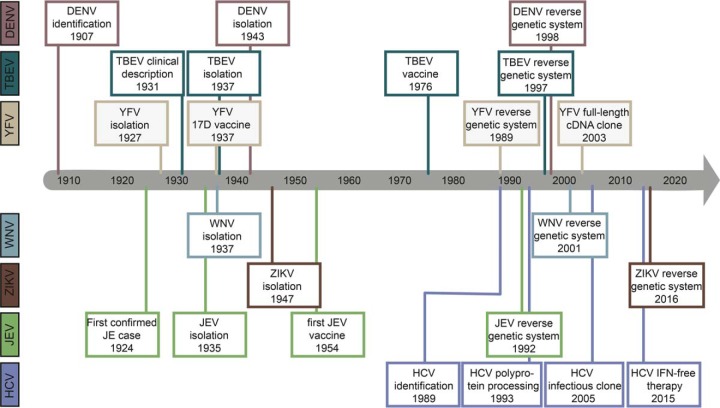
Fig. 1.
Fig. 1.
Milestones in flavivirus and hepacivirus research. The identification, development of reverse genetic systems to study the protein biochemistry and cell biology of infection as well as the first vaccines are shown for the seven human-pathogenic Flaviviridae family members discussed in this review. See text for references.
Fig. 2.
Fig. 2.
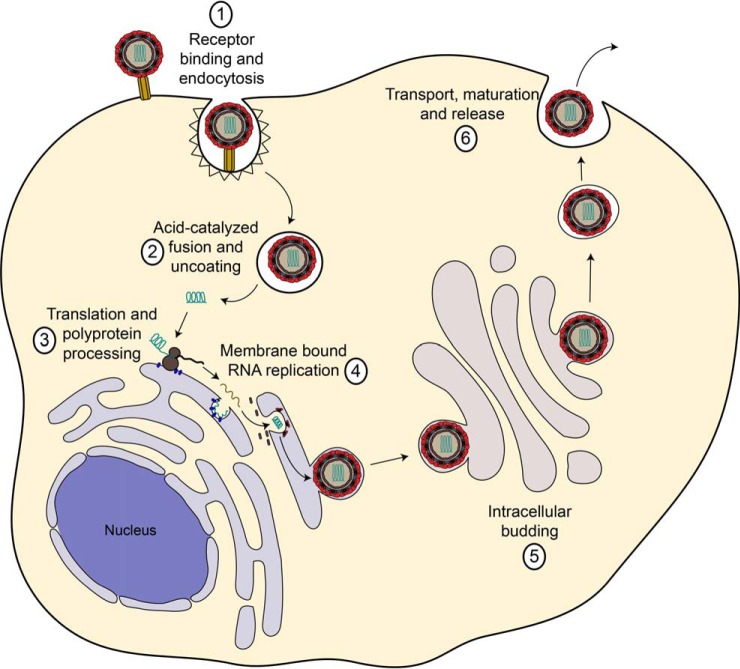
The Flaviviridae life cycle. The viruses attach to receptors on the host cell and internalize by endocytosis. In endosomes the viral envelope fuses with the host membrane and the viral capsid disassembles, releasing the viral genome into the cytoplasm. At the ER, viral proteins are translated by host ribosomes. The viral RNA-dependent RNA polymerase replicates the viral genome in specialized ER-derived membrane compartments. Assembled viral nucleocapsids bud into the ER lumen and get released from the cell through the secretory pathway. During GOLGI transit of flaviviruses, the host protease furin processes the viral envelope protein prM. In contrast, HCV does not require proteolytic processing but instead tightly associates with the host lipoprotein release pathway. See text for details.
Fig. 3.
Fig. 3.
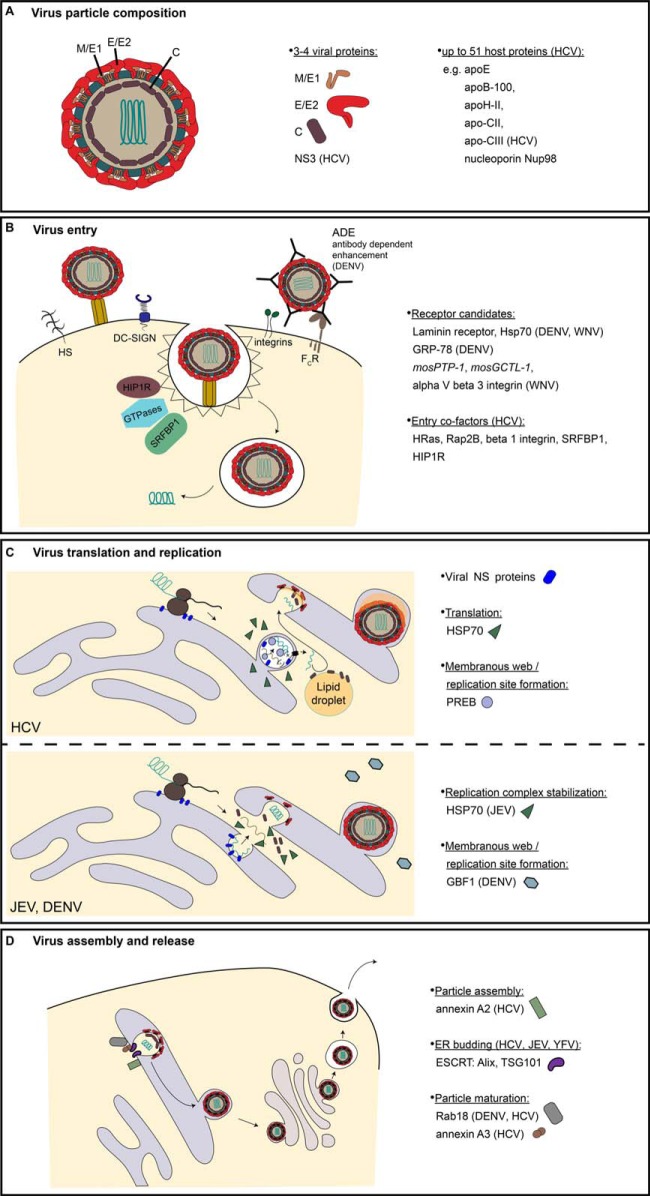
Protein interactions during the flavivirus life cycle elucidated by MS-based proteomics. (A) Flavivirus particle composition. Flaviviridae particles are composed of a capsid/core (C) surrounded positive strand RNA genome and enveloped by a host derived lipid bilayer in which the viral transmembrane domain glycoproteins M/E1 and E/E2 are embedded. Additionally, the virions may comprise of nonstructural proteins and host proteins. (B) Virus host protein interactions during entry. Flaviviridae members penetrate the host cell by receptor-mediated endocytosis and fusion in endosomal compartments. MS-based proteomics discovered the listed interaction partners of viral glycoproteins as receptor candidates. SILAC-approaches further revealed secondary interactors of HCV through co-IP MS of the HCV receptor CD81 (listed as entry cofactors). (C) Virus host protein interactions during translation and replication. The Flaviviridae viral genomes translate and replicate in the cytosol in close association with ER membranes, which are remodeled during infection. MS-based proteomics identified heat shock protein 70 (HSP70) as host translation factor and prolactin regulatory element binding (PREB), HSP70, and GBF1 as host replication factors for the indicated viruses. Viral NS proteins forming the replication complex are depicted by a single blue symbol. (D) Virus host protein interactions during particle assembly and release. Particles are assembled at ER-derived membranes and exit the cell through the secretory pathway. MS-based proteomics revealed annexins, ESCRT components, and the GTPase Rab18 as host factors promoting particle assembly, ER budding, and maturation of the indicated Flaviviridae members. All panels show the assumed but not necessary experimentally confirmed localization of host factors identified by MS-based proteomics.

References

    1. Valentine G, Marquez L., and Pammi M. (2016) Zika virus epidemic: An update. Expert Rev. Anti Infect. Ther. 14, 1127–1138 - PubMed
    1. Monath T. P. (2008) Treatment of yellow fever. Antiviral Res. 78, 116–124 - PubMed
    1. Guzman M. G., Halstead S. B., Artsob H., Buchy P., Farrar J., Gubler D. J., Hunsperger E., Kroeger A., Margolis H. S., Martínez E., Nathan M. B., Pelegrino J. L., Simmons C., Yoksan S., Peeling, and R. W. (2010) Dengue: A continuing global threat. Nat. Rev. Microbiol. 8, S7–S16 - PMC - PubMed
    1. Halstead S. B., and Thomas S. J. (2010) Japanese encephalitis: New options for active immunization. Clin. Infect. Dis. 50, 1155–1164 - PubMed
    1. Gubler D. J. (2002) The global emergence/resurgence of arboviral diseases as public health problems. Arch. Med. Res. 33, 330–342 - PubMed

Publication types