. 2016 Nov 30;6(6):310-327.
eCollection 2016.

Precision medicine and molecular imaging: new targeted approaches toward cancer therapeutic and diagnosis

Affiliations

Precision medicine and molecular imaging: new targeted approaches toward cancer therapeutic and diagnosis

Mojtaba Ghasemi et al. Am J Nucl Med Mol Imaging. .

Abstract

This paper presents a review of the importance and role of precision medicine and molecular imaging technologies in cancer diagnosis with therapeutics and diagnostics purposes. Precision medicine is progressively becoming a hot topic in all disciplines related to biomedical investigation and has the capacity to become the paradigm for clinical practice. The future of medicine lies in early diagnosis and individually appropriate treatments, a concept that has been named precision medicine, i.e. delivering the right treatment to the right patient at the right time. Molecular imaging is quickly being recognized as a tool with the potential to ameliorate every aspect of cancer treatment. On the other hand, emerging high-throughput technologies such as omics techniques and systems approaches have generated a paradigm shift for biological systems in advanced life science research. In this review, we describe the precision medicine, difference between precision medicine and personalized medicine, precision medicine initiative, systems biology/medicine approaches (such as genomics, radiogenomics, transcriptomics, proteomics, and metabolomics), P4 medicine, relationship between systems biology/medicine approaches and precision medicine, and molecular imaging modalities and their utility in cancer treatment and diagnosis. Accordingly, the precision medicine and molecular imaging will enable us to accelerate and improve cancer management in future medicine.

Keywords: P4 medicine; Precision medicine; cancer theranostics; metabolomics-based systems medicine; molecular imaging; precision medicine initiative; radio-omics; systems biology.


Figures
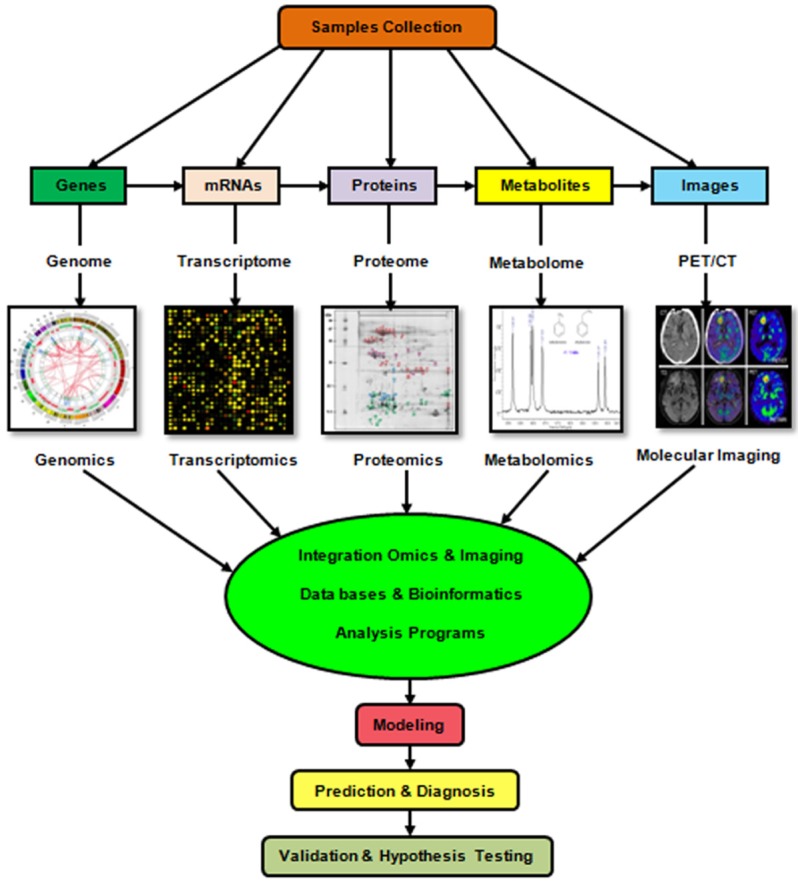
Figure 1
Figure 1
A general hierarchical diagram of the systems biology approaches integrated to the molecular imaging techniques toward diagnosis and prognosis a typical cancer disease.
Figure 2
Figure 2
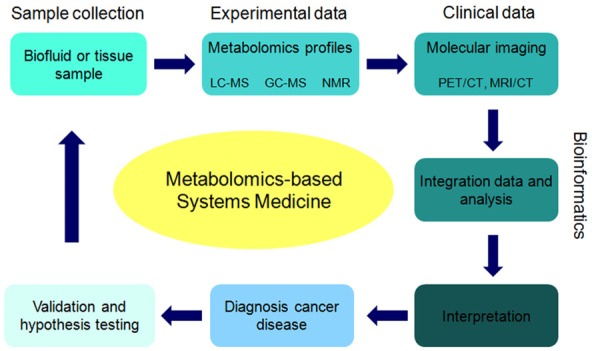
A schematic illustration of metabolomics-based systems medicine and molecular imaging tools into cancer diagnosis studies.
Figure 3
Figure 3
A schematic representation of the procedure of precision medicine (predictive, preventive, personalized and participatory) and two principal objectives of precision medicine as future of medicine comprising: 1) Quantifying wellness, 2) Demystifying disease.
Figure 4
Figure 4
The components that will permit to precision medicine for discovering the biological complexity. These emerging technologies such as systems biology approaches and molecular imaging techniques will enable the implementation of precision medicine.
Figure 5
Figure 5
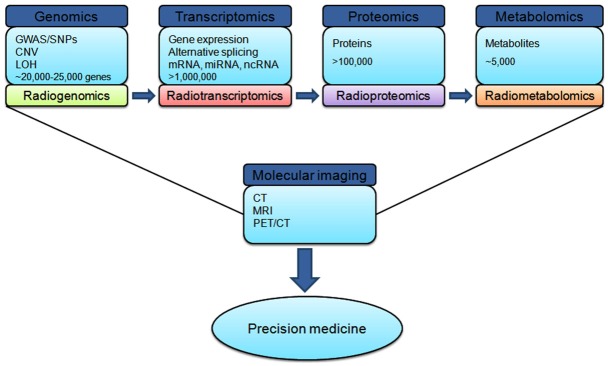
From Radiogenomics to Radiometabolomics. We present a transition from the integration of systems biology with molecular imaging techniques to precision medicine.
Figure 6
Figure 6
A typical representative of the PET/MRI imaging benefits in Precision medicine cancer care. Staging PET/MRI scan of a 56-year-old woman with ovarian cancer. The MRI images (A and B) show multiple lesions abutting the liver posteriorly (long arrow), involving the porta hepatis (short arrow) and seeding the peritoneum (arrowheads). A round, well defined lesion with same features is also visualized in segment IV of the liver (dotted arrow). On PET/MRI images (C and D) the lesions earlier described, and others not so evident, are depicted by high FDG uptake confirming their malignant nature. Maximum intensity projection of the whole body (E) reveals several lesions both in the chest and abdomen. Reproduced from [117].
Figure 7
Figure 7
Schematic overview of precision medicine strategies exploiting the tumor microenvironment. Reproduced from [3] with permission of John Wiley and Sons License.
Figure 8
Figure 8
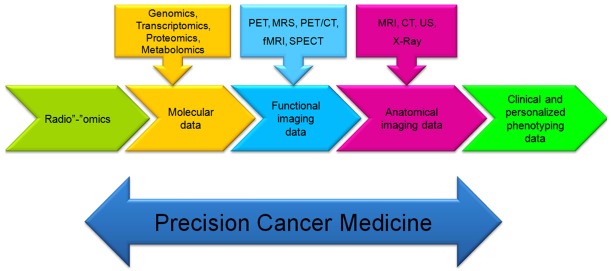
An overview of the integration of radio-omics, Molecular biology information and molecular imaging data in precision cancer medicine.

References

    1. Collins FS, Varmus H. A New Initiative on Precision Medicine. N Engl J Med. 2015;372:793–5. - PMC - PubMed
    1. Nabipour I, Assadi M. Precision medicine, an approach for development of the future medicine technologies. ISMJ. 2016;19:167–84.
    1. Penet MF, Krishnamachary B, Chen Z, Jin J, Bhujwalla ZM. Molecular Imaging of the Tumor Microenvironment for Precision Medicine and Theranostics. Adv Cancer Res. 2014;124:235–56. - PMC - PubMed
    1. Gupte AA, Hamilton DJ. Molecular Imaging and Precision Medicine. Cardiology. 2016;133:178–80. - PubMed
    1. Ahn B. Personalized Medicine Based on Theranostic Radioiodine Molecular Imaging for Differentiated Thyroid Cancer. Biomed Res Int. 2016;2016:1680464. - PMC - PubMed

LinkOut - more resources