. 2017 Feb:22:905-917.
doi: 10.2119/molmed.2016.00229. Epub 2017 Jan 4.

The transcription factor XBP1 in memory and cognition: Implications in Alzheimer disease

Affiliations

The transcription factor XBP1 in memory and cognition: Implications in Alzheimer disease

Moustapha Cissé et al. Mol Med. 2017 Feb.

Abstract

X-box binding protein 1 (XBP1) is a unique basic region leucine zipper transcription factor isolated two decades ago in a search for regulators of major histocompatibility complex class II gene expression. XBP1 is a very complex protein regulating many physiological functions, including immune system, inflammatory responses, and lipid metabolism. Evidence over the past few years suggests that XBP1 also plays important roles in pathological settings since its activity as transcription factor has profound effects on the prognosis and progression of diseases such as cancer, neurodegeneration, and diabetes. Here we provide an overview on recent advances in our understanding of this multifaceted molecule, particularly in regulating synaptic plasticity and memory function, and the implications in neurodegenerative diseases with emphasis on Alzheimer disease.

Keywords: Alzheimer disease; EphB2; Kalirin-7; XBP1; dendritic spines; memory.


Conflict of interest statement

DISCLOSURE

The authors declare that they have no competing interests as defined by Molecular Medicine or other interests that might be perceived to influence the results and discussion reported in this paper.

Figures

Figure 1.
Figure 1.
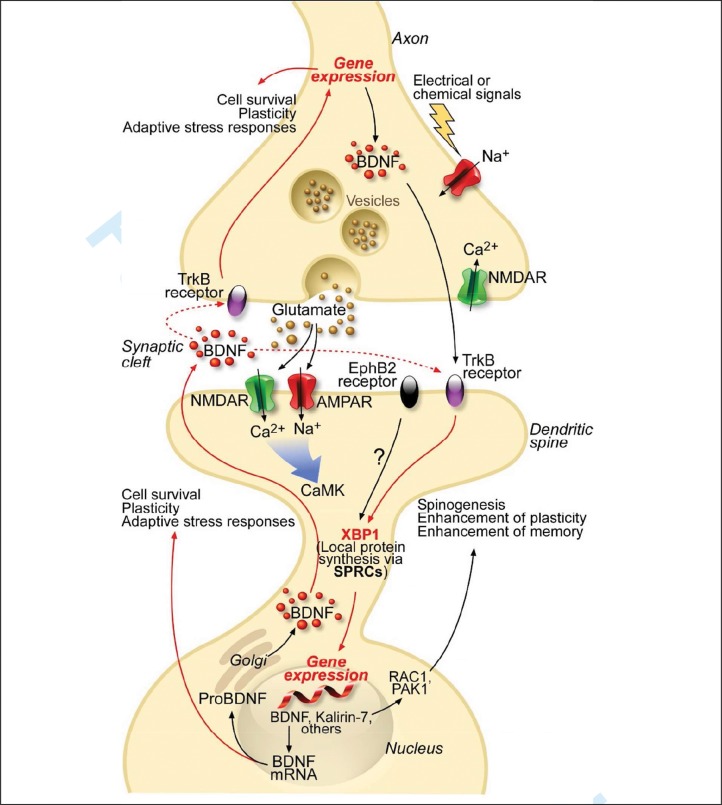
XBP1 signaling and neuronal plasticity. Presynaptic influx of Ca2+ releases glutamate into the synaptic cleft. This activates AMPA, EphB2 and NMDA receptors at the postsynaptic membrane that engages CaMKs and induces the transcription of the Bdnf gene. In parallel, XBP1 can be locally synthetized within dendrites through SPRCs and transported into the nucleus to activate transcription of BDNF, Kalirin-7 and a myriad of other genes that are crucial for the survival and plasticity of neurons. mBDNF is released at synapses and activates TrkB receptors to recruit XBP1 and Kalirin-7, which controls spinogenesis through Rho-GTPases RAC1 and PAK1, resulting in a positive activation loop. BDNF signaling also regulates synaptic transmission through control of neurotransmitter release at presynaptic terminals. Abbreviations: AMPA(R), α-amino-3-hydroxy-5-methyl-4-isoxazolepropionic acid (receptor); BDNF, brain-derived neurotrophic factor; CaMK, Ca2+/calmodulin-dependent kinase; NMDA(R), N-methyl-D-aspartate (receptor); SPRCs, synapse-associated polyribosome complexes; EphB2, EphrinB2 receptor. Whether EphB2 acts upstream of XBP1 remains to be determined. Graphic adapted from (235).

References

    1. Selkoe DJ. The molecular pathology of Alzheimer’s disease. Neuron. 1991;6:487–98. - PubMed
    1. Mucke L, Selkoe DJ. Neurotoxicity of amyloid beta-protein: synaptic and network dysfunction. Cold Spring Harb. Perspect Med. 2012;2:a006338. - PMC - PubMed
    1. Selkoe DJ. Alzheimer’s disease is a synaptic failure. Science. 2002;298:789–91. - PubMed
    1. Shankar GM, Walsh DM. Alzheimer’s disease: synaptic dysfunction and Abeta. Mol. Neurodegener. 2009;4:48. - PMC - PubMed
    1. Shankar GM, et al. Amyloid-beta protein dimers isolated directly from Alzheimer’s brains impair synaptic plasticity and memory. Nat. Med. 2008;14:837–42. - PMC - PubMed